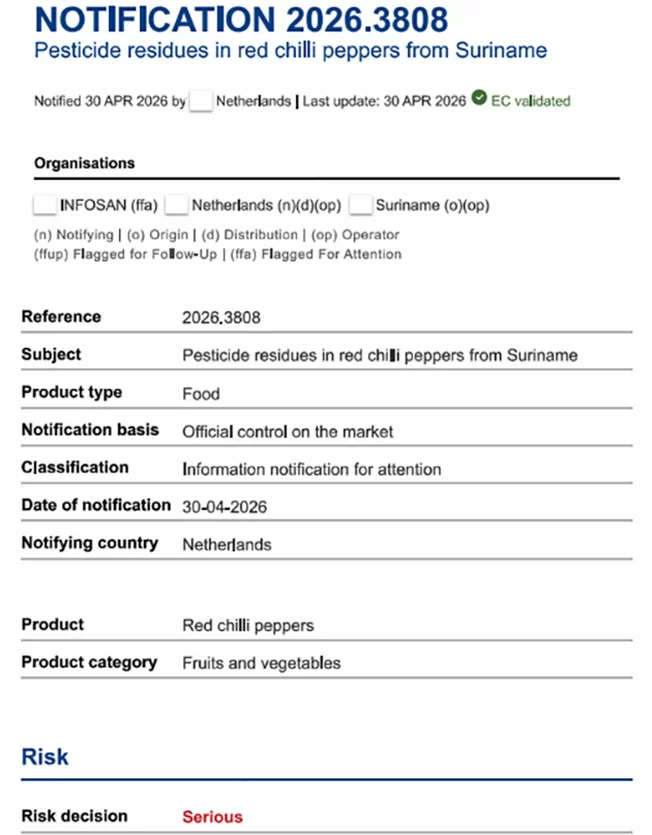
A major political controversy has erupted in Suriname after the European Union rejected two of the country’s key agricultural export shipments in just four days, triggering fierce criticism of the government’s failed food safety regulation from lawmakers in the National Assembly (DNA).
The rejected products, red pepper and yardlong bean, failed EU entry checks due to containing pesticide residues that exceeded the bloc’s strict safety limits. Lawmakers from across the political spectrum have warned that this failure is not just an international trade issue, but an immediate threat to domestic public health, with one senior parliamentarian saying the current broken system is actively poisoning the Surinamese population.
During Wednesday’s public parliamentary session, legislators drew a direct line between the EU rejections and deep, structural flaws in Suriname’s domestic food safety monitoring regime. NDP parliamentarian Jennifer Vreedzaam led the criticism, leveling sharp blame at Agriculture, Livestock and Fisheries (LVV) Minister Mike Noersalim for the government’s inaction on this long-recognized problem.
VHP lawmaker Cherryl Dijksteel emphasized that the incident confirms a fundamental breakdown in the country’s food control infrastructure. “If we cannot stop banned substances from entering the supply chain, detect residue limit breaches, or inspect products before they reach markets, we have to ask: does our current system work at all?” Dijksteel said. She pressed the government to answer a series of urgent, detailed questions about the incident, including whether the responsible exporters have been identified, whether products from the same farms are being retested for domestic sale, and how the country can improve product traceability. “You cannot run effective control if you do not know where a product comes from,” she stressed.
A core unresolved question at the heart of the debate is whether agricultural products are actually tested before they are distributed domestically or exported. If pre-market testing does occur, lawmakers say, the failure to catch the excessive pesticide residues points to major gaps in inspection quality and process. If testing does not occur at all, that indicates a complete failure to deliver the most basic level of consumer protection.
Vreedzaam and VHP colleague Dew Sharman argued that Minister Noersalim and the broader government cannot be allowed to avoid accountability for this failure. Vreedzaam called for immediate corrective action, noting that no recalls have been issued for potentially contaminated products sold domestically. “Nothing has been done. We haven’t seen any products pulled from store shelves, which means contaminated goods are still sitting there for consumers to buy. That can only mean one thing: we are poisoning our own people,” Vreedzaam said.
Dijksteel added that the crisis is entirely avoidable: the problem of unsafe pesticide residues has been recognized as a top priority for years in the strategic plan of the National Institute for Food Safety Suriname (NIVS), and global development programs including the STDF project have already mapped out clear solutions. “We know what the problems are, we already have the solutions worked out, but nothing is being implemented,” she said.
The consequences of this inaction stretch far beyond the two rejected shipments, lawmakers warned. Beyond the immediate damage to Suriname’s reputation as a reliable agricultural exporter, unregulated pesticide residues pose a long-term threat to the health of the domestic population. Dijksteel called the fact that EU inspectors, not local regulators, detected the breaches particularly alarming. “This means our system is failing at its most basic core function: protecting the consumer,” she explained.
Criticism has centered almost entirely on the LVV ministry, which holds formal responsibility for food safety oversight and enforcement. The demand for immediate government intervention has grown louder, with Dijksteel noting the issue has long outgrown the stage of being a simple technical problem. “This is a governance failure. The question is no longer whether there is a problem, it is why nothing has been done to fix it,” she said.
Suriname’s government is now facing widespread pressure to deliver concrete, immediate policy changes: strengthening pesticide use monitoring, closing gaps in food safety inspection, protecting public health, and rebuilding trust with both domestic consumers and international trade partners.