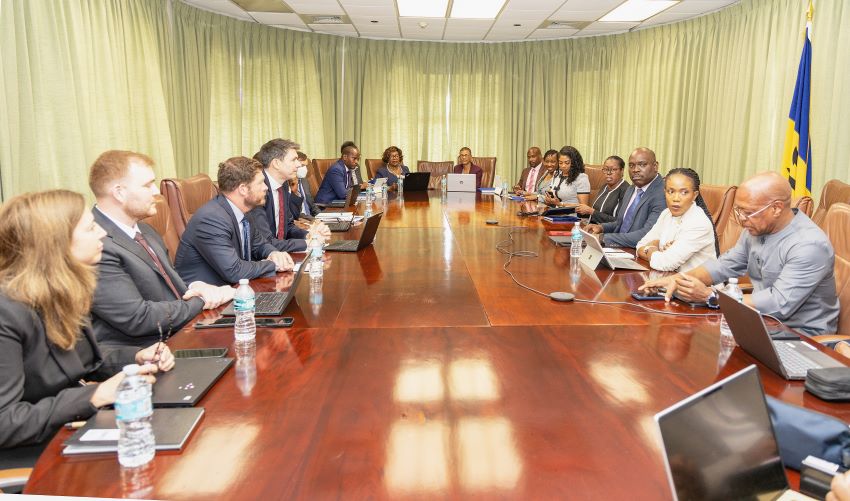
A high-level team from the International Monetary Fund (IMF) has landed in Bridgetown this week for a working visit that combines the institution’s routine Article IV economic consultations and exploratory discussions on a new bilateral framework with Barbados, one year after the Caribbean nation wrapped up its formal IMF-backed economic program.
Led by senior IMF official Michael Perks, the delegation is scheduled to hold a series of high-stakes meetings with top Barbadian leadership, including Prime Minister Mia Mottley, Finance Minister Ryan Straughn, and Minister of Economic Affairs and Planning Marsha Caddle. Additional talks are also planned with technical officials from the Ministry of Finance, Economic Affairs and Investment, as well as leaders from the Central Bank of Barbados. The entire mission kicked off with an opening working session on Monday morning, where Caddle joined the Barbadian delegation to align expectations for future collaboration between the country and the global lender.
Barbados officially exited its twin lending arrangements – the Extended Fund Facility (EFF) and the Resilience and Sustainability Facility (RSF) – in June 2024, after successfully delivering on the commitments laid out in its home-grown economic strategy: the Barbados Economic Recovery and Transformation (BERT) Plan. At the time of the program’s conclusion, both Barbadian authorities and the IMF confirmed that all core objectives of the arrangements had been met. The IMF highlighted that Barbados had successfully reestablished macroeconomic stability, implemented landmark reforms to strengthen long-term fiscal sustainability, accelerate inclusive growth, and build systemic economic resilience. The institution also noted that Barbados’ economic performance remained strong post-reform, with robust output expansion, moderating inflation, improved fiscal and external balances, and a steady decline in the public debt-to-GDP ratio.
Speaking after Monday’s opening session, Caddle reflected on Barbados’ economic journey since 2018, which has progressed from urgent macroeconomic stabilization to sustained growth and now deep structural transformation. As a small island developing state, proactive risk management has to remain a core pillar of the country’s economic governance framework, she emphasized.
“Preparing for scenarios where we may need rapid access to emergency liquidity will always be a critical priority for us,” Caddle explained. “We already have several risk-mitigation tools in place, including a Contingent Credit Facility with the Inter-American Development Bank, natural debt clause disaster provisions, and other similar risk instruments. But climate and environmental shocks are not the only threats we face. The COVID-19 pandemic showed us that global health crises can upend our economy, and ongoing geopolitical conflicts around the world continue to disrupt our access to essential commodities. This is why our institutional partnerships with global financial institutions remain so vital.”
Caddle went on to outline the unfinished agenda for Barbados’ economic transformation under the updated BERT 3.0 strategy, which is being led by her ministry. Key priorities include scaling up infrastructure investment to match the economy’s growth trajectory and the aspirations of the Barbadian people, restructuring state-owned enterprises to put them on a financially sustainable footing, addressing persistent skills gaps across both the public and private sectors, and securing long-term sustainability for public investments in health, education, and water access. “As we push forward with this transformation, our top priority is making sure that no future crisis can erode the hard-won gains we have already achieved,” she added.
Beyond official government meetings, the IMF mission is also scheduled to hold discussions with a broad range of non-governmental stakeholders during its visit, including representatives from the private sector, civil society organizations, and labor groups, to gather diverse perspectives on the country’s economic outlook.