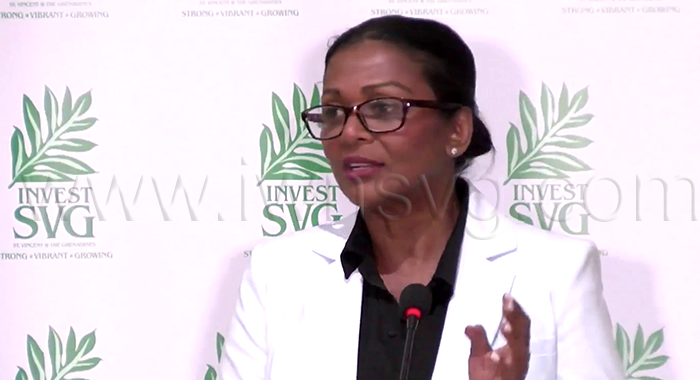
Fresh off her appointment and 36 years living outside St. Vincent and the Grenadines (SVG), Anna Young, the newly sworn-in Executive Director of Invest SVG, has delivered a landmark call to unity and collective action to the large Vincentian diaspora community in the British Virgin Islands (BVI), urging an end to outdated divisions between domestic and overseas nationals and positioning diaspora contribution as a core strategic pillar of the country’s economic transformation.
Young, who officially began her role just one day after returning to SVG, used her first major public address as agency head to frame her own homecoming as living proof that diaspora members can successfully reintegrate and contribute meaningfully to national development — a need the country says is increasingly urgent amid shifting global economic conditions. The speech capped off the latest stop of a national investment outreach forum that has already stopped in London, bringing the conversation to the BVI, where an estimated 20% of the population traces its roots to SVG.
At the core of Young’s message was a rejection of the long-held distinction between Vincentians who reside at home and those who have built lives overseas. “Whether you left our home by choice or by necessity to pursue a better future, you never stopped being Vincentian,” she emphasized, arguing that identity, not current geographic location, defines national belonging. “Vincy by birth, Vincy by descent, Vincy by identity, first generation, second generation, third generation, Vincy by choice. Home is where the heart is, and we are one people,” she told the gathered audience on May 2, 2026.
Young stressed that this outreach is far more than a sentimental call to return home; it is a deliberate invitation for the global Vincentian community to become structural partners in building the country’s economy. “We are not just asking you to come back — we are asking you to build with us,” she said, noting that contribution extends far beyond high-net-worth investment. “Whatever your profession, from caregivers to nurses, tradespeople to C-suite professionals, your skills, experience and connections matter. Investment is not just about capital. It is human, it is intellectual, it is relational — and we need all of it to move SVG forward.”
She highlighted early progress from the BVI leg of the forum, noting that local BVI merchants have already expressed interest in stocking products made by Vincentian producers. “That is not just trade. That is increased visibility, growing confidence, and new market opportunities for our entrepreneurs back home. It is a perfect example of what we can achieve when we connect our people across borders,” Young explained.
Outlining the government’s clear economic roadmap, Young identified four interconnected priority pillars that will drive SVG’s transformation over the coming years: tourism, the green economy, the blue economy, and creative industries. She framed each sector as accessible, growing opportunity areas for diaspora engagement. Tourism, the long-standing cornerstone of the SVG economy, is expanding beyond traditional offerings into high-value niche segments including eco-tourism, boutique experiences, and heritage tourism. The green economy spans renewable energy development, climate-smart agriculture, sustainable construction, and environmental innovation, while the blue economy leverages SVG’s abundant marine assets, covering fisheries, coastal development, marine transport, and emerging ocean-based initiatives. Finally, the creative industries position SVG’s unique cultural identity as an exportable asset, encompassing music, film, digital content, fashion, and visual arts.
To remove barriers for diaspora investors, Young detailed a comprehensive restructuring of Invest SVG itself, reorienting the agency around four core mandates: export and trade development, foreign direct investment attraction, financial services growth, and intentional diaspora investment mobilization. She positioned the reworked agency as an active, hands-on facilitator rather than a passive bureaucratic body, promising end-to-end support for every investor.
“We are not asking you to navigate the system alone. We walk with you every step of the way,” Young said, outlining the full scope of support Invest SVG will provide, from initial business registration and project structuring to accessing government incentives, coordinating permits, liaising across ministries, and providing ongoing aftercare once a project launches. Acknowledging that past investment processes have not always been seamless, Young also announced ongoing legislative reforms to the nation’s Investment Act and Tourism Aid Act, designed to turn Invest SVG into a true one-stop shop for investors, with improved transparency, stronger investor protections, and more streamlined coordination across government agencies. The ultimate goal, she said, is to deliver “clarity, predictability and confidence” for all investors.
SVG already offers a robust package of incentives for qualifying projects, including duty-free concessions on approved imports, corporate tax holidays, targeted sector-based tax deductions and exemptions, facilitated work permits and entry for key personnel, access to land for strategic projects, and ongoing post-launch support. These incentives are structured to make viable local projects more competitive and sustainable, Young noted, adding “You can succeed in St. Vincent.”
To further support incoming investors, Invest SVG is also building a vetted national ecosystem of pre-qualified service providers, covering construction and project management, sustainable design, architecture, engineering, legal and investment advisory, real estate acquisition, and hospitality operations. “Investment doesn’t succeed in isolation — it succeeds in a strong ecosystem. When you come to SVG, you won’t have to build that ecosystem from scratch; we already have the expert partners you need to hit the ground running,” Young explained.
Closing her address, Young emphasized that diaspora investment is not a secondary supplementary source of capital for SVG — it is a core strategic priority, particularly amid today’s shifting global economic landscape. “Capital is more selective than ever, competition for investment is fierce, and resilience is the defining requirement for small open economies like ours,” she said. “In this context, diaspora investment is strategic, because you bring more than capital — you bring confidence, credibility, and existing global connections that no outside investor can match.”
Young rejected the idea that overseas Vincentians must choose between their current adopted homes and their connection to SVG, extending an open invitation for dual belonging: “St. Vincent and the Grenadines is not divided between home and abroad. It is one nation, one people, one identity, working together. Welcome home, come home, invest, build, and let us rise together.”