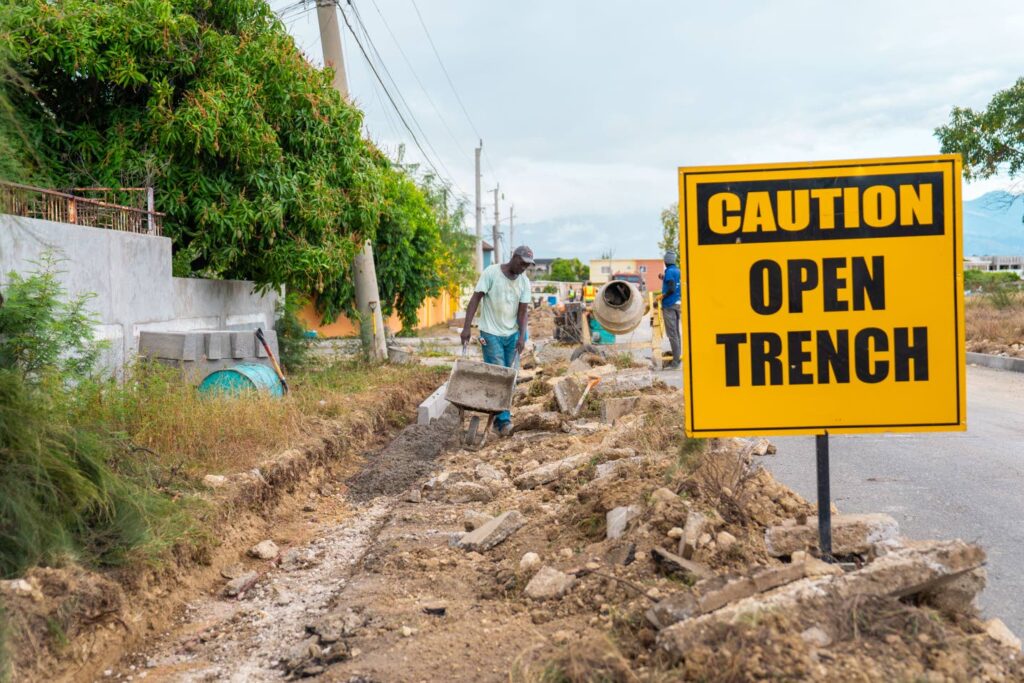
Political interference in Jamaica’s flagship multi-million dollar road infrastructure initiative is triggering costly project delays and rising financial risks, top government infrastructure officials have warned. The caution came from National Works Agency (NWA) Chief Executive Officer EG Hunter during a recent appearance before Parliament’s Public Administration and Appropriations Committee (PAAC), where he outlined growing challenges plaguing the Shared Prosperity through Accelerated Improvement to our Road Network (SPARK) programme.
China Harbour Engineering Company (CHEC), the lead contractor heading SPARK which includes 27 local and international sub-contractors, formally documented the issue in correspondence shared with NWA. In the letter, CHEC detailed that repeated disruptions from political actors, ranging from sitting Members of Parliament to local partisan representatives, have held up segments of road projects for months at a time. Contractors frequently face demands to alter pre-approved road alignments and design plans, which were settled through earlier public consultation processes, forcing work stoppages while disputes are resolved.
Hunter emphasized that these unplanned changes do not just slow progress — they almost always lead to formal cost adjustment claims from the contractor, driving up public expenditure for the programme. To maintain legal clarity and project accountability, he noted that the Jamaican government, as the client, only maintains a formal working relationship with the lead contractor, not outside third parties seeking to alter project terms. He laid out a clear formal channel for concerns from elected representatives: all issues should first be directed to a constituency liaison officer, a role for which each MP was previously invited to nominate a representative. Unresolved concerns can then be escalated to project engineering staff, and ultimately to Hunter himself, who also serves as SPARK’s chief engineer.
When contacted for further comment, Minister of Works Robert Morgan confirmed the government has already taken formal action to address the growing problem, tabling a formal Ministry Paper in Parliament outlining binding guidelines to curb unregulated third-party interference. Morgan specifically called out newly elected Opposition Members of Parliament, who have increasingly pushed to alter pre-selected road routes that were finalized through public input, creating contractual conflict between the government and CHEC. Since contractors have signed fixed-price agreements to deliver specific pre-approved work, outside interference that changes project scope puts the government in a legally and financially vulnerable position, he explained.
Morgan pushed back against claims from some MPs that they were unaware of the new guidelines, noting that the document was properly presented to Parliament during sitting, and that MPs who missed the notification simply failed to pay attention to official business. He added that many elected officials have been directly engaging with contractors outside the approved governance framework, exposing the government to avoidable legal and financial risk.
The formal guidelines, titled *Guidelines governing the involvement of third parties in the implementation of road infrastructure projects*, outline clear boundaries for all external stakeholders — a group that includes MPs, councillors, community residents, civil society groups, private businesses, and non-prime contractors. The framework is designed to align all third-party engagement with Jamaican law, improve transparency, protect project integrity, and eliminate unauthorized political influence.
Under the new rules, third parties are permitted to participate in public sensitization meetings, represent constituent needs related to local infrastructure, and flag implementation challenges. MPs are also guaranteed formal notification of all contractual work taking place in their constituencies, with cross-constituency projects triggering notifications for all affected representatives. However, the rules explicitly prohibit third parties from participating in any stage of procurement or contract administration, including attempts to influence contract awards, which could constitute violations of procurement standards and criminal offenses under the Integrity Commission Act. All procurement decisions are reserved for official procuring entity leadership, accounting officers, the Public Procurement Committee, and Cabinet as appropriate. Third parties are also barred from managing project funds, signing contracts, approving payments, or overseeing project financial administration.