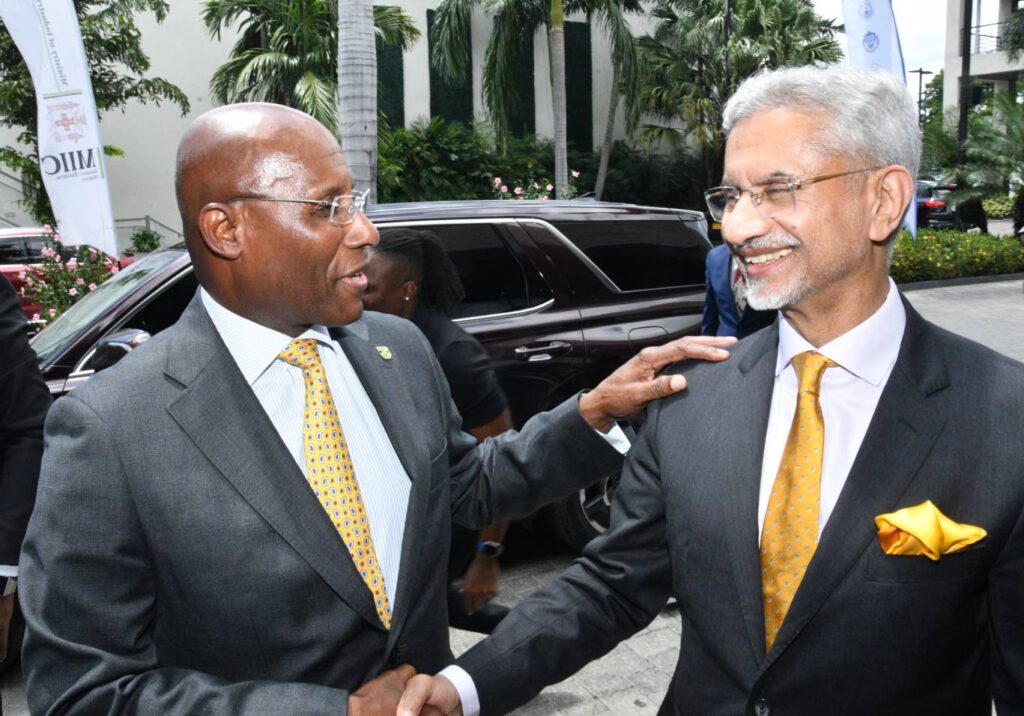
Against a backdrop of rising geopolitical instability and interconnected global markets, India’s Foreign Affairs Minister Dr. Subrahmanyam Jaishankar has delivered a clear call to action for Jamaican business leaders: expand into new markets and build diversified supply chains, as shifting political landscapes continue to upend long-standing global trade patterns.
Jaishankar shared his insights during a Monday ministerial luncheon hosted by Jamaica’s Ministry of Industry, Investment and Commerce at Kingston’s AC Hotel, where he framed modern commerce as inherently tied to global political dynamics. He emphasized that businesses can no longer afford to operate ignoring cross-border spillover effects from global crises, pointing to three major recent disruptions that have reshaped international trade: the COVID-19 pandemic, the ongoing Russia-Ukraine conflict, and escalating tensions in the Middle East.
“In our deeply globalized world, any crisis or conflict anywhere carries global consequences,” Jaishankar explained. “Thousands of miles can separate us from a conflict zone, but events there still shape energy prices, drive global inflation, impact national fiscal deficits, and even threaten political stability in smaller nations, as we saw after the invasion of Ukraine.”
The minister noted that years of repeated trade disruptions have laid bare the critical risks of overreliance on a narrow set of traditional supply routes and trading partners, a risk amplified by growing global trends toward economic nationalism and domestic protectionism.
“The COVID-19 pandemic proved that supply chain reliability cannot be taken for granted,” he said. “Years of volatile tariff policy have also shown that market access is not guaranteed. At the same time, rapid technological advancement has opened new pathways for business growth and new global partnerships. Just as we see the global political order shifting, a parallel transformation is underway in global commerce. Every nation is now actively seeking new, alternative trading partners.”
Against this shifting landscape, Jaishankar encouraged Jamaican and Caribbean businesses to broaden their strategic outlook and carve out new positions in a rapidly evolving global economy, where nations across the world are prioritizing the development of alternative, more resilient trade networks.
“In today’s uncertain world, the key question is how we build more strategic options, how we expand our partnerships, how we diversify our connections,” he said. “This is the same advice I give to Indian businesses: go out, explore new markets, leverage regional hubs, pursue nearshoring opportunities. You cannot afford to limit your operations to your home market in this new climate.”
To illustrate his point, Jaishankar shared India’s own recent experience adapting to supply chain disruption. When conflict in the Gulf region threatened critical liquefied petroleum gas (LPG) supplies— a primary cooking fuel for hundreds of millions of Indian households— via the Strait of Hormuz, New Delhi was forced to rapidly secure alternative suppliers. That scramble ultimately opened new, durable trade opportunities with partners across Latin America and the Caribbean, Jaishankar said.
“Ten years ago, we would never have considered this region as a major LPG supplier, and the economic logistics would have been far too prohibitive anyway,” he noted.
He also highlighted the fast-growing commercial ties between India and the broader Latin American and Caribbean region, where annual bilateral trade now nears $50 billion and continues to climb year over year.
Jaishankar added that major advancements in global logistics, infrastructure development, and digital technology have dramatically eroded the barriers that geography once created for small and mid-sized economies. This shift opens unprecedented new opportunities for nations like Jamaica to deepen bilateral trade and investment links with major global economies like India, he said.
He pointed to India’s own massive recent infrastructure expansion— including new interstate highways, expanded airports, and upgraded national rail networks— alongside its booming digital economy as proof of the country’s growing competitiveness and capacity to expand global commercial partnerships.
As India continues to establish itself as a leading global economic power, Jaishankar confirmed that the country is eager to strengthen trade and investment ties with Jamaica and the wider Caribbean. Both regions stand to benefit from searching out new opportunities to offset global uncertainty, he said.
“I know Jamaica has a great deal to offer, from its strategic geographic location to its growing domestic demand, to its ongoing post-pandemic recovery and national modernization agenda,” Jaishankar told gathered business leaders. “I am confident that across a wide range of sectors, we will see Indian companies, Indian expertise, and Indian innovation expand their presence here far more than ever before. I urge you to explore the mutual opportunities this new partnership can deliver.”