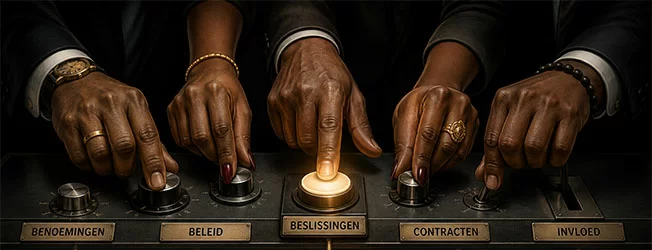
When we talk about national governance, our attention automatically goes to the president, vice president, and cabinet ministers. These are the public faces of power: they announce policy, sign official documents, and deliver public accountability. But anyone seeking to understand how power actually operates in practice has to look far past the familiar names and faces that dominate daily news cycles. Behind every elected official lies an extensive network of unelected actors, and it is within these behind-the-scenes circles that much of the real decision-making takes place.
This pattern repeats itself every time a new government takes office. Hundreds of political operatives shift into new positions, as party loyalists who provided unwavering support during election campaigns are rewarded for their service after victory at the polls. Roles are carved up, new positions are created, and influence is locked in for key insiders. This is the very system that current ruling coalition promised to reform, campaigning under the slogan *Tra fas’ de en nyun pasi* (New path, clean path) that pledged full transparency and open governance. Yet time and again, it is not the elected cabinet ministers who shape this network of influence — it is unelected advisors and close confidants. These actors, whether they hold a formal title or not, wield enormous tangible power. They control the placement of candidates for key government positions, regardless of whether those candidates are qualified for the roles they are given. It should come as no surprise, then, that persistent administrative problems continue to fester across the country, such as the ongoing anomaly in Nickerie, where two district commissioners are on the public payroll but only one can actually carry out official duties.
Those who believe all government policy is developed in formal meeting rooms are only getting half the story. The most influential actors in the President’s Office are widely recognized to be Faisel Abdoelgafoer and Sergio Akiemboto, operating through a tangled web of formal and informal channels that guide decision-making. Too often, unqualified candidates are placed on the boards of state-owned enterprises, a pattern that has led to a string of high-profile blunders in recent years. One of the most recent missteps involved Minister Harish Monorath and the Saya project, yet the minister faced no consequences for the incident. He escaped unscathed largely because he enjoys the unwavering backing of coalition leader and ABOP party chief Ronnie Brunswijk. Brunswijk not only maintains firm control over his own party but also holds the entire governing coalition in a chokehold, blocking action to address longstanding issues at state-owned firms Grassalco and EBS.
In many cases, key decisions are drafted, adjusted, and finalized long before they ever appear on the agenda for an official government vote. Just as banks are required to know not just their customers but the full network of connections around them, the public deserves to examine the full network of people that surround the nation’s top elected leaders. That is where private interests intersect with public policy, that is where backroom deals are struck, and that is where the overall direction of the country is ultimately set. Across every administration, there are advisors and holders of key positions who prioritize advancing their own personal agendas over the public good. Candidates are placed in roles not to challenge bad decisions or offer independent perspective, but simply to carry out the orders handed down from insiders. This creates a system where formal responsibility is visible to the public, but actual influence remains diffuse and hidden from view.
To date, the current administration has yet to present a clear, unified policy agenda for the country, thanks in large part to bitter infighting over competing interests within the coalition — disputes that are particularly intense in the housing development sector. The ongoing conflict over the country’s Fisheries Inspection Institute remains unresolved, while state-owned water utility Canawaima has been mired in quiet dysfunction for months.
It is long past time for the public to stop only looking at the “display window” of formal government, while blunders and mismanagement pile up behind closed doors. The real work of governance happens far from the public eye: in rooms with no press cameras, in unrecorded phone calls, in informal agreements that are never written down but still shape policy and outcomes. As long as we pretend that only elected officials set the direction of government, we are only fooling ourselves. Power does not only reside in formal job titles. It lives in access, in access, in personal connections, in who you can call and who calls you back. The critical question for Suriname is not who holds the top formal offices — it is who is really pulling the strings.