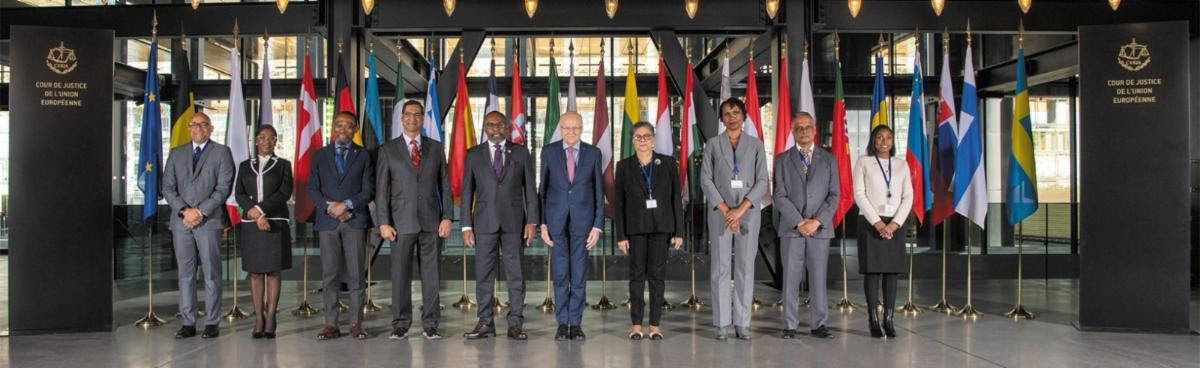
Between April 27 and 30, 2026, a delegation led by Caribbean Court of Justice (CCJ) President Winston Anderson wrapped up a high-impact four-day knowledge-sharing and collaboration tour of key European judicial institutions, built to strengthen cross-regional judicial capacity and foster long-term institutional partnerships. Funded by the European Union through the 11th European Development Fund, the mission marked a deliberate step to connect two major regional judicial systems and exchange actionable insights on modern court operations.
The CCJ delegation’s itinerary centered on three of Europe’s most influential international legal bodies, starting with the Court of Justice of the European Union (CJEU) based in Luxembourg. There, the team was officially received by CJEU President Koen Lenaerts and Vice President Marc van der Woude, holding structured high-level discussions before observing ongoing court proceedings. Beyond formal dialogues, the delegation gained exclusive behind-the-scenes access to the CJEU’s core administrative functions, from digital case management infrastructure and communications protocols to specialized judicial library services. This hands-on exposure allowed the CCJ team to study the CJEU’s tested approaches to boosting operational efficiency and embedding innovation into daily court work.
From Luxembourg, the delegation traveled to Strasbourg, France—a global hub recognized for advancing international human rights law and intergovernmental legal cooperation—to meet with leadership from the European Court of Human Rights (ECtHR) and the Council of Europe. The CCJ team held judicial dialogues with ECtHR judge Arnfinn Bårdsen and members of the court’s Section V registrar team, and President Anderson also paid a formal courtesy call to Council of Europe Secretary General Alain Berset.
Across all Strasbourg engagements, participants centered talks on three defining priorities for modern regional courts: upholding unwavering judicial independence, advancing effective regional integration through law, and clarifying the critical role that supranational judicial bodies play in defending democratic values, the rule of law, and fundamental human rights. For the CCJ, these dialogues reinforced its long-standing commitment to continuous institutional improvement and mutually beneficial global judicial collaboration.
Unlike one-off diplomatic visits, this mission was designed as a two-way exchange: while the CCJ delegation drew on decades of European experience in supranational judicial governance to identify opportunities for refining its own operations, CCJ officials also shared their unique perspective on adjudicating disputes within a developing regional integration framework. The EU’s funding for the initiative underscores the bloc’s ongoing investment in strengthening rule of law institutions across the Caribbean, and lays the groundwork for future joint initiatives, training programs, and collaborative research between the CCJ and its European partner institutions.