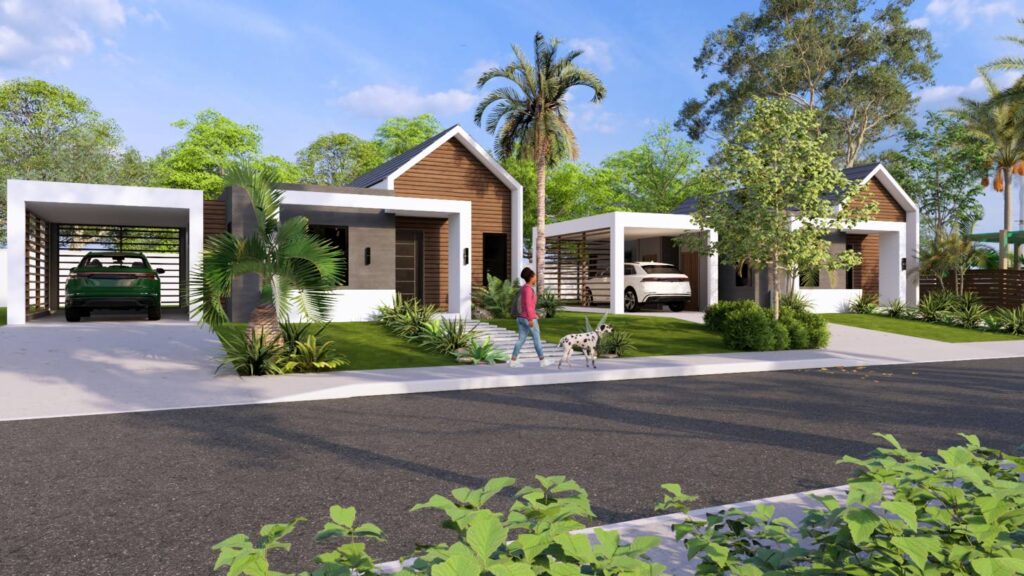
In Jamaica’s increasingly saturated new housing market, architect Mlela Matandara-Clarke has built a distinctive niche that is far more challenging to achieve than it appears: delivering aesthetically striking, thoughtfully designed homes at price points accessible to ordinary working Jamaicans.
After seven years in operation, her firm Matandara-Clarke Architects has cultivated a design identity rooted in what Matandara-Clarke describes as “creative, tropical, contemporary design solutions.” This philosophy is on full display in the studio’s latest flagship project: Wick Hall Estate, a multi-phase residential development being built by ALTRUHOMES in Spanish Town, St Catherine, which is already in advanced stages of construction.
The development’s core design mission is to deliver premium value at an accessible cost, a deliberate departure from the cookie-cutter layouts and low-quality finishes that have long defined Jamaica’s mid-priced housing segment.
“Wick Hall is targeted at Jamaicans living on regular incomes who deserve access to high-quality housing they can actually afford,” Matandara-Clarke explained. “That has always been the intentional goal for our client: to let this group of homebuyers own a property that fits their budget while still granting them an elevated standard of living.”
Entry-level homes start at just JMD $28.5 million, a price point that undercuts the $40 million-plus starting cost that has become standard for new townhouses and high-rise apartments across Jamaica in recent years. Even at this accessible price, the standard inclusions read like a luxury home buyer’s wish list: porcelain tile flooring, durable sintered stone kitchen countertops, hurricane-rated aluminium windows, pre-installed solar water heating, an integrated water tank and pump system, and pre-wiring for both air conditioning and future rooftop solar panel installation. Matandara-Clarke emphasized that this full specification is intentional: new owners should move in and feel at home immediately, with no costly renovation projects waiting for them after receiving their keys. The development’s three home collections range from 800 to 1,190 square feet of interior space, sited on individual lots starting at 4,000 square feet.
“The price point is explicitly tailored to lower-to-middle income families, and we worked to offer a range of housing types to fit different household needs,” Matandara-Clarke said. She walked through the development of the project’s design alongside her husband Deon Clarke, the firm’s design lead, and Production Director Shamar Boews.
“We tested multiple kitchen layouts and roofing configurations, and every feature we selected was chosen to raise the overall quality of the living space,” she explained. “We modulated the roof design to combine a concrete slab on one half of the home and a gable roof on the other.”
This structural choice creates intentional variation in ceiling height: the living room feels open and expansive, while the connected kitchen and dining area offers a cozier, more intimate atmosphere ideal for family gathering and conversation.
Every design decision prioritizes natural cross-ventilation and abundant natural light. While the kitchen, living, and dining areas follow an open-plan layout, each zone is purposefully defined to have its own distinct character.
“The dining space connects directly to the kitchen via an island counter, so family members can chat with the cook while meals are prepared before moving to the table for dinner,” Matandara-Clarke said. “We also placed a large window directly in front of the dining table to bring in natural light and constant airflow.”
Hurricane resilience is not an afterthought added to the plans at Wick Hall Estate—it is built into the project’s core structural design. As Jamaica faces increasingly intense storm patterns amid a changing climate, this focus on safety has grown even more critical, but Matandara-Clarke noted that the commitment to storm-resistant design was in place long before the most recent high-profile hurricane events.
“We were prioritizing hurricane-proofing in our designs long before the latest major storms,” she said. “From the first day of planning, we wanted to include a concrete slab component in every home, which makes the structure significantly more resilient to strong winds. We also adjusted roof angles to account for wind load requirements.”
The angled concrete slabs also create a natural protective buffer between adjacent homes. Every unit is fitted with hurricane straps, limited eave overhangs, and parapets that anchor the ends of the roof firmly to the home’s exterior walls.
Nestled just off Old Harbour Road, Wick Hall Estate occupies 36 acres of gently sloping land at the edge of a rapidly growing corridor that has emerged as a hub for new middle-income housing development in Jamaica. Pre-sales for the development launched recently, and full construction is scheduled for completion by August 2028. The largest offering in the development, the two-storey Terrace Collection, includes three bedrooms and three bathrooms across 1,190 square feet of interior space, plus private balconies and generous yard space for family outdoor activity. Pricing for the Terrace Collection starts at $36.5 million.
Environmental sustainability is also baked into the development’s master plan, not just a marketing add-on. A continuous green belt runs through the center of the community, balancing built infrastructure with natural green space.
“That green belt was really important to us—it balances the hard construction of the homes with soft natural landscape elements,” Matandara-Clarke said. “We worked hard to avoid overbuilding in sensitive areas while still maximizing the number of affordable units we could deliver. We consolidated landscaping and spread green space evenly across the entire site, with a dedicated children’s play area separate from the community centre.”
A natural existing pond at the lowest point of the site will be retained as both a functional storm water management feature and a community recreational amenity. After consulting with Fluid Systems Engineering Limited, the firm leading storm water planning for the project, the design team chose to build a public recreational zone around the pond rather than filling it in for development.
“Keeping the pond lets it function naturally for drainage, and it also cuts down on overall infrastructure costs,” explained design lead Clarke. “We incorporated it not just as a functional storm water feature, but as a public space that the whole community can enjoy.”
On the topic of flooding, a persistent concern for any new residential development in Jamaica, Clarke was clear about shared responsibility for long-term safety.
“Flood management is a shared responsibility between the developer and the local municipality,” he said. “Storm water infrastructure needs to be adequately sized from the start, properly maintained over time, and designed to scale as the community grows.” The drainage system at Wick Hall Estate is being designed with exactly that long-term flexibility in mind.
In the end, Wick Hall Estate makes a powerful statement about what is possible in Jamaica’s housing market: it proves that thoughtful, high-quality design does not require a luxury price tag, and that Jamaicans living on regular incomes deserve access to durable, sustainable, beautiful homes that can withstand extreme weather. For Matandara-Clarke and her team, Wick Hall Estate is their clearest, most concrete demonstration of that vision to date.