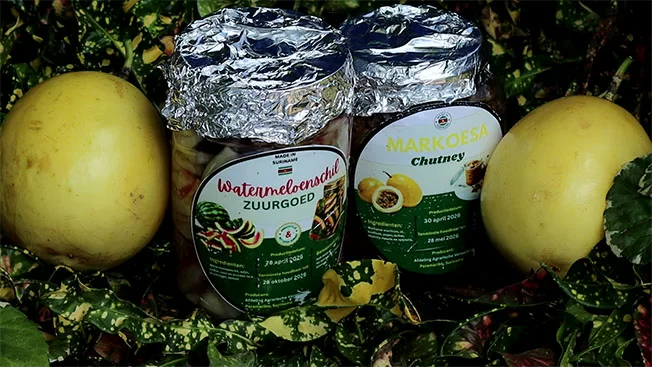
At Suriname’s ongoing Agrarian Trade Fair hosted at the KKF building, the nation’s Ministry of Agriculture, Livestock and Fisheries (LVV) is showcasing a creative new approach to sustainable food production: turning commonly discarded fruit peels into marketable, delicious edible products. Two standout innovations drawing crowds of visitors are tangy passion fruit peel chutney and pickled watermelon rind, part of the ministry’s broader push to eliminate food waste and unlock added value across the local agricultural supply chain.
Speaking at the event, LVV Minister Mike Noersalim emphasized that the project’s core mission is to cut unnecessary food waste by making use of every part of harvested crops. “No product goes to waste here, and we are working aggressively to build new revenue streams by adding value to locally grown produce,” Noersalim stated. To scale this model, the ministry has committed to supporting interested local entrepreneurs through a range of targeted programs, with two key policy goals: boosting domestic agricultural production and reducing Suriname’s long-standing reliance on imported food goods.
The passion fruit chutney concept originated from the Agricultural Marketing and Processing division of the Directorate of Agricultural Research, Marketing and Processing. Junior researcher Romana Matdalim explained that commercial processors have traditionally thrown away passion fruit peels as a valueless byproduct. She and her team developed the idea to repurpose the discarded peels into a unique flavor product, a development she says the team is deeply proud of. The same innovative philosophy applies to the pickled watermelon rind on display, which has surprised fair attendees who sampled the item; many visitors reported mistaking the tangy pickled rind for papaya before learning its true origin.
Wikash Ghisaidoobe, lead researcher for the Agricultural Processing division, noted that the initiative has already drawn overwhelmingly positive feedback from fair guests, with dozens asking for full recipes to replicate the products at home. Ghisaidoobe highlighted that the LVV’s zero-waste model opens new economic opportunities for both emerging young entrepreneurs and established local business owners, turning agricultural waste into an additional source of steady income.
By integrating byproduct processing into the full food supply chain, the project adds tangible economic value while advancing more sustainable agricultural practices across the country, Ghisaidoobe explained. “This approach lets us use our harvested fruit more responsibly, and moves us one step closer to achieving our goal of becoming the regional food hub for the Caribbean,” he added.
Beyond the zero-waste product showcase, Minister Noersalim announced a new capacity-building initiative for Suriname’s agricultural sector: two LVV officials will travel to Indonesia in the coming weeks to complete specialized training on full-supply-chain processing for breadfruit, known locally as bredebon. According to President Jennifer Simons’ prior policy guidance, breadfruit is one of the key local crops targeted for large-scale production expansion. Minister Noersalim noted that international demand for Suriname’s breadfruit already outpaces current supply, with major demand coming from regional markets including Barbados.
The 2026 Agrarian Trade Fair opened earlier this month and will remain open to the public through Sunday, giving agricultural stakeholders and consumers more time to explore the new sustainable innovations on display.