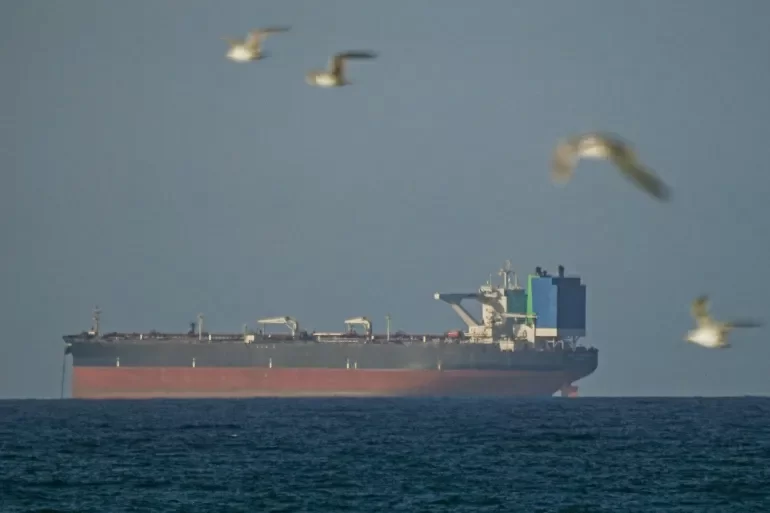
Weeks after a temporary two-week ceasefire between the United States and Iran that kept the critical Strait of Hormuz partially open, a cargo vessel waits off the coast of Oman to traverse the chokepoint. But this image of uncertainty is far from an isolated incident: geopolitical power struggles are rapidly unraveling the decades-old rules-based order that has kept global maritime trade secure and predictable, analysts warn. The warning comes after a sudden policy proposal from Indonesia that sent shockwaves through global shipping and insurance markets last week. Indoneisan Finance Minister Purbaya Yudhi Sadewa suggested imposing transit tolls on commercial vessels passing through the Strait of Malacca, a key global trade chokepoint, explicitly drawing inspiration from recent Iranian actions in the Strait of Hormuz. While Jakarta quickly walked back the controversial suggestion, industry analysts say it exposed a growing, dangerous shift: the once-stable system of open maritime navigation is becoming increasingly risky, costly and overtly politicized. “We have not seen the oceans this unsettled and dangerous since nations first came together to agree on shared rules for maritime navigation,” said Elisabeth Braw, a senior fellow at the Atlantic Council. For centuries, maritime shipping carried inherent risks, from piracy to rogue attacks. But in the decades following World War II, the international community built a comprehensive framework of treaties and agreements designed to guarantee open, safe passage for commercial vessels across global waterways. The results have been transformative: the World Trade Organization reports that global trade grew from roughly $60 billion in the 1950s to more than $25 trillion last year, with 80 percent of all global trade by volume moving across the world’s oceans. Today, however, experts agree that actions from major global powers including the United States, Iran, Russia and China are systematically undermining the rules that made this growth possible. The most high-profile flashpoint right now is the Strait of Hormuz, the narrow chokepoint through which roughly a fifth of global oil supplies pass. Starting in March, Iran restricted passage for dozens of vessels after joint strikes by the U.S. and Israel on Iranian targets. On April 13, the U.S. imposed a full maritime blockade on Iranian vessels and ports, and has since seized Iranian tankers near the strait and detained other vessels across the Indo-Pacific that it accuses of carrying sanctioned Iranian crude. In response, Iran has seized unauthorized vessels attempting to transit the strait and opened fire on multiple commercial ships passing through the waterway. These escalating tit-for-tat actions have worsened the ongoing global energy crisis, pushing oil and natural gas prices to multi-year highs. “Even without a full closure of the strait, requirements for transit approval and constant political pressure create massive cost increases and widespread uncertainty,” said Jack Kennedy, senior analyst at S&P Global. Kennedy pointed to a recent incident off the coast of Oman, where a container ship was fired on by an Iranian military patrol boat, leaving the vessel’s bridge damaged. He described the attack as “calculated use of force to demonstrate control without shutting down all traffic entirely,” a tactic that creates uncertainty across the entire shipping industry. Tensions are now spreading to other critical maritime infrastructure, including the Panama Canal. Earlier this week, the U.S. and multiple South American and Caribbean nations accused China of using “targeted economic coercion” against Panamanian-flagged vessels, claiming Beijing is detaining Panamanian ships in its ports as part of a broader effort to politicize maritime trade and undermine regional sovereignty. China has forcefully rejected the accusations, calling the U.S. claims hypocritical. A spokesperson for China’s Ministry of Foreign Affairs noted that the U.S. occupied the Panama Canal for decades and repeatedly violated Panama’s sovereignty, pointing to a long history of American interference in the region. The latest dispute comes after Panama’s Supreme Court canceled a concession held by a Hong Kong-based firm to operate two major ports along the canal, a move widely viewed as the result of U.S. pressure to roll back Chinese influence around the strategic waterway. Experts note that the vast majority of global maritime trade still operates within the existing legal framework, but the number of high-profile political exceptions is growing at an alarming rate. In recent years, maritime disruptions have become increasingly strategic and organized. Russian control of large swathes of the Black Sea during its full-scale invasion of Ukraine triggered global food shortages by blocking grain exports. In the South China Sea, China has been repeatedly accused of intimidating commercial vessels to enforce its disputed territorial claims, allegations Beijing has repeatedly denied. “Maritime action has always been a tool to exert pressure on an adversary’s economy and military. What has changed is the scale: the volume of container trade and the size of the global fleet mean disruptions ripple across the entire global economy far faster than ever before,” explained Jean-Paul Rodrigue, a maritime trade expert at Texas A&M University. Non-state actors have also amplified risk in global waterways. Houthi attacks on commercial shipping in the Red Sea have forced major shipping lines to reroute vessels around the Cape of Good Hope, adding thousands of miles of extra travel and billions in extra costs. The biggest long-term risk, analysts agree, is the precedent being set by increasingly frequent violations of the existing rules. The cumulative effect of these developments is a clear shift away from predictable, rules-based navigation toward a system where access, costs and safety are increasingly determined by power, influence and political interests. Non-state groups have also exploited gaps in international enforcement: the International Maritime Bureau’s latest report shows global piracy incidents have already reached their highest level in five years this year. These geopolitical tensions translate directly to tangible costs for global consumers. Vessel rerouting increases fuel consumption and transit times, pushing up operating costs for shipping lines. Insurance premiums and risk surcharges have skyrocketed in high-tension areas, and even short detentions or inspections can create cascading delays across global supply chains. As a result, shipping lines are increasingly reconsidering their routes, flag registrations and port calls to minimize political exposure. “The biggest risk is the precedent that emerges when multiple nations test boundaries through selective enforcement, new permitting requirements or tolls in international straits. When that becomes normalized, outcomes depend entirely on power dynamics and bilateral negotiations, not shared rules,” Kennedy said.