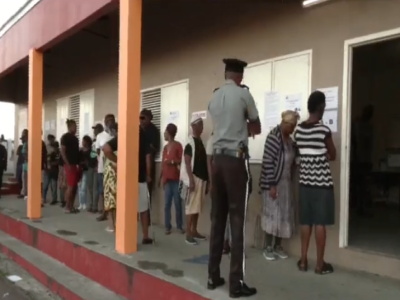
Residents across Antigua and Barbuda have turned out to 190 polling stations nationwide on Thursday for a snap general election, called nearly two years ahead of its constitutionally mandated schedule by sitting Prime Minister Gaston Browne. Polling got underway at 6:00 a.m. local time, with voting scheduled to wrap up 12 hours later at 6:00 p.m. the same day.
According to the Antigua and Barbuda Electoral Commission (ABEC), a total of 63,330 eligible voters are registered to select representatives for 17 contested parliamentary seats – marking an increase of nearly 3,000 eligible voters from the previous election cycle. The electoral body has publicly committed to running a fully transparent, smoothly coordinated voting process for all participants.
To address common last-minute administrative issues, ABEC announced that eligible voters needing to replace expired voter identification cards will be able to obtain a temporary Special Identification Card at on-site constituency registration units open throughout election day, from 6:00 a.m. to 6:00 p.m. ABEC Public Relations Officer Elisa Graham urged all qualified residents to exercise their democratic right to vote, while noting that no voter will be permitted to cast a ballot without valid official identification. Voters applying for the temporary special ID are required to bring one passport-sized photograph to complete their application on site.
The election is being overseen by independent international observer delegations from three major regional and global bodies: the Caribbean Community (Caricom), the Organization of American States (OAS), and the Commonwealth. These observers will monitor the voting process to assess its compliance with international democratic standards.
Prime Minister Browne, who leads the incumbent Antigua and Barbuda Labour Party (ABLP), is campaigning to secure an unprecedented fourth consecutive term in office – a milestone no other prime minister in the nation’s history has achieved. Framing his party’s platform as a “renaissance in changing times,” Browne urged voters to stick with the incumbent administration, warning against supporting an opposition that he claims is unprepared to govern. “On election day, do not take a risk on a leader and a team that’s just not ready. Let’s keep Antigua and Barbuda in strong and safe hands,” Browne said.
The ABLP’s hold on power is being challenged by the nation’s main opposition bloc, the United Progressive Party (UPP), led by first-time election candidate Jamale Pringle. Pringle has campaigned on widespread discontent with the current administration, arguing that Antiguans and Barbudans have endured too many hardships under Browne’s government. “No longer will the people be subjected to the whims and fancy of a political party or a candidate or political person,” Pringle said. He pledged that a UPP government would implement inclusive policies that benefit all citizens, free of partisan political interference.
For this election cycle, the incumbent ABLP is fielding candidates in all 17 parliamentary seats. The UPP is running candidates for the 16 seats located on Antigua, while its political affiliate, the Barbuda People’s Movement (BPM), contests the single seat allocated to the island of Barbuda. Three independent candidates are also running for office across multiple constituencies.
The 2026 snap election comes three years after the 2023 general election, where the ABLP secured a narrow majority, winning 9 of the 17 available seats. The UPP won the majority of the remaining seats, with one seat going to an independent candidate. All eyes are now on the final vote count, which will determine whether Browne makes history as the first prime minister to win four consecutive terms, or if the opposition UPP will unseat the incumbent after three terms in power.