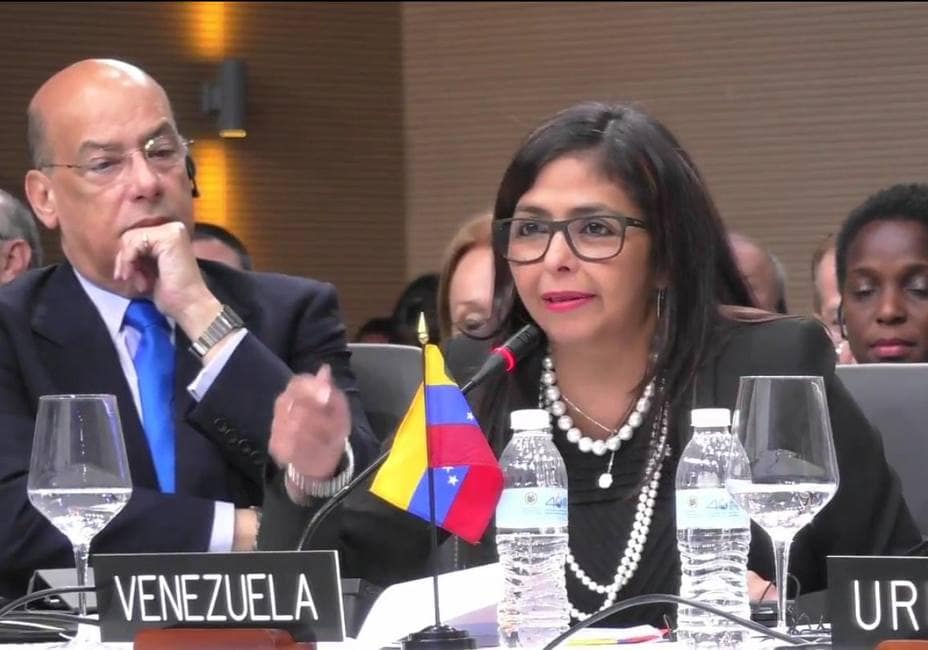
In the delicate landscape of global diplomacy, even minor symbolic gestures can expose deep divides over core international principles. The recent uproar over an official Caribbean diplomatic engagement, where a Venezuelan official wore a lapel brooch depicting Guyana’s Essequibo region as Venezuelan territory, stands as a perfect example of this dynamic.
Critics who brush off this incident as an overblown reaction to a trivial piece of personal clothing miss the point entirely. Dismissing the controversy as mere hypersensitivity to personal attire is not just inaccurate—it deliberately misframes what is at stake here. This is not a debate over fashion; it is a debate over official state conduct.
When a sitting senior government official wears a territorial claim symbol during an official diplomatic meeting with a third party in a dispute over that land, the act stops being personal expression and becomes an explicit tool of state policy. The gesture is deliberately crafted to communicate, entrench, and normalize a disputed territorial position that is currently the subject of formal international legal proceedings.
This border dispute between Venezuela and Guyana is far from a theoretical disagreement. Guyana has already brought the case to the International Court of Justice (ICJ), seeking a final, legally binding ruling on the validity of the 1899 Arbitral Award that established the current international border between the two nations.
Venezuela has framed its claim as rooted in international law and the 1966 Geneva Agreement, but this narrative demands closer inspection. The Geneva Agreement never settled the question of sovereignty over Essequibo, nor did it invalidate the 1899 border award. What it did do was create a framework for peaceful negotiation of the dispute, which ultimately led to the case being referred to the ICJ for adjudication. There is no legal basis for Venezuela to claim the agreement justifies unilateral assertions of territorial ownership while the court is actively considering the matter.
This contradiction is impossible to ignore: Venezuela claims it upholds international law, yet its actions are clearly designed to shape global public opinion on a case that is currently sub judice—meaning under judicial consideration. No state can credibly claim to submit a dispute to binding international adjudication while simultaneously working outside the courtroom through symbols, legislation, and administrative moves to lock in the outcome it favors.
The lapel brooch incident is far from an isolated misstep. It fits into a broader pattern of Venezuelan actions: national legislation that purports to annex the Essequibo region, the appointment of unofficial administrative officials to the territory, and a sustained public campaign asserting Venezuelan sovereign ownership. Taken together, these moves show no willingness to exercise restraint while the court rules. Instead, they represent a parallel political campaign to consolidate Venezuela’s claim through non-legal means.
Against this backdrop, the recent statement from the Caribbean Community (CARICOM) carries outsized importance. Released on April 28, 2026, the CARICOM statement was measured in tone but unmistakeable in its message. It reaffirmed that CARICOM member states retain the right to conduct their own bilateral relations with outside nations, but framed that right within the boundaries of collective obligations laid out in the Revised Treaty of Chaguaramas. Most critically, it emphasized that CARICOM regional platforms cannot be used, either directly or indirectly, to advance or legitimize territorial claims that are currently before the ICJ.
This position is a quiet but firm assertion of regional rules-based discipline, even at a time when critics point to growing disunity within the Caribbean integration movement. The CARICOM statement accomplishes three key goals: it protects the integrity of the international judicial process, preserves the overall unity of the regional bloc, and makes clear that while CARICOM will not interfere in individual member states’ bilateral ties, it will not allow its own forums to be used to advance a territorial claim against one of its own members. That last principle is far more significant than many observers have acknowledged.
Guyanese President Irfaan Ali’s formal written response to the CARICOM chair was therefore both fully justified and necessary. It was not an overreaction, nor was it empty political rhetoric. It was a principled defense of international law at a moment when ambiguity could have easily damaged that principle.
For context, this article’s author worked closely with Venezuelan Vice President Delcy Rodríguez between 2015 and 2017, when he opposed efforts by some Organization of American States member states to impose unilateral sanctions on the Venezuelan government that violated the OAS’s own rules. That stance grew out of a core commitment to due process, international law, and fair treatment of all nations, and the author still recognizes Rodríguez as a formidable defender of her government’s interests during a period of intense geopolitical pressure. But this current controversy has nothing to do with personal relationships, political alignments, or pieces of clothing. It is entirely a matter of principle, legal process, and respect for the ICJ’s ongoing adjudication.
The larger question raised by this incident goes far beyond the Essequibo border: it asks whether all parties will actually back their public commitments to international law with conduct that aligns with those commitments. For this dispute to end in a peaceful, final resolution consistent with international rules, the ICJ’s process must be allowed to move forward without external actions that prejudge or politicize its outcome. That requires deliberate restraint, not provocative symbolism; it demands disciplined adherence to process, not political theater.
A small lapel brooch cannot redraw an international boundary. But the conduct it represents can either strengthen or undermine the very principles that are supposed to guide the peaceful resolution of this dispute. In this case, the Caribbean community has made its position clear: quietly but unflinchingly, it stands on the side of international law.