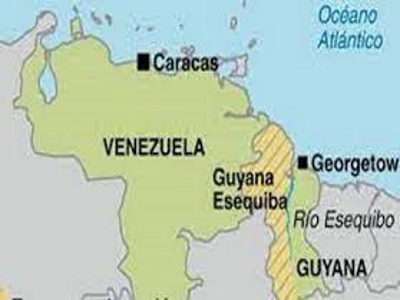
A decades-old border dispute between Venezuela and Guyana over the resource-rich Essequibo region has reignited into a new diplomatic row, sparked by a piece of jewelry worn by Venezuela’s acting president Delcy Rodriguez during recent talks with Caribbean community leaders.
The controversy erupted earlier this month, when Rodriguez met with the heads of government of Barbados and Grenada, two member states of the 15-nation Caribbean Community (Caricom). During the meeting, Rodriguez wore a brooch engraved with a map of Venezuela that includes the 159,000-square-kilometer Essequibo region — territory Guyana claims as its own sovereign land.
Soon after the meeting, Guyanese President Irfaan Ali issued a formal statement of grave concern over the symbolic display of Venezuela’s territorial claim. In an April 28 letter addressed to Caricom Chairman Terrance Drew, who also serves as prime minister of St Kitts and Nevis, Ali clarified that Guyana does not oppose any Caricom member state pursuing independent bilateral relations with Venezuela. However, he emphasized that pairing high-level diplomatic engagements with public assertions of territorial claims against another member state was unacceptable.
Caricom later issued a formal statement noting the controversy, reaffirming its longstanding support for Guyana’s position in the border dispute. Senior Guyanese officials have also separately voiced their objection to Rodriguez’s brooch.
But Venezuelan officials have uniformly pushed back against the criticism, framing the backlash as an overreach that questions a core national position. Speaking at an anti-sanctions rally held in Valencia, the capital of Venezuela’s Carabobo state, Rodriguez dismissed the controversy. She said the map on the brooch is the only map of Venezuela her country has ever recognized, and questioned why Guyana would object to the clothing she chooses to wear.
Venezuela will stand firm in its claim to Essequibo, Rodriguez added, ahead of upcoming hearings at the International Court of Justice (ICJ) that will hear the merits of the decades-long dispute. “We will soon be at the International Court of Justice in the coming days to reaffirm our historic position, which is aligned with international law and respect for the 1966 Geneva Agreement,” she said. “It is outrageous when Venezuela is attacked, and that is why we are undertaking this entire process for the good of our nation.”
Venezuela’s Foreign Minister Yván Gil doubled down on this position, calling Ali’s public criticism unprecedented. Gil dismissed Ali’s complaints as “improvised shows” and argued that the brooch is merely a public acknowledgment of a longstanding historical truth that has been recognized since the 1966 Geneva Agreement. He added that Guyana’s harsh reaction reflects a desperate, erratic attempt to distract from the core legal issues of the dispute.
Jorge Rodríguez, president of Venezuela’s National Assembly, also defended the country’s position in a post on the social platform X. “We maintain an incontrovertible position on our Guayana Esequiba. It is a historical, legal and moral right; it belongs to all Venezuelan women and men,” he wrote. “Our response remains one of peace diplomacy, but with the firmness of a people that does not renounce its sovereignty.”
The current controversy comes as the decades-long border dispute heads to substantive hearings at the ICJ. The root of the disagreement dates back to the 1899 Arbitral Award, which established the current boundary between the two countries and granted Guyana control over Essequibo. The award stood unchallenged for more than 60 years, until Venezuela declared it null and void in 1962 and revived its claim to the entire region.
In 1966, Venezuela and Guyana (then still a British colony) signed the Geneva Agreement, which established formal mechanisms to pursue a peaceful negotiated settlement to the dispute. When years of bilateral talks failed to produce a resolution, the United Nations Secretary-General referred the case to the ICJ in 2018, after Guyana formally brought the dispute before the court to seek legal confirmation that the 1899 award is fully legally binding.
The ICJ has already issued a preliminary ruling confirming it has jurisdiction to hear the case, clearing the way for upcoming substantive hearings where both sides will present their full legal arguments to settle the dispute once and for all.