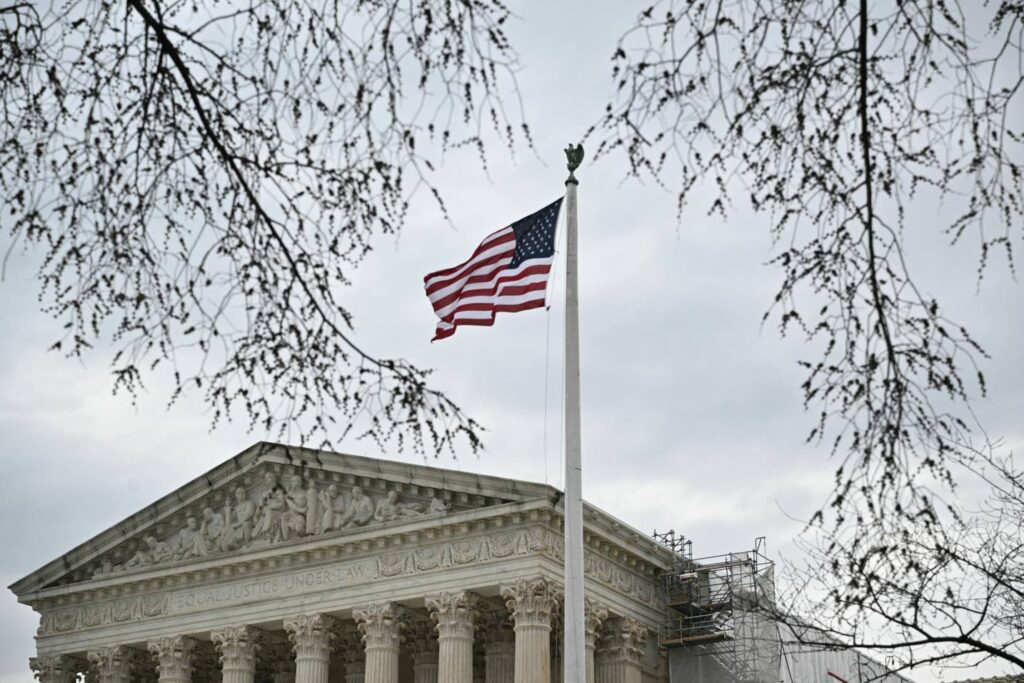
On Wednesday, the U.S. Supreme Court delivered a landmark, ideologically divided ruling that places strict new limits on how race can be factored into the drawing of congressional electoral districts, a decision that experts say could reconfigure legislative maps across the country and bolster Republican electoral chances ahead of November’s midterm elections.
In a 6-3 vote split along the court’s conservative-liberal ideological divide, the conservative-majority court struck down Louisiana’s revised electoral map, which had been drawn to create a second majority-Black congressional district. The map was crafted to meet requirements outlined in the landmark 1965 Voting Rights Act (VRA) after courts ruled the state’s previous plan illegally diluted Black voting power. Even so, the high court ruled that the race-conscious map amounted to unconstitutional racial gerrymandering.
While the ruling leaves the core legal framework of the VRA intact, it narrows the scope of how the act can be enforced in redistricting cases. Civil rights advocates have already framed the decision as a major blow to a law that has been progressively weakened by a series of Supreme Court rulings over the past decade.
Voting rights advocacy platform Democracy Docket projects the ruling could help Republicans pick up as many as 27 additional congressional seats across the country, potentially cementing long-term GOP control of the U.S. House of Representatives. The organization warned that without clear racial protections in districting rules, states face almost no restrictions when redrawing electoral boundaries to benefit a particular party or demographic group.
The immediate impact of the decision on November’s elections remains uncertain, as primary contests are already underway and legal challenges are expected to delay any rapid redrawing of maps. Even so, Republicans are predicted to move aggressively to revise district lines in states where legal timelines and regulatory frameworks allow for changes.
Writing for the court’s conservative majority, Justice Samuel Alito argued that compliance with the VRA did not justify the explicit use of race to draw district boundaries in the Louisiana case. Alito noted that Section 2 of the VRA does not require states to design districts primarily around racial demographics. “That map is an unconstitutional gerrymander, and its use would violate the plaintiffs’ constitutional rights,” Alito wrote, referencing the group of non-Black voters who brought the original challenge against the revised map.
The decision marks a substantial shift in how federal courts interpret the balance between preventing racial discrimination in voting and upholding the 14th Amendment’s equal protection guarantee. The ruling effectively raises the legal standard for considering race during post-census redistricting cycles. In an unusual procedural step, both the majority opinion and the dissenting opinion were read aloud from the Supreme Court bench, a sign of the high stakes of the case.
In her dissent, Justice Elena Kagan warned the decision would carry sweeping, long-reaching consequences for minority voting power. Kagan argued the ruling opens the door for states to systematically weaken the voting influence of minority communities with no legal recourse to challenge the practice. “After today, those districts exist only on sufferance, and probably not for long,” she said.
Legal analysts emphasize the implications of the ruling stretch far beyond Louisiana. The decision will make it far harder for states to create or preserve majority-minority districts, a tool that has been used for decades to guarantee adequate representation for Black voters and other racial minority groups. Because majority-minority districts have historically tended to elect Democratic candidates, the ruling is expected to deliver a major partisan advantage to Republicans in tightly contested House races this fall.
Senate Majority Leader Chuck Schumer, the top Democratic leader in the U.S. Senate, called the ruling a “devastating blow” to the Voting Rights Act. “Today, the Supreme Court turned its back on one of the most sacred promises in American democracy — the promise that every voice counts,” Schumer said in a post-ruling statement.
The decision comes as national partisan fights over redistricting have intensified following the 2020 U.S. Census, with both Republican- and Democratic-led state governments working to redraw district boundaries to shift congressional power in their favor. Section 2 of the VRA, the provision at the center of the Louisiana case, was created to block voting practices that dilute minority political influence, even in cases where there is no explicit proof of intentional discrimination.
The Supreme Court’s conservative majority has increasingly pushed back against race-conscious policy remedies in recent years, arguing that such measures conflict with what Justice Clarence Thomas — the court’s only Black justice — has described as a “color-blind” reading of the U.S. Constitution.