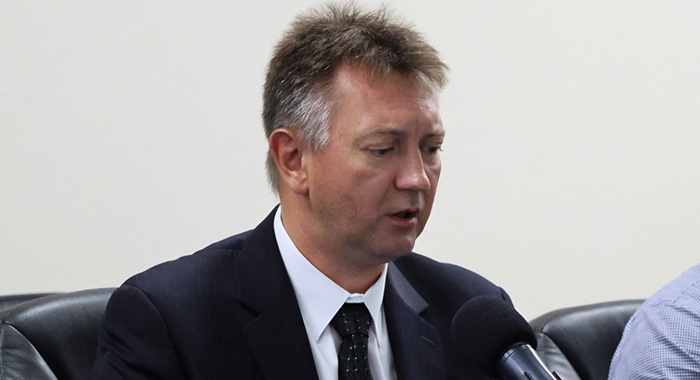
Less than one month after the New Democratic Party (NDP) took power following a landslide election victory that ended a quarter-century of Unity Labour Party (ULP) rule in St. Vincent and the Grenadines (SVG), the International Monetary Fund (IMF) has weighed in on two of the new administration’s flagship policy proposals, delivering a mix of conditional approval and sharp pushback. In a joint press conference held Tuesday in the capital Kingstown with SVG Prime Minister and Finance Minister Godwin Friday, IMF mission chief Sergei Antoshin shared the global financial body’s assessment of the NDP’s planned citizenship by investment (CBI) programme, a key campaign promise from the party’s successful November 2025 election run. Antoshin noted that, if structured correctly, the new CBI programme could deliver a modest but meaningful boost to SVG’s public fiscal revenue, the explicit core goal of the initiative. But he stressed that poor design carries significant unaddressed risks, and outlined clear parameters for what the IMF considers an effective, low-risk framework. According to Antoshin, the optimal structure for the programme centers on a single direct donation or contribution to public funds, while pathways that grant citizenship in exchange for private sector investments or real estate purchases are strongly discouraged. He also added a critical requirement: all revenue generated through the CBI programme must be allocated exclusively to reducing the country’s outstanding public debt. The NDP administration has remained firm in its commitment to launching the programme, despite ongoing public opposition from the defeated ULP, which has pushed back against the policy since it was first introduced on the campaign trail. Beyond the CBI proposal, Antoshin made clear that the IMF does not back the NDP’s plan to establish a new national development bank, a proposal already being debated in the country’s parliament. The IMF’s rejection draws on past high-risk experiences with similar institutions across the Caribbean region, and aligns with the ULP opposition’s stance against the initiative. Antoshin explained that launching the new bank would require significant upfront public capitalization, paired with ongoing recurring fiscal costs that would undermine SVG’s critical ongoing fiscal consolidation efforts. He also warned that the institution would create substantial additional contingent liabilities that would strain the country’s public finances long-term. Instead of creating a new standalone institution, Antoshin argued that policymakers should prioritize strengthening the country’s existing credit intermediation systems to support economic development. The IMF’s public comments come one week after SVG’s parliament opened debate on a private member’s motion put forward by government senator Chelsea Alexander, which formally calls for the establishment of the new development bank. ULP Opposition Leader Ralph Gonsalves, who served as prime minister for the party’s 25 years in office, has already spoken against the motion, drawing on historical experience with similar development-focused institutions in SVG to back his opposition. Prime Minister Friday has rejected Gonsalves’ criticism as lacking forward-thinking imagination, arguing that consolidating development financing functions into a single entity is far more efficient than the fragmented model of eight separate institutions that operated under the previous ULP administration. The parliamentary debate on the motion is currently adjourned, with a resumption date yet to be announced by legislative leaders.
IMF says CBI can help SVG but warns against development bank