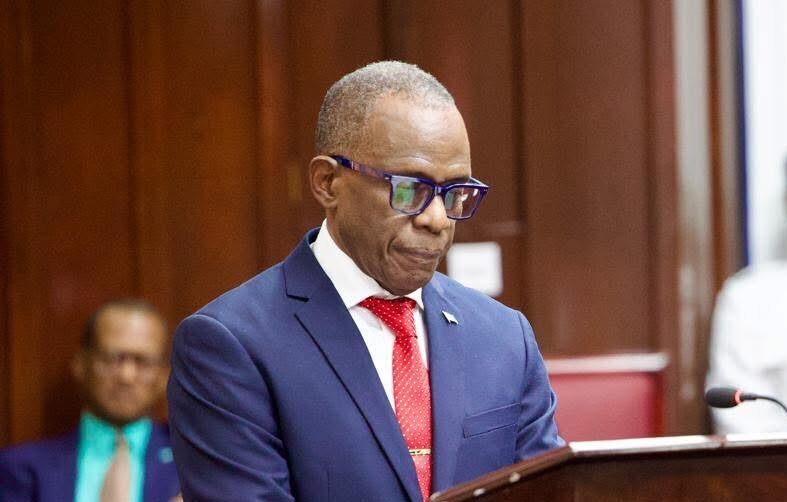
St. Lucian Prime Minister Philip J. Pierre has pushed back against widespread public and social media criticism of a new family-focused policy unveiled during his recent annual Budget address, pushing to correct misinformation that has overshadowed the full scope of the government’s planned support package.
During the three-hour Budget policy speech last week, Pierre announced a core policy measure: a one-time EC$1,000 grant that will be disbursed to eligible first-time mothers with registered newborn children, set to take effect on August 1, 2026. In the days following the address, the single grant announcement dominated public discourse, drawing critical commentary on social media and in local community discussions that framed the policy as a misguided attempt to incentivize higher birth rates.
Speaking at a pre-Cabinet press briefing held on Monday, Pierre addressed the swirling controversy head-on, noting that critics had fixated on the grant while entirely overlooking a suite of complementary, far-reaching family support policies included in the Budget plan. “It’s one of the policy proposals for mothers of registered newborn babies who will receive a one-time grant of one thousand dollars… but there are some below it that everybody seems not to have seen,” he told reporters.
Beyond the one-time grant, the Prime Minister outlined, the government’s full plan begins with a comprehensive review of national parental leave regulations following childbirth, designed to update existing provisions to better meet the needs of modern families. That policy overhual will be followed by a review of the island’s Affiliation Maintenance Act, alongside an expansion of the national school feeding programme that will deliver enhanced nutritional support to students across the country. Pierre argued that these context-setting measures had been erased from public conversation, replaced by superficial, politically motivated criticism.
The Prime Minister also pushed back against claims that the grant program is intended to encourage higher birth rates to address the island’s well-documented low fertility rate and stagnating population growth. He emphasized that while population growth is a widely acknowledged concern for the small island nation, the government is seeking a thoughtful, responsible public conversation about the issue rather than pushing hasty, poorly targeted policies.
“Whether we like it or not, there are concerns about population growth in this island, that’s a fact and what we ask for is a mature conversation by the country, a responsible discussion,” Pierre said. He dismissed claims that the grant amounts to a government payout to incentivize having children as political mischief, stressing that the policy’s core purpose is far more targeted.
“People like to make political mischief when they talk about the government will give you a thousand dollars to make children, that is really not true, it was never true, and the buildup to it shows that it is not true,” he added.
The Prime Minister clarified that the EC$1,000 grant is only intended to cover the initial costs associated with welcoming a new child, a burden that disproportionately impacts low-income and unemployed first-time mothers. Raising a child carries significant financial costs from birth, he noted, and the grant is a limited initial support measure — not a comprehensive solution, nor a reward for having children.
“Babies are expensive, so the thousand-dollar grant is just an incentive to help people with their initial expenses; it is not a reward, nor is it a payment, nor is it something we give you, because the government wants you to make children. It is far from enough, it was never meant to be enough, nor was it meant to be any situation where the government is giving you an incentive to make babies, what it is, it is support for mothers, especially low-income or unemployed mothers,” Pierre explained.
To round out the government’s broader family policy push, Pierre added that the grant will be paired with two additional support measures: expanded government assistance for parents with children enrolled in early childhood education facilities, and new financial incentives for private sector businesses that offer on-site or subsidized child care facilities for their employees.