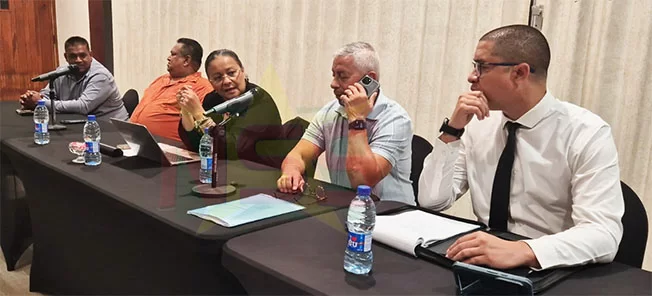
A high-profile leadership shakeup at Suriname’s leading fisheries inspection body has ignited a bitter public dispute over governance, institutional independence and ministerial authority, with the outgoing director stepping down early to avoid formal removal amid claims of sustained pressure and intimidation. After more than two decades at the helm of the Viskeuringsinstituut (VKI), Juliette Colli-Wongsoredjo announced her resignation before her planned removal from office, prompting immediate intervention from Suriname’s Minister of Agriculture, Livestock and Fisheries Mike Noersalim. The minister quickly appointed Arisha Sital-Sewbaran as acting director and named Rashley Resida, current secretary of the VKI Supervisory Board, as second co-signatory for institutional financial transactions, granting him authority to co-approve all transactions worth more than 10,000 Surinamese dollars. As of the time of the dispute, the VKI holds a bank balance of more than $600,000 in its operating account, and unlike many state entities, the institution is entirely funded by the domestic fishing industry rather than government tax revenue. The unfolding conflict came to public light during a widely attended press conference held at the Banquet Hall of Torarica, where representatives of major industry groups including the Federation of Suriname Farmers (FSA), the Suriname Seafood Association, small-scale artisanal fishing communities, along with members of the VKI Supervisory Board and their legal counsel outlined their deep concerns about recent developments at the inspection body. All speakers at the event stressed the critical importance of preserving VKI’s operational independence, a core requirement for its international accreditation and market access. Amid the leadership chaos, VKI’s full staff has issued a formal statement calling for calm, continuity and institutional stability. In an open letter addressed to the Supervisory Board, staff members confirmed that all core daily operations of the VKI remain fully functional, including import and export processing, routine product inspections, mandatory certification workflows, laboratory testing, and administrative support services, all of which are operating on schedule and to required standards. The staff also expressed their full backing for the Supervisory Board’s ongoing agenda focused on increasing institutional transparency, strengthening governance frameworks, and rebuilding public and sector trust in the body. They called on all involved stakeholders to respect the need for calm and allow space for a thorough, objective fact-finding process, arguing this approach is in the best interest of Suriname’s entire fishing sector and the country’s international reputation. Speakers at the press conference highlighted the transformative growth VKI achieved under Colli’s 20-plus years of leadership, describing her as a transformative figure comparable to iconic Surinamese leader Eddy Jharap for the institution. Under her direction, VKI upgraded its operational standards to fully align with European Union regulations, a position it maintains today, giving the institution a unique, respected standing across the Caribbean region. Speakers also pushed back against recent claims that the VKI has failed to complete required financial reporting. FSA chair Tania Lieuw-A-Sjoe clarified that all annual financial reports have been completed and filed on schedule, and the institution only received an extension to 2026 to adapt its reporting formats to the new international IFRS accounting standards. All annual financial statements have consistently been audited by independent accountants in line with global regulatory requirements, and the national audit body CLAD served as the external auditor through 2020. Press conference organizers also noted that they only learned of Minister Noersalim’s formal letter to the Supervisory Board – copied to President Jennifer Simons – appointing the new acting director and co-signatory during the event itself. Industry representatives have formally challenged the minister’s legal authority to unilaterally appoint a second co-signatory, arguing the move directly violates VKI’s official founding statutes. Under existing institutional rules, the director holds sole signing authority for transactions under 10,000 Surinamese dollars, while larger transactions require co-signature from either the Supervisory Board chair or a second co-signatory. By statute, this second co-signatory must be nominated by the sitting director and approved by the full Supervisory Board. Industry representatives also noted that by long-standing convention, the co-signatory is always a representative of the fishing sector, since all operating funds are contributed directly by sector participants. The previous co-signatory was Udo Karg, who now sits as a member of the VKI Supervisory Board. According to industry accounts, Colli refused to approve Resida’s appointment as co-signatory on the grounds that he lacks broad support within the fishing sector. Questions have also been raised about Resida’s conduct during a recent meeting with President Jennifer Simons, particularly around adherence to requirements for confidentiality and data privacy. After these concerns emerged, the FSA formally requested a public accounting from the Supervisory Board, but Lieuw-A-Sjoe said the body failed to provide satisfactory answers, leading to a further erosion of trust. Colli had previously nominated Supervisory Board member Mark Lall for the co-signatory position, but the group never responded to that nomination. “We have no clarity on what the underlying agenda here is, but it is surprising that they have been able to push their changes through despite our objections,” Lieuw-A-Sjoe said. “We are now waiting to see what the next steps will be.” Beyond the immediate leadership dispute, the sector has expressed serious anxiety about an upcoming regulatory audit by the European Union, a critical check that VKI has passed without incident for many consecutive years. Lieuw-A-Sjoe confirmed that Colli stepped down because she felt systematically intimidated and pressured by members of the Supervisory Board and a special “quick scan” review team, including unfounded accusations of money laundering tied to the institution’s financial management. Colli has issued a formal ultimatum to Minister Noersalim and the Supervisory Board, threatening legal action if the accusations of financial misconduct and mismanagement are not backed up by concrete evidence. That ultimatum was set to expire on April 28.