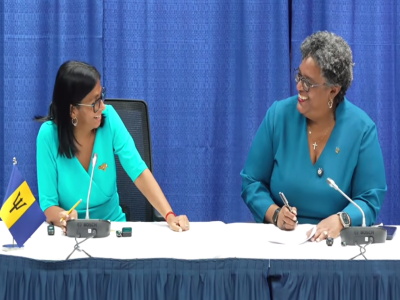
BRIDGETOWN, Barbados – In a landmark diplomatic meeting held this week, the Caribbean island nation of Barbados and the South American country of Venezuela have laid the groundwork for a significantly expanded bilateral partnership, reaching consensus on a sweeping slate of collaborative initiatives spanning energy development, trade expansion, economic integration, and cultural exchange.
Venezuela’s acting President Delcy Rodriguez, who touched down in Bridgetown Sunday evening for the high-level talks, met face-to-face with Barbadian Prime Minister Mia Mottley to hash out the details of the new cooperation framework. Both leaders emerged from the closed-door deliberations praising the productive discussions and shared commitment to deepening ties between their nations.
“April 27 will go down in history as the founding date of modern economic and trade cooperation between Venezuela and Barbados,” Rodriguez told reporters following the talks. She added that negotiations opened new investment opportunities for Barbadian firms in Venezuela’s burgeoning hydrocarbons sector, including invitations for joint exploration and development of the country’s untapped oil and natural gas fields.
Rodriguez emphasized that Barbadian partnership would play a critical role in boosting Venezuela’s domestic hydrocarbon production, while Caracas would in turn deliver long-term, reliable energy security guarantees for Barbados’ population. She also noted that the two sides have identified strong synergies in renewable energy development, outlining a joint plan to manufacture solar panels that would build a fully integrated, diversified regional energy sector. To further catalyze cross-border investment, the leaders agreed to revisit and update existing bilateral agreements covering investment protections and double taxation, creating a more welcoming regulatory environment for businesses from both nations.
For her part, Prime Minister Mottley highlighted that volatile global energy prices have put unprecedented pressure on small island developing states like Barbados, making expanded bilateral energy cooperation a long-held strategic priority. She noted that Barbados’ state-owned National Energy Company, despite its modest size, is well-positioned to enter into joint investment projects in the energy opportunities Venezuela has put forward. These collaborations, she explained, will help Barbados expand its domestic energy capacity, strengthen its resilience to global market shocks, and maintain affordable access to critical energy products for all Barbadians.
Mottley recalled Venezuela’s decades-long track record of supporting Caribbean energy security, pointing to the 1970s San Jose Agreement – a joint initiative with Mexico that stabilized energy access for the entire region during a global oil crisis – and the 1990s PetroCaribe initiative launched by former Venezuelan President Hugo Chávez that delivered discounted oil to dozens of Caribbean nations. In recent years, she added, discussions have focused on continuing this legacy by extending discounted energy supplies to other Caribbean partners where possible. “Over the past five decades, Venezuela has stood as a close, reliable friend to the entire Caribbean on issues of energy security and affordable access to energy products,” Mottley said. “At a moment of profound global energy insecurity, we welcome this opportunity to build cooperation that delivers mutual benefit for both our nations.”
Barbados is pushing to expand energy cooperation beyond fossil fuels to capture the massive potential of renewable energy collaboration, Mottley clarified. From small-scale residential solar water heating systems to utility-scale photovoltaic panels and onshore wind energy development, Mottley said the two sides have identified enormous untapped potential for joint work in the clean energy transition. Mottley accepted an invitation to visit Caracas in the coming months to continue advancing the partnership, noting that the short one-hour flight between the two nations underscores the geographic and strategic proximity that makes cooperation so natural. “We cannot allow historical or language barriers to hold us back from unlocking the full potential of cooperation for our two peoples,” she said. “We aim to build on the strong foundation our predecessors laid, and turn this diplomatic partnership into tangible benefits for ordinary citizens, not just government leaders.”
In addition to energy and trade, the talks yielded a landmark agreement on cultural and linguistic cooperation. Rodriguez confirmed that Mottley has outlined Barbados’ plan to designate Spanish as the country’s second official language, building on the existing work of the bilateral Institute for Cultural Cooperation, which has long offered Spanish language training to Barbadian residents. The two sides have agreed to expand the institute’s capabilities, including integrating new digital learning tools and facilitating exchanges that will bring Venezuelan language instructors to Barbados to provide advanced training for local learners. Rodriguez added that the expanded program will also create opportunities for Venezuelans to learn from Barbadian educators and cultural leaders, creating two-way people-to-people exchange.
The partnership also includes new commitments to advance regional food security, a pressing priority for small import-dependent Caribbean nations. Mottley said Barbados is working aggressively to build a robust domestic agro-processing industry to expand exports, and the new agreement will create new market access for Barbadian agricultural goods in Venezuela. “We are committed to making sure that planes and ships arriving from Venezuela do not return empty – they will carry back Barbadian produce that supports our farmers and manufacturers,” Mottley explained. The two sides also agreed to explore joint agricultural production projects on Venezuelan soil that will deliver food supplies for Barbados, alongside collaborative research and scientific development initiatives to boost agricultural yields. The partnership will focus on addressing the global challenge of declining soil productivity, working together to develop sustainable practices that increase harvests and deliver benefits for farmers across the Caribbean region.
Leaving the meeting, Rodriguez emphasized that both delegations left the talks with high levels of enthusiasm for the new roadmap of cooperation, saying “we are departing this visit extremely happy with the progress we have made.”