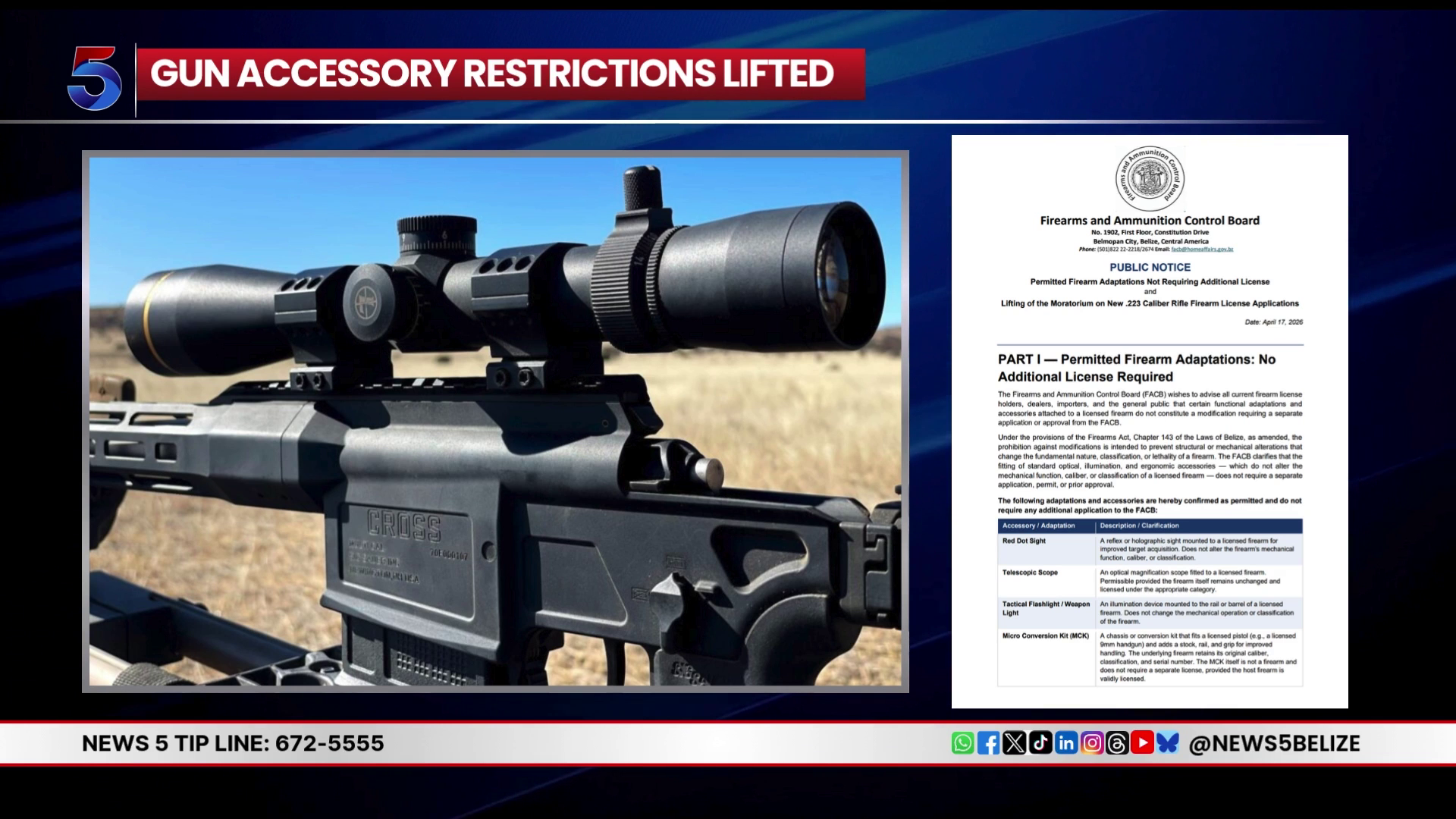
Nearly two years after Belize implemented a controversial moratorium on .223 caliber rifles, the recent decision by the country’s Firearms and Ammunition Control Board to end the ban has reignited fierce discussion over gun regulation and public safety, as the nation grapples with persistent challenges from community gun violence.
Critics of the policy reversal have raised urgent alarms that rolling back this restriction at a time of ongoing safety risks sends a dangerous message to the public, and could open the door to greater proliferation of high-powered firearms that end up in criminal hands. But government officials have defended the move, noting that the rifles fill a critical practical need for the country’s agricultural sector, particularly cattle ranchers who depend on the firearms to fend off predatory animals that threaten their livestock.
Now, Abner Murillo, a prominent Belizean gun retailer and outspoken gun rights advocate who owns Locked ‘n Loaded Guns and Ammo, has waded into the debate, pushing back hard against critics who frame the ban’s end as a threat to public safety. In an interview, Murillo argued that widespread fears over the relegalization of .223 rifles are wildly overblown, and that the original moratorium never had a factual basis to begin with.
Murillo laid out the multiple legitimate, non-criminal uses for the caliber that make it popular among Belizean gun owners: “For the .223 caliber, you have many uses including farm use, recreational use. Many people use it to protect their farms against coyotes or certain animals. You have recreational shooting, you have hunting. They’re excellent for hunting smaller game meat or medium sized game meat.”
Beyond practical utility, Murillo emphasized that there is no evidence linking legally owned .223 rifles to violent crime in Belize, undermining the core public safety justification for the original ban. “And if you once again look at the facts, it has never been a matter of public security because there hasn’t been anything to warrant any concerns of public security. There hasn’t been shootings with licensed .223s. I believe there’s one or two incidents of brandishing since those firearms were introduced to the public here in Belize,” he explained.
Murillo also commended the board’s decision, noting that it was rooted in empirical data and on-the-ground knowledge rather than unfounded public opinion. “I think that the board made a decision based on facts once again and based on actual knowledge and not just personal opinion. So we definitely support the removal of a moratorium that wasn’t necessary in the first place, and there wasn’t anything in the first place to warrant such a moratorium. There is nothing there to say, okay, this is a matter of public security and let’s put a moratorium on it,” he added.
A key detail that has further fueled skepticism of the original 2024 moratorium: when the restriction was first implemented in February 2024, regulators promised a full audit and comprehensive policy review to assess the ban’s impact and justifications. As of April 2026, that audit remains incomplete, leaving the core rationale for the years-long ban unvalidated by official data.
This report is a transcript of an evening television broadcast, with all Kriol-language statements transcribed using a standardized spelling system for accuracy.