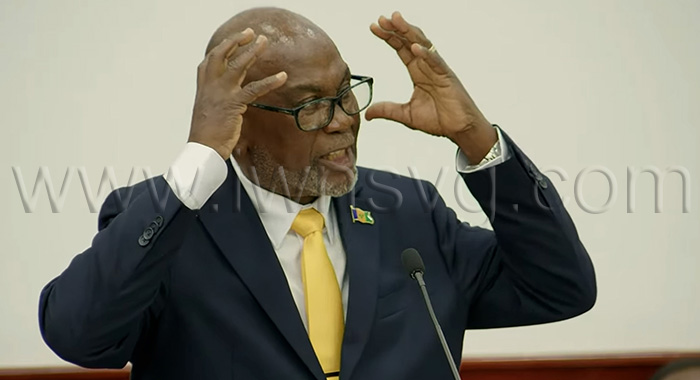
A fierce political debate has unfolded in St. Vincent and the Grenadines’ Parliament over a proposed national security bill, pitting current Deputy Prime Minister and National Security Minister St. Clair Leacock against former Prime Minister and Opposition Leader Ralph Gonsalves. The tension stems from Leacock’s recent startling revelations about the extent of citizen data collected by Gonsalves’ Unity Labour Party (ULP) administration, which held power for 25 years until its electoral defeat in November 2024.\n\nSpeaking during debate on the Advanced Passenger Information and Passenger Name Record Bill on Tuesday, Leacock expressed shock at the types of intelligence that now cross his desk, collected by the previous government. “When I see the things that come across my desk in this role… sometimes I hold my head and ask, ‘Is this the kind of intelligence the former prime minister held on me, my party, and ordinary private citizens during his time in office?’” Leacock told the legislative chamber.\n\nThe bill, designed to strengthen border and national security by standardizing collection and sharing of traveler data, ultimately passed with no formal unified position from the three-member opposition. Gonsalves, a trained lawyer, launched sharp criticism of the legislation, arguing that it reads like an unfinished draft rather than a final piece of law. He raised pointed concerns about gaps in data protection, unclear frameworks for official appointments, and ambiguous timelines for mandatory information submission, also questioning whether the bill had completed required vetting through the CARICOM Legal Affairs Committee (LAC).\n\nLeacock pushed back forcefully against these critiques, framing Gonsalves’ objections as part of a long-standing pattern of authoritarian control over policy. He told Parliament, “If it is not under the suzerainty of the Honourable Ralph Everett Gonsalves, it ain’t good. Nobody is good enough for him unless he presides over it.” The Central Kingstown MP added that as a former prime minister and decades-long national security minister, Gonsalves has a greater national responsibility to avoid undermining the credibility of current national and regional security institutions. Leacock accused Gonsalves of nitpicking over minor drafting details like punctuation to erode public trust in the new government’s work, calling his focus “all semantics” that amounts to an attack on the integrity of public servants.\n\nLeacock further alleged that Gonsalves’ 25-year administration left St. Vincent and the Grenadines with a disjointed, ramshackle national security apparatus that the new government is working to repair. He pointed to port security as a key example: while the previous ULP government installed passenger screening equipment at the main port, it failed to put in place legal mechanisms that would automatically share screening data with police, leaving critical security gaps. On the question of regional vetting, Leacock clarified that the bill was already reviewed by the CARICOM LAC during Gonsalves’ own tenure, and passed through all required regional processes when Gonsalves led the country’s involvement in CARICOM IMPACS, the regional security body.\n\nResponding to Gonsalves’ comment that the current New Democratic Party administration would only serve one term, Leacock framed the remark as evidence of the opposition’s core goal of undermining the new government rather than working for the national good. “It points to a poison that in order for this country to go forward, we must not underestimate the hurdles that remain for us to climb. Your single purpose is to ensure that we become a one-term government,” he said.\n\nIn his rebuttal, Gonsalves rejected all of Leacock’s claims, denying that he had ever criticized or disrespected regional security bodies.\n\nLeacock closed his argument by reaffirming the core purpose of the new legislation: to protect travelers entering and exiting St. Vincent and the Grenadines, boosting public confidence that the country offers both safety and streamlined access for visitors. He noted that any minor drafting imperfections can be corrected through regular governance processes down the line, and there is no justification for delaying the critical security framework the country needs to address modern transnational threats that may outpace the capacity of the outdated system inherited from the previous administration.
Leacock shocked by info ULP gov’t was collecting on citizens (+video)