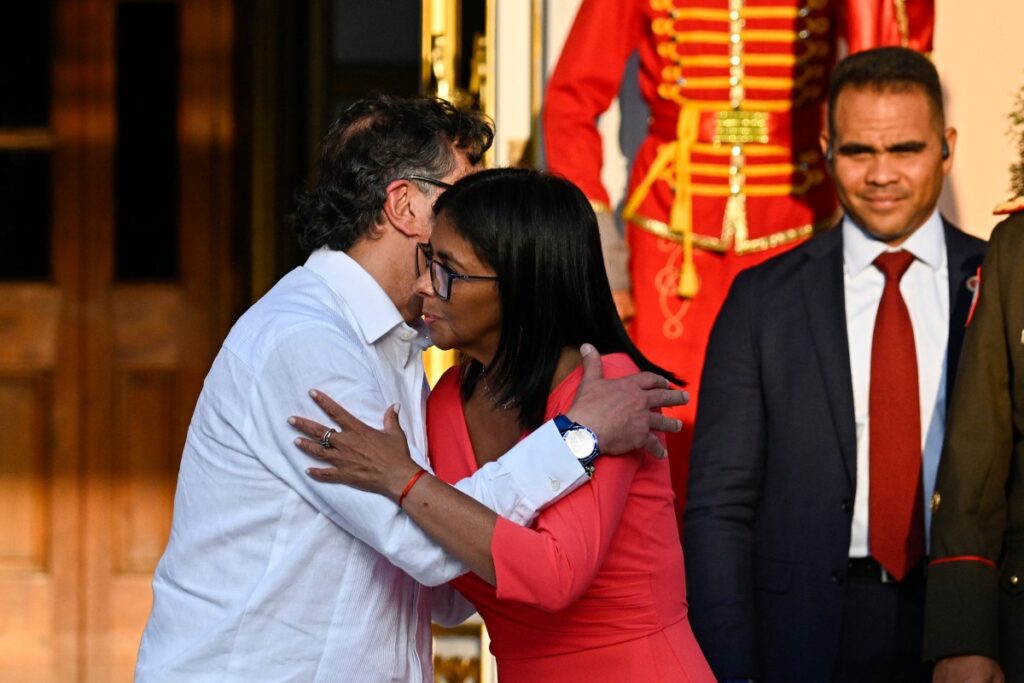
In a landmark moment marking the first foreign leader visit to Venezuela following the ousting of longtime authoritarian ruler Nicolas Maduro, Colombian President Gustavo Petro sat down for high-stakes talks with Venezuelan interim President Delcy Rodriguez in Caracas, where the two heads of state committed to coordinated military action against transnational criminal networks operating along their shared 1,375-mile border.
Rodriguez stepped into the interim presidency earlier this year after a rapid U.S. military special operations raid on the Venezuelan capital on January 3 successfully captured Maduro, the socialist leader who had held autocratic control of the country for more than a decade. Following his capture, Maduro was extradited to New York City to face formal charges related to large-scale drug trafficking.
Speaking to reporters after closed-door negotiations, Petro outlined the core mission of the newly announced partnership: the joint military push will target criminal mafias that have turned the porous border region into a hub for a wide array of illicit economies, with cocaine trafficking, unregulated illegal gold mining, human smuggling, and the illegal extraction of rare earth minerals topping the list of priorities.
For her part, Rodriguez confirmed that the two nations have already begun advancing concrete operational plans to back up the pledge. Beyond joint military deployments, the countries are moving quickly to put in place formal cross-border systems for real-time information sharing and coordinated intelligence gathering to disrupt criminal operations more effectively.
The Trump administration has thrown its full political and diplomatic support behind Rodriguez’s interim government, which has already moved to open Venezuela’s massive untapped oil reserves to development by U.S. energy companies, a major policy shift from Maduro’s long-standing nationalization of the country’s oil industry.
The meeting comes amid long-running tensions between Petro and the Trump White House. Petro, a leftist leader, has openly and harshly criticized the January U.S. military raid that toppled Maduro, prompting fierce pushback from Trump, who has publicly attacked Petro and claimed the Colombian president has failed to take sufficient action to curb drug production within Colombia’s borders.
A planned summit between the two leaders was originally scheduled to take place in March in Cucuta, the major Colombian border city that sits at the heart of cross-border smuggling routes. However, the meeting was abruptly scrapped at the eleventh hour for undisclosed reasons, leaving diplomatic relations in a holding pattern until this week’s visit.
For decades, the border region surrounding Cucuta has been a hotbed of activity for left-wing guerrilla factions and drug trafficking rings, with successive Colombian governments long accusing previous Venezuelan administrations of providing funding and safe haven for these armed groups. Monday’s agreement marks a new chapter in bilateral relations, as both countries seek to address long-standing security challenges that have plagued the border for generations.