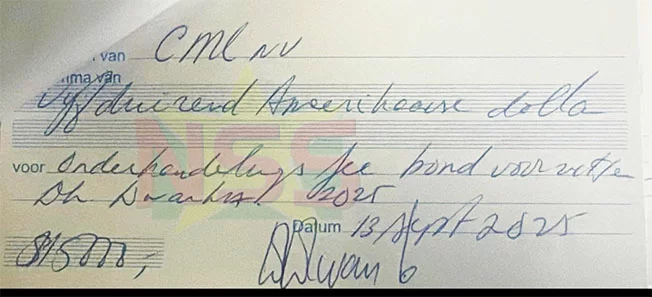
Fresh controversy has emerged at Suriname’s Canawaima Management Company (CMC), a state-owned enterprise, after a whistleblower leaked a receipt to local outlet Starnieuws confirming that union chair Dayanand Dwarka received a $5,000 payment labeled as a negotiation fee.
When contacted for comment on the undisclosed payment, Dwarka did not deny receiving the funds. Instead, he defended the transaction, arguing that such reimbursements are a standard practice during collective labor agreement negotiations.
The union leader explained that the specific negotiations required repeated trips from his home base in Paramaribo to Nieuw-Nickerie, all of which he completed using his personal vehicle and covered travel expenses out of his own pocket upfront. “I used my private car and paid all travel costs out of my own pocket to carry out these negotiations,” Dwarka stated in his response.
He further noted that the International Labour Organization (ILO)’s regulations explicitly allow for this type of cost contribution. Drawing a comparison, he pointed out that travel costs would be even higher if CMC board members based in Nickerie had traveled to Paramaribo via taxi for negotiations, making a cost contribution from the employer a reasonable request.
Dwarka also emphasized his long-standing commitment to the labor movement, noting he has worked voluntarily in the sector for more than 40 years. This case was an exception, he argued, because travel expenses were unusually high: the negotiations were for the first-ever collective labor agreement in the history of the state-owned company, requiring more frequent travel than typical negotiations.
In his closing defense, Dwarka rejected claims that accepting the negotiation fee or potential signing bonus constitutes unethical behavior, framing the payment as a legitimate reimbursement for significant out-of-pocket costs incurred during the negotiation process.