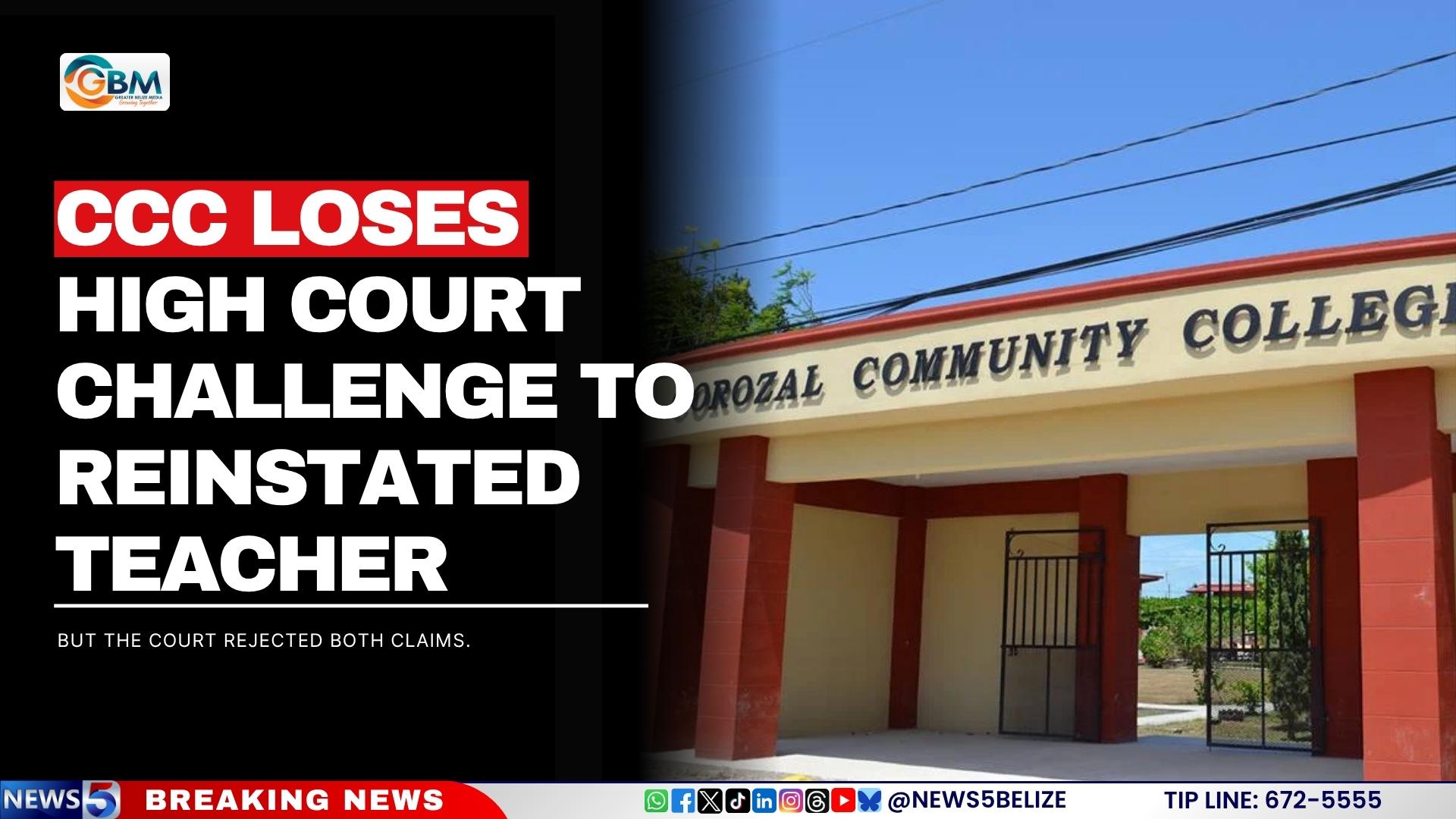
In a landmark ruling delivered in late March 2026, the Belizean High Court has thrown out a legal challenge launched by Corozal Community College (CCC) seeking to overturn a disciplinary tribunal’s decision that reduced a teacher’s penalty from dismissal to a lesser sanction. The outcome leaves the teacher’s reinstatement firmly in place, and has set clear new guidance on the legal standing of unincorporated educational institutions in domestic litigation.
The case stems from a 2025 disciplinary action against Renan Ruiz, a teacher at CCC who was originally fired by the Belize Teaching Service Commission following a finding that he sent inappropriate messages to minor students during out-of-school hours. Ruiz appealed the dismissal to the Teaching Service Appeals Tribunal (TSAT), which in September 2025 revised the penalty. While the tribunal explicitly confirmed that Ruiz’s conduct was unacceptable and violated professional teaching standards, it ruled that permanent termination was an excessively harsh punishment. Instead, TSAT imposed a penalty of one and a half months’ lost pay and required Ruiz to complete mandatory professional counselling, clearing the way for his return to the classroom.
Unwilling to accept the tribunal’s ruling, CCC launched a judicial review challenge, bringing the case before High Court Justice Rajiv Goonetilleke. The college based its challenge on two core legal arguments: first, that TSAT had acted irrationally by slashing the original dismissal penalty, and second, that Ruiz’s initial appeal to the tribunal contained fatal procedural errors that should have invalidated his case entirely.
Justice Goonetilleke rejected both of CCC’s claims out of hand after hearing arguments in the case on March 18 and 20, 2026. On the allegation of irrationality, the justice ruled that the tribunal’s reasoning was legally sound and fell well within the discretionary authority granted to TSAT under education law. “The tribunal’s view cannot be said to be so unreasonable as to be irrational,” Goonetilleke wrote in his formal judgment, noting that the panel had carefully weighed the circumstances of the case and properly evaluated whether a lesser penalty aligned with the severity of Ruiz’s misconduct.
The court also dismissed CCC’s procedural argument, which claimed Ruiz had filed his appeal outside the required 30-day window and that discrepancies on his appeal form invalidated the submission. Evidence presented during the hearing confirmed that Ruiz submitted all required documentation within the statutory deadline after receiving formal notice of his dismissal. Discrepancies between different copies of the appeal form were fully explained to the court, and the explanation was deemed credible, with no finding of procedural irregularity recorded in the judgment.
Beyond rejecting the college’s substantive arguments, the ruling also addressed a foundational legal issue: CCC’s status as an unincorporated educational institution. The court confirmed that as an unincorporated body, CCC holds no separate legal personality, meaning it does not have the legal standing to bring or defend lawsuits in its own official name. While Justice Goonetilleke noted that this finding was not strictly required to dismiss the challenge, he relied on a 2024 Court of Appeal precedent involving the Claver College Extension to address the issue when ruling on litigation costs.
The judge further found that CCC had failed to comply with mandatory procedural rules for bringing a representative action on behalf of its staff and governing body. As a result of the dismissed application, the court ordered CCC to pay all litigation costs awarded to Ruiz, and granted nominal costs of $1,000 to the Teaching Service Appeals Tribunal. In a key final provision, the court ruled that if CCC fails to satisfy the cost award, Ayonie Briceno — the individual who submitted the supporting affidavit for CCC’s challenge — can be held personally liable for the unpaid amount.