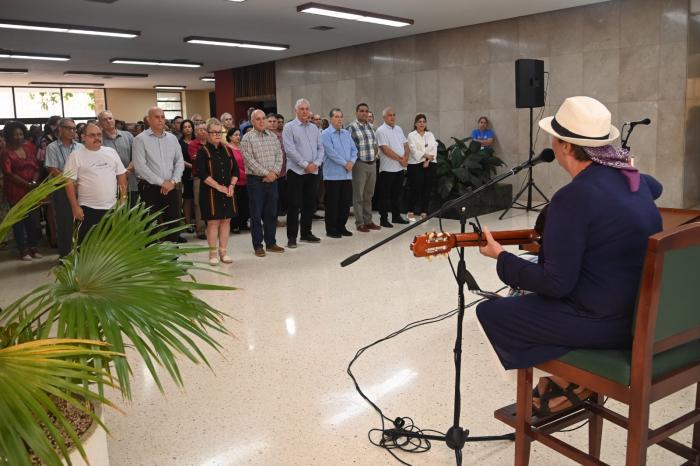
On Wednesday morning, Cuba’s highest political leader, Miguel Díaz-Canel Bermúdez — who holds dual roles as First Secretary of the Central Committee of the Communist Party of Cuba and President of the Republic of Cuba — took part in a solidarity gathering at the Communist Party Central Committee Headquarters to publicly back the growing ‘My Signature for the Homeland’ movement.
The grassroots initiative has emerged as a nationwide call to action, inviting every Cuban to stand together in defense of the country’s revolutionary project and national sovereignty in the face of what Cuban officials frame as external imperial aggression. During Wednesday’s event, both senior party officials and administrative staff based at the headquarters added their signatures to the initiative, which is already circulating through communities, workplaces and public institutions across the entire island.
Díaz-Canel first outlined the movement’s broader ambitions during an April 16 commemoration of the 65th anniversary of the proclamation of the Cuban Revolution’s socialist character. At that event, he stressed that the signature drive should grow beyond Cuba’s borders to become a global solidarity movement, tasked with sharing the unfiltered truth of Cuba’s situation with audiences across the world. This includes raising international awareness of the widespread harm inflicted on the Cuban people by the long-standing U.S. economic blockade, a measure that has been escalated into a multidimensional economic war further tightened by an energy embargo. Díaz-Canel has described this campaign as genocidal, pointing to the severe, widespread deprivation it has imposed on all sectors of Cuban society.
Wednesday’s gathering, which also included attendance from Roberto Morales Ojeda, a member of the Communist Party Political Bureau and Organization Secretary of the Central Committee, is just one of hundreds of similar events rolling out across the country. It follows an initial high-profile signing held April 19 at the Bay of Pigs, a historic site of Cuban resistance to foreign intervention, where Díaz-Canel and other senior leaders of the revolution first put their names to the initiative.
That opening signing ceremony reaffirmed the Cuban nation’s long-standing, unwavering commitment to peace, a core value rooted in the national identity forged through decades of resistance. It also reiterated a principle enshrined in Cuba’s constitution: that standing in defense of the nation is not merely a fundamental right for Cuban citizens, but the highest honor and most fundamental supreme duty of every person on the island.