Against a backdrop of intensified U.S. economic pressure, Cuba has logged notable progress in restoring its National Electric System while laying out a clear, long-term roadmap to achieve full energy sovereignty, according to the nation’s top energy official. In an extensive interview aired on the *Round Table* public affairs program, Vicente de la O Levy, Cuba’s Minister of Energy and Mines, detailed the challenges imposed by the ongoing U.S. blockade, the gains secured by the 2025 national recovery strategy, and the government’s priorities for stabilizing the power grid in 2026.
When the recovery program launched in early 2025, Cuba’s energy sector faced a catastrophic starting point. Of nearly 3,000 megawatts (MW) of installed distributed generation capacity, only around 350 MW were operational at the end of 2024, hamstrung by chronic shortages of spare parts and limited access to international financing. Through targeted, system-wide repairs and strategic resource allocation, the country expanded available distributed generation capacity to more than 1,000 MW by the close of 2025. This gain proved life-saving late in the year when major hurricanes swept through Cuba’s eastern provinces of Granma, Guantánamo, Holguín, and Las Tunas, cutting those regions off from the central national grid. Local distributed generation allowed communities to maintain critical services through the emergency.
In addition to distributed generation, the government prioritized repairing core thermal power infrastructure, bringing Units 3 and 4 at the Céspedes thermoelectric plant and Unit 5 at Santiago de Cuba’s Renté facility back online. Though the return of Céspedes Unit 4 was delayed by planning missteps and substandard maintenance work, it is now fully operational.
One of the most striking shifts over the past year has been the rapid expansion of domestic fuel production and renewable energy integration. New drilling operations have boosted domestic associated gas output, bringing the nation’s gas-fired generation capacity to 370 MW, with a consistent average output of 340 MW running entirely on domestically produced fuel. For renewables, penetration jumped from just 3% at the start of 2025 to 10% by year’s end – a seven percentage point increase in 12 months. When accounting for smaller-scale renewable projects deployed by the private sector, state enterprises, and public agencies, total renewable penetration already reaches 15% across the system, with combined installed capacity and energy savings from renewables hitting roughly 1,700 MW.
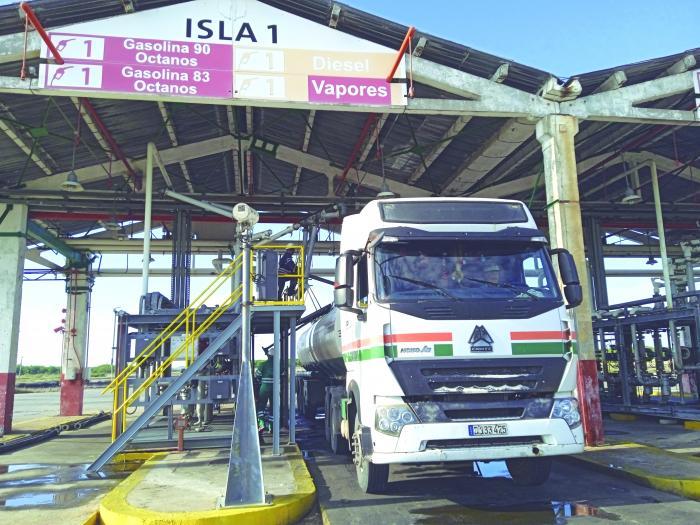
Despite these gains, de la O Levy emphasized that the intensified U.S. blockade, ramped up in January 2026, has created crippling, ongoing disruptions to Cuba’s fuel supply. After the U.S. seized a Cuban-chartered vessel carrying one million barrels of fuel in December 2025, no new fuel shipments arrived until a Russian cargo vessel delivered 100,000 tons of crude in early 2026. Since the January 2026 expansion of U.S. sanctions, which include secondary penalties against third countries that trade fuel with Cuba, most international suppliers have been deterred from doing business with Havana, effectively cutting off most regular import channels. This has left Cuba reliant almost entirely on domestic production and existing stockpiles for months, creating a persistent 600 MW generation shortfall across the national grid. As of mid-April 2026, Cuba is only able to distribute 800 tons of fuel daily, half of the 1,600 tons needed to eliminate widespread rolling blackouts.
To minimize harm to the national economy amid persistent power shortages, the Cuban government adopted a deliberate prioritization framework that reserves available power for critical economic and social sectors. A total of 631 electrical circuits serving key industries, agricultural production, and export-oriented businesses are protected, requiring more than 800 MW of dedicated capacity that is only cut during extreme grid emergencies. This policy has allowed irrigation for major staple crops including tobacco, corn, and soybeans to continue, and keeps export-generating industries operational, even as it means longer and more frequent rolling blackouts for residential consumers.
For 2026, the government’s 62-point action plan – tracked weekly with monthly milestones – focuses on consolidating the gains of 2025 rather than pursuing rapid new expansion, while rolling out key new infrastructure to stabilize the grid. As of April 2026, available distributed generation capacity stands at 1,114 MW, and domestic oil and gas production has reversed years of decline to begin growing again. The most notable new initiative is the deployment of utility-scale energy storage systems, with all necessary equipment already in Cuba and installation underway. The government has also restarted the manufactured cooking gas expansion program for Havana, which was paused due to gas shortages, with a goal of adding 25,000 new residential customers to reduce residential electricity demand.
Cuba’s strategy prioritizes importing crude oil rather than finished refined petroleum products, a choice de la O Levy said is driven by economic efficiency: processing crude domestically produces gasoline, fuel oil, diesel, and liquefied petroleum gas (LPG) all in one facility, cutting the high freight and third-party refining costs that come from importing each finished product separately. Priority for available refined fuel is given to critical social services, including hospitals, public transportation, and medical facilities, while crude oil is reserved for running the nation’s core thermoelectric plants – a necessity to avoid a total national blackout. The recent 100,000-ton Russian crude shipment was unloaded in just 90 hours at an alternate port after draft restrictions prevented it from docking at Cienfuegos, with coastal barges used to transfer the cargo to smaller vessels for refining.
De la O Levy acknowledged that unequal blackout impacts across provinces and unplanned disruptions remain persistent challenges, rooted in structural differences between regional grids and unforeseen events. Provinces with higher concentrations of essential services have fewer non-critical circuits that can be taken offline to reduce demand, meaning local residents face more frequent outages even when allocation formulas are designed to be equitable. Unplanned events, from unexpected thermoelectric plant breakdowns to sargassum blooms blocking cooling water intakes at coastal power facilities, require constant last-minute adjustments to blackout schedules that cannot be fully anticipated.
To address the inherent intermittency of solar and wind power, the government is rolling out large-scale battery storage systems across four major sites totaling 200 MW, with all equipment already delivered to Cuba. The first 50 MW storage facility will allow the country to push total renewable capacity over 900 MW. Even with limited financing, the government has rolled out targeted small-scale renewable solutions to protect vulnerable communities: 15,000 modified solar-only portable power units have been distributed to teachers, medical workers, and households dependent on electricity for life-sustaining medical equipment, while 5,000 fixed solar systems have been installed at critical public facilities including polyclinics, maternity homes, nursing homes, and telecommunications infrastructure.
Looking ahead, Cuba has laid out a three-phase roadmap to achieve full energy sovereignty by 2050. The first phase targets 24% renewable penetration by 2030, rising to 40% by 2035 – a threshold that would allow Cuba to eliminate all fuel imports, saving more than one million tons of fuel purchases annually. The final phase, targeted for 2050, will deliver 100% renewable energy across the entire national system, leveraging Cuba’s abundant natural resources including forest biomass, hydroelectric potential, onshore and offshore wind, and tidal power. Installation of turbine towers has already begun this year at the Herradura 1 wind farm, marking the first step in the next phase of the nation’s energy transition.