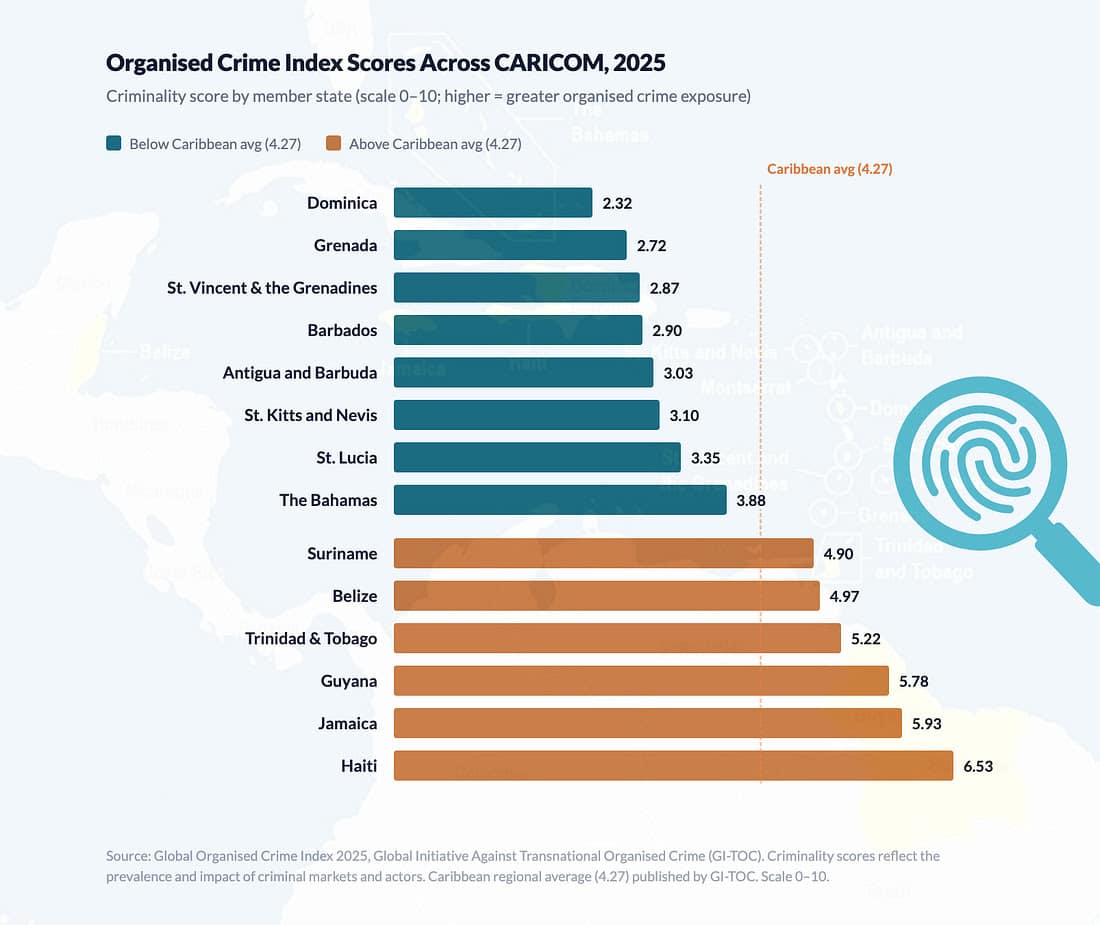
Released by the Global Initiative Against Transnational Organised Crime, the 2025 Global Organised Crime Index has delivered new insights into the distribution of organised criminal activity across the Caribbean, with Antigua and Barbuda emerging as one of the bloc’s lowest-risk jurisdictions. The index ranks nations on a 10-point scale, where lower numerical scores signal weaker infiltration of organised crime networks and illicit activity. Antigua and Barbuda earned a criminality score of 3.03, landing it among the eight CARICOM member states that fall below the Caribbean regional average of 4.27. This performance puts the dual-island nation in a similar risk bracket to regional neighbors Barbados, which scored 2.90, and St. Kitts and Nevis, which notched a 3.10. By contrast, the index marks several Caribbean states as far higher-risk hotspots for organised crime: Jamaica recorded a 5.93, Guyana came in at 5.78, and Haiti topped the bloc with a 6.53, holding the unenviable title of the Caribbean nation with the highest documented criminality level. The 2025 assessment measures the prevalence and societal impact of a range of organised criminal operations, from cross-border drug trafficking to a spectrum of other illicit markets operating across the region. Even with Antigua and Barbuda’s relatively strong standing, the broader Caribbean region continues to face persistent systemic threats tied to global drug smuggling. Geographically positioned along key trafficking routes moving cocaine from producer nations to consumer markets in North America and Europe, the Caribbean ranks as the world’s third-largest transit zone for the illicit drug trade. The index’s final conclusions make clear that while Antigua and Barbuda cannot insulate itself entirely from the organised crime pressures impacting the wider Caribbean, its domestic level of criminal activity remains moderate compared to most of its regional peers.
Antigua and Barbuda Below Regional Average in Organised Crime Exposure, 2025 Index Shows