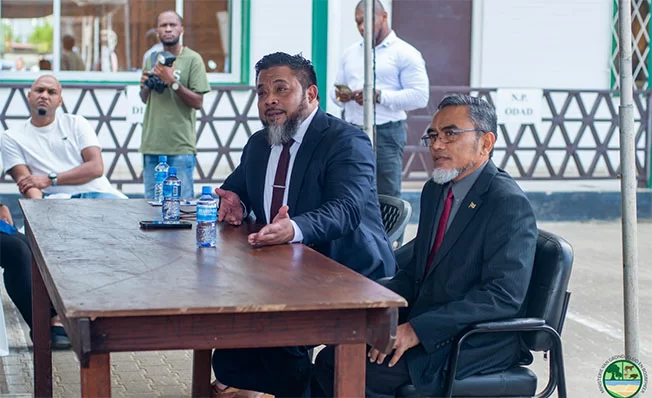
On April 23, a landmark public gathering between senior Surinamese government officials and residents of Mariënburg brought long-simmering land rights issues in the region to the forefront of national policy action, with top leaders announcing an end to delayed talks and the launch of a targeted, case-by-case resolution process.
Thousands of local residents packed the venue of the meeting, held by the Ministry of Land and Forest Management, after years of waiting for formal clarification on their legal land ownership claims. For decades, Mariënburg residents have navigated systemic uncertainty around land tenure, with repeated unfulfilled promises from previous administrations leaving deep public distrust.
Opening the meeting, Minister of Land and Forest Management Stanley Soeropawiro delivered a clear, uncompromising message to attendees: the phase of rhetorical commitment is over, and tangible, on-the-ground action is set to begin immediately. “Let me be perfectly clear,” Soeropawiro stated. “If our government can successfully resolve complex challenges like illegal land occupation, there is no credible reason why the decades-long issues in Mariënburg cannot be fixed.”
Bronto Somohardjo, chair of the Standing Committee on Land Affairs in the National Assembly, echoed the minister’s commitment, drawing a clear distinction between the current administration’s approach and pre-election political performativity criticized by local residents. “We are not here today to play politics,” Somohardjo emphasized. “If that were our goal, we would have followed the same playbook as the VHP: call you in right before an election, hand you a meaningless piece of paper with no legal standing, and disappear. That is not what the people of Mariënburg deserve.”
Instead of empty promises, the ministry has rolled out a new, community-centered resolution strategy: direct documentation collection and individual case assessment. Local residents have been formally called on to submit all relevant paperwork supporting their claims, including land allocation letters, payment receipts, and formal plot boundary information. Officials will review each dossier individually to develop targeted, long-term structural solutions that resolve tenure uncertainty permanently.
Soeropawiro framed the public gathering as an official turning point for the region, saying, “The era of waiting and uncertainty must come to an end. We will now work step by step to deliver clarity, justice, and solutions that last.” The ministry’s core priority throughout this process is to rebuild fractured public trust: rather than relying solely on communication, officials have committed to delivering visible, measurable results that address the community’s decades-old grievances.