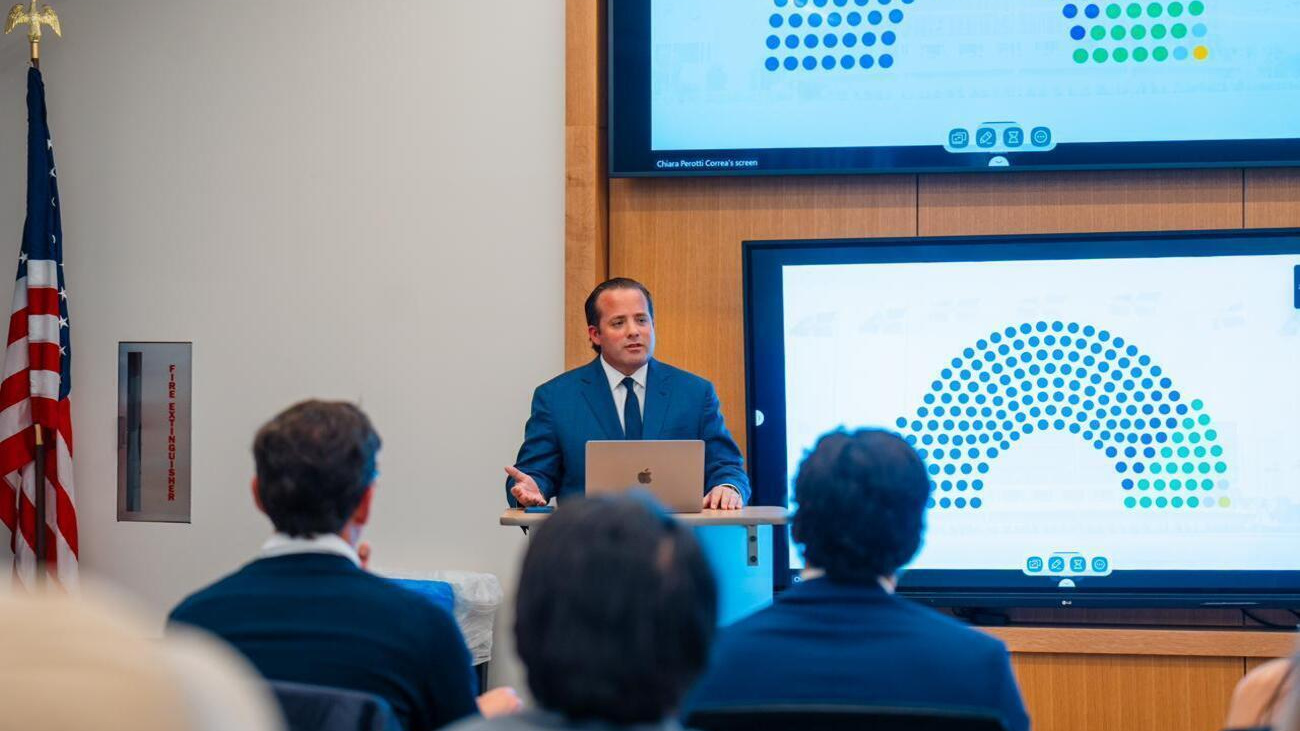
During a high-profile public discussion hosted at Georgetown University’s McCourt School of Public Policy in Washington, D.C., Dominican Republic cabinet minister José Ignacio Paliza has reaffirmed the deep, multifaceted alliance between his country and the United States, framing the northern neighbor as the Caribbean nation’s most critical strategic and bilateral partner.
The event, formally titled “Democracy & Governance: A Conversation with José Ignacio Paliza,” brought together policy scholars, students, and regional affairs experts to unpack interconnected challenges of democratic consolidation and institutional governance across Latin America and the Caribbean. Organized by the Latin American and the Caribbean Policy Association and moderated by seasoned policy analyst Michael Shifter, the conversation centered not only on regional issues but also on the longstanding bond between the Dominican Republic and the U.S.
In his opening and closing remarks, Paliza emphasized that the bilateral relationship stretches far beyond the geographic proximity that naturally connects the two nations. He traced the connection across overlapping historical trajectories, shared democratic commitments, and intertwined cultural identities, noting that the partnership is anchored in common principles and values that guide cooperation across multiple sectors.
A core pillar of people-to-people connection that Paliza highlighted is the large Dominican diaspora settled in the United States. More than 1.6 million Dominican-born and Dominican-descended people reside across the U.S., with heavy concentrations along the Eastern Seaboard. This widespread community, Paliza argued, acts as a living bridge between the two societies, fostering constant cultural exchange, economic ties, and mutual understanding that strengthens the official bilateral relationship from the ground up.
Beyond discussing bilateral ties, Paliza stressed the outsized value of academic dialogue and cross-border collaboration in tackling shared regional challenges. He noted that open conversations between policy practitioners and academic communities, like the one held at Georgetown, create space to identify evidence-based solutions for strengthening democratic institutions, improving public governance, and addressing the most pressing institutional gaps facing countries across Latin America and the Caribbean.