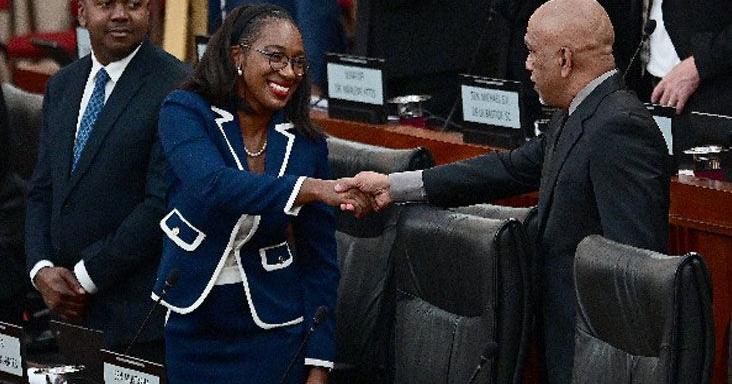
A political shakeup has hit the Trinidad and Tobago Senate, where opposition Senator Janelle John-Bates has been removed from the influential Public Administration and Appropriations Committee (PAAC), with fellow opposition legislator Vishnu Dhanpaul tapped to fill her vacant seat. The personnel change comes amid a heated parliamentary controversy tied to an ongoing PAAC probe into the government’s pharmaceutical acquisition, importation and approval processes.
On Tuesday, Leader of Government Business Darrell Allahar formally presented the PAAC’s explosive special report on the matter during a Senate sitting held at Port of Spain’s Red House, following the document’s initial tabling in the lower house of Parliament last Friday. Both legislative chambers are now scheduled to debate the report, which brings sharp scrutiny to John-Bates’ role in assisting former Health Minister Terrence Deyalsingh prepare his witness statement for the committee inquiry.
Chaired by House Speaker Jagdeo Singh, the PAAC launched the investigation to examine systemic gaps and procedural conduct in how the state procures and approves imported pharmaceutical products. The inquiry was derailed in recent weeks after metadata from Deyalsingh’s April 8 witness memorandum revealed tracked edits directly linked to John-Bates, a sitting voting member of the committee responsible for overseeing the probe. Further digital records indicate she began contributing to the drafting of the document before a key closed-door committee hearing held on March 25.
Speaking to reporters outside Parliament following the report’s tabling, John-Bates acknowledged her conduct and struck a conciliatory tone about her removal. She stated that stepping aside would remove potential distractions and allow the committee’s critical policy work to move forward unimpeded. “I respect that decision. I think it will allow the important work of the PAAC to continue without it being overshadowed by any issue,” she told journalists. When asked about her future as an opposition senator, John-Bates emphasized she would defer to her party leadership’s judgment, adding that any disputed facts should be resolved through proper parliamentary procedure.
John-Bates was not the only opposition legislator linked to the drafting effort: opposition Senator Faris Al-Rawi also contributed edits to Deyalsingh’s statement. When approached by the media for comment Tuesday, Al-Rawi, a practicing attorney, declined to discuss the matter, citing legal professional privilege.
The controversy first came to a head during an April 13 PAAC meeting, where members raised formal concerns that John-Bates’ dual role as a committee investigator and a collaborator with the witness created an untenable conflict of interest that undermined procedural impartiality. In its special report, the PAAC concluded that John-Bates had compromised her duty of impartiality and potentially participated in a conspiracy to commit contempt of Parliament. The document notes that upon being presented with electronic evidence of her involvement, John-Bates admitted to the conduct. The committee warned that her continued membership would make other fellow members uncomfortable and risk eroding the body’s ability to function effectively, and formally recommended her recusal or replacement.
All voting members of the PAAC signed the special report, with one notable exception: opposition MP Camille Robinson-Regis, who submitted a dissenting Minority Report rejecting the committee’s findings and procedural handling of the case. Robinson-Regis pushed back against the PAAC’s claim that John-Bates’ continued presence would disrupt parliamentary work, dismissing the assertion as unsubstantiated speculation that violates constitutional principles of legislative participation. “The Minority rejects, in the strongest terms, the conclusion that the continued involvement of the Member ‘could make other Members uncomfortable to the point of negatively affecting the work of the Parliament’. This assertion is speculative, unsupported by evidence, and constitutionally unsound,” the Minority Report states. Robinson-Regis also warned that the committee’s reasoning sets a dangerous precedent, noting that “Parliamentary participation cannot be curtailed on the basis of subjective discomfort.” She also raised formal objections to the unauthorized leak of confidential closed-door committee proceedings related to the case.
The PAAC has confirmed it will launch a separate parallel investigation into the leak of in-camera meeting materials, and has noted that the broader inquiry into pharmaceutical procurement remains ongoing, with no final conclusions reached yet as the committee continues to collect witness evidence.