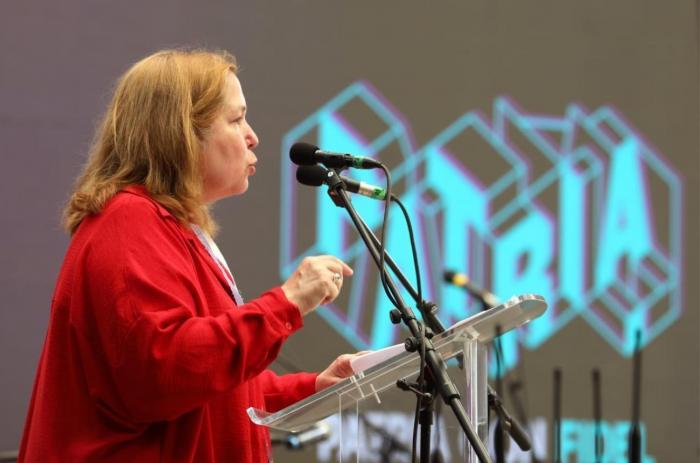
Against the backdrop of escalating external pressure on Cuba, participants at the 5th International Patria Colloquium have issued a united condemnation of unilateral coercive measures and systemic exploitation of digital and economic power, while laying out a collective vision for a more just global information and political order. Held in Havana from April 16 to 18, 2026, the gathering brought together 154 international delegates and more than 3,000 Cuban participants, timed to honor two landmark milestones: the 100th birth anniversary of iconic Cuban revolutionary leader Fidel Castro, and the 65th anniversary of the Bay of Pigs Invasion, widely recognized as the first major defeat of U.S. imperialism in the Americas.
Opening the official declaration, colloquium attendees emphasized the deep political, historical and strategic significance of their assembly, which reaffirms the ongoing relevance of the Cuban Revolution’s emancipatory ideals for communities across the globe.
In an era defined by rapid digital transformation, the declaration frames digital communication as one of the central battlegrounds of modern political, cultural and geopolitical struggle. Contestation over this space, attendees argue, determines not just public narratives, but the future of global power dynamics, competing societal models, and divergent civilizational projects.
A core point of criticism raised by the gathering is the extreme concentration of global informational and technological power in the hands of a tiny group of transnational corporations. These entities control nearly every critical layer of the digital ecosystem: from core infrastructure, global data flows, and advertising systems to cloud services, semiconductor supply chains, major digital platforms, recommendation algorithms, and an increasing share of cutting-edge artificial intelligence development and deployment.
This monopolistic concentration poses grave risks to the global community, the declaration warns. It undermines national sovereignty, erodes global cultural diversity, weakens informational pluralism, and enables new forms of economic, cognitive and political subordination. The result is a cross-border architecture of digital domination that overrides the self-determination of nations, particularly those in the Global South.
Attendees also expressed deep alarm over the weaponization of digital tools for political destabilization. Industrial-scale disinformation campaigns, targeted hate speech, covert foreign influence operations, and algorithmic manipulation have become systematic tools to fracture societies, disrupt domestic political processes, and undermine social cohesion in countries across the world, the declaration notes.
Further, the gathering condemned the integration of digital technologies, AI, automated surveillance systems, and algorithmic frameworks into military aggression, occupation, economic blockades, and psychological warfare campaigns. Participants highlighted the particularly harmful combination of military operations and information domination strategies in ongoing conflicts affecting Palestine, Lebanon, and Iran as a dangerous violation of international norms.
Against these threats, the colloquium affirmed the inalienable right of all peoples to build technological sovereignty, develop independent domestic communication capabilities, cultivate democratic digital ecosystems, and enact regulatory frameworks centered on public interest, social justice, and the protection of collective rights.
To advance these goals, delegates agreed to strengthen the International Patria Colloquium as a permanent collaborative platform connecting journalists, independent media outlets, grassroots activists, social movements, researchers, technology developers, and public officials across the Global South. The platform will enable coordinated action and shared capacity building to counter systemic digital and economic coercion.
Participants also committed to building out a global cooperation network focused on four key priorities: training for practitioners, applied research on digital coercion, coordinated production of independent content, and rapid response capabilities to counter disinformation, manipulation, and hate campaigns. The declaration emphasizes that the global battle for fair information requires organized collective intelligence and sustained, coordinated action.
In line with its people-centered vision, the colloquium expressed support for the development of open, auditable, transparent, multilingual, and culturally adaptive technologies and AI systems. These tools should be oriented toward advancing public goods including education, health, scientific research, culture, and accessible public administration, and centered on empowering people-centered communication rather than private or geopolitical domination.
The gathering closed with a formal call to action for all international organizations, academic networks, popular movements, and peace-aligned states to unite around a shared agenda for a new global information and communications order. This order, delegates argued, must center truth, justice, human dignity, and the fundamental right of peoples to self-determination.
In a dedicated rebuke of long-standing external pressure on Cuba, the 5th International Patria Colloquium issued a firm, categorical condemnation of the United States’ sustained policy of aggression against the island nation. Specifically, delegates condemned the intensification of the decades-long economic, commercial and financial blockade, as well as the imposition of a targeted energy embargo crafted to stifle Cuba’s development and inflict harm on the daily lives of ordinary Cuban people.
These actions are clear violations of international law and the foundational principles of national sovereignty and self-determination, the declaration confirms. Attendees also drew attention to the extraterritorial reach of these coercive measures, which intentionally obstruct Cuba’s access to global fuel supplies, critical technology, and international markets.
In closing, the collective of participants reaffirmed the full legitimacy of the Cuban people’s right to defend their independent social project. They demanded the immediate removal of all unilateral coercive measures imposed on Cuba, and urged the global community to reject all forms of economic warfare that weaponize access to energy and communication as tools of collective punishment against sovereign nations.