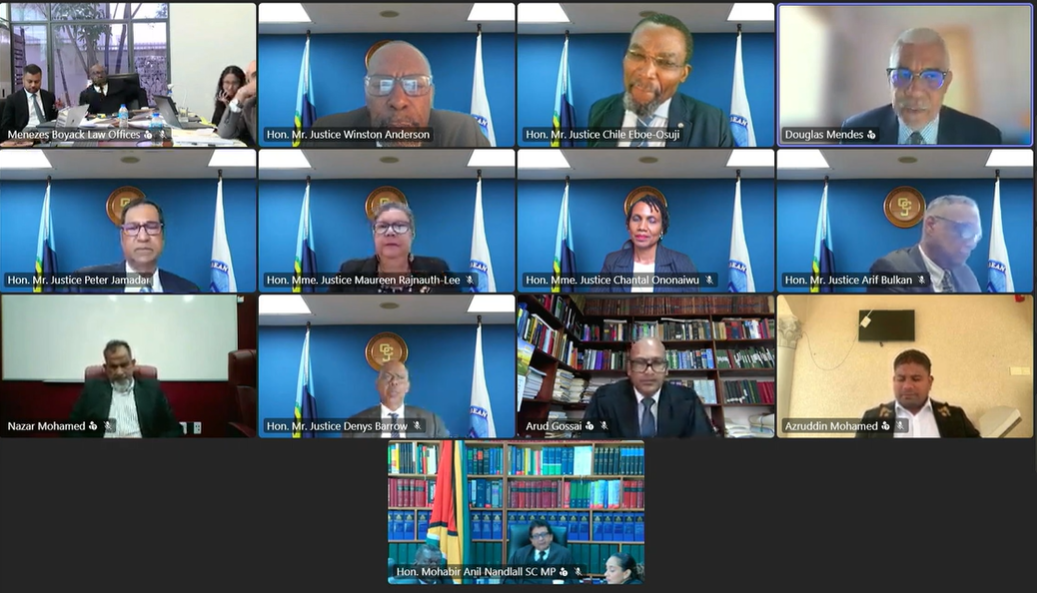
On Tuesday, the Caribbean Court of Justice (CCJ) convened a high-stakes hearing for an appeal brought by Guyanese father-son businessmen Nazar Mohamed and Azruddin Mohamed, who are wanted by United States authorities. The pair is challenging the Authority to Proceed (ATP) issued by Guyana’s Home Affairs Minister Oneidge Walrond, which cleared the way for their extradition proceedings to move forward.
Contrary to common assumptions in extradition challenges, the Mohameds do not oppose the extradition request itself. Their core argument centers on a claim of political bias tainting Walrond’s ATP decision, and they are calling for the current order to be set aside and reassigned to an impartial, unaligned decision-maker. Speaking on the pair’s behalf to the court, lead defense counsel Fyard Hosein clarified that the challenge does not seek to block the extradition process entirely, only to ensure it is overseen by a decision-maker free from perceived political prejudice.
When questioned by CCJ Judge Peter Jamadar on whether remitting the ATP decision to an independent alternative official would resolve their concerns, Hosein confirmed that this outcome would be acceptable. He further added that the defense would not object to the ATP being issued by the Director of Public Prosecutions or a Permanent Secretary, so long as the new decision-maker is free of bias and follows all applicable legal protocols.
The two businessmen are scheduled to stand trial in a Florida federal court on charges of mail fraud, wire fraud, and money laundering tied to their gold trading operations. Prior to their appeal to the CCJ, they have already unsuccessfully challenged Walrond’s ATP before Guyana’s magistrate court, High Court, and local Court of Appeal. The Mohameds argue that Walrond, Attorney General Anil Nandlall, and Vice President Bharrat Jagdeo made public statements labeling them as criminals and attacking them long before the ATP was issued, because the pair are known political opponents of the current administration.
During the hearing, Justice Chile Eboe-Asuji noted that the regional court had reviewed social media recordings of statements made by one of the Mohameds accusing the Guyanese government of corruption. He raised the question of what the pair could reasonably expect from government officials after such open provocation. In response, Hosein pushed back, emphasizing that the court’s focus must remain on the bias of the decision-maker, not political tensions between the parties.
CCJ President Dr. Winston Anderson raised a key procedural question: if the current Home Affairs Minister delegated the ATP authority to another cabinet minister, would the risk of bias not still persist. Defense counsel Roysdale Forde responded that the Fugitive Offenders Act explicitly permits delegation of this responsibility to a non-ministerial public officer, which would resolve that concern. Forde echoed earlier arguments from Hosein, noting that senior government officials including Jagdeo and Nandlall had made public comments about the extradition months before the ATP was ultimately issued on 30 October 2025 — just one day before the Mohameds were arrested and brought before the court.
Forde stressed that the case hinges on protection of fundamental legal rights, explaining that raising the bias challenge after the magistrate issues a ruling on committal, during the habeas corpus phase, would have resulted in unreasonable delay for the pair.
Representing the government of Guyana, attorney Douglas Mendes argued that the Mohameds had already waived their right to challenge the minister’s authority on bias grounds. Mendes noted that the pair sent two formal letters to the Home Affairs Minister, on 6 October and 13 October 2025, well before the ATP was issued, while already aware that an extradition request was pending. Mendes explained that extradition processes inherently include an executive, or high political, component, and the Home Affairs Minister holds statutory discretion to issue or deny the ATP, as well as the final extradition order.
Mendes contended that a member of the executive cabinet must be involved in the ATP decision, rather than delegating the authority to a non-political public officer, who would lack the ability to exercise required political judgment and be held accountable to parliament. If bias against the current minister were confirmed, Mendes argued that the only appropriate remedy would be for the President to reassign the portfolio or appoint an acting Home Affairs Minister temporarily, rather than delegating to a public officer. He added that even if bias were proven, the Mohameds are not entitled to any additional relief, as the court system already has mechanisms to address bias claims through the judicial phase of the process.
Appearing personally before the court, Attorney General Anil Nandlall argued that fair trial principles do not apply to extradition committal proceedings, since no formal criminal charges have been brought in Guyana. This position was immediately questioned by Justice Arif Bulkan, who requested legal authorities to support the claim in light of Guyana’s constitutional guarantee of a fair hearing. Nandlall pushed back, noting that politicians may hold personal biases but can still act fairly and in compliance with the law, adding that the government’s only bias is in favor of its policy of processing legally complete extradition requests once all statutory criteria are met.
At the close of the hearing, CCJ President Winston Anderson announced that no decision date has been set, and the existing interim stay on the magistrate court’s committal proceedings will remain in effect. He reiterated that the court is fully aware of the need to resolve extradition cases in a timely manner.