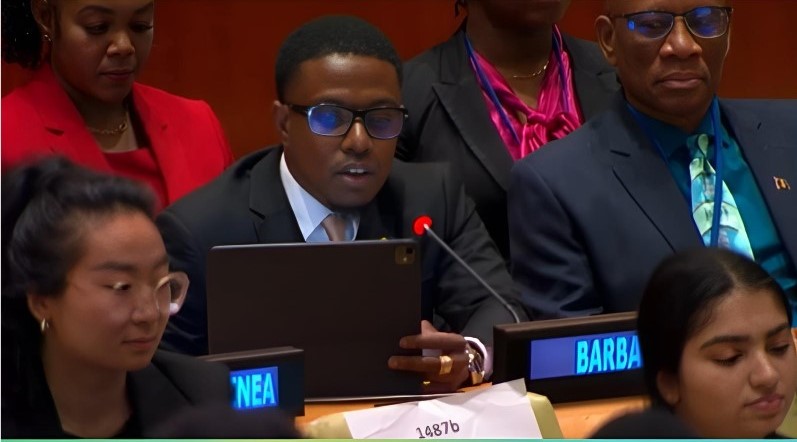
At the 2026 Economic and Social Council (ECOSOC) Youth Forum held at United Nations Headquarters in New York, Senator Shane Archer, Barbados’ Minister of State in the Prime Minister’s Office with oversight for Youth and Culture, has delivered a rousing call to reorient global sustainable development around the unique perspectives and needs of small and developing nations. Archer challenged the long-held assumption that smaller states must merely adapt to outdated development frameworks designed by larger, more industrialized economies, arguing instead that these nations deserve a central, defining role in building new, more inclusive models for industry, innovation, and infrastructure aligned with the UN Sustainable Development Goal 9 (SDG 9).
In his address to the annual forum, which brings together young leaders, UN member states, global institutions, and partner organizations to advance youth participation in the 2030 Sustainable Development Agenda, Archer laid out a reimagined vision for SDG 9. He emphasized that true progress cannot be measured by the quantity of infrastructure or industrial output alone, but by how development tangibly improves people’s daily lives. “When youth, culture, technology and resilience come together, SDG 9 stops being a target on paper and starts becoming a platform for transformation,” Archer stated, delivering the official position of the Caribbean island nation.
Archer broke down his tailored vision for how core development pillars must adapt to the realities of Small Island Developing States (SIDS). For SIDS like Barbados, he argued, industry must go beyond manufacturing goods to create new pathways for economic participation. Innovation should not just be a flashy achievement for wealthy nations, but a tool to solve the specific on-the-ground challenges that smaller states face. And infrastructure, he added, must do more than stand as a physical structure – it needs to connect marginalized and remote communities to opportunity, build climate resilience, and uphold human dignity.
Central to Archer’s proposal is a commitment to equitable access that levels the global playing field for emerging creators and entrepreneurs. He outlined a future where global development frameworks prioritize digital connectivity, universal clean energy access, and modern public systems that empower small businesses and creative workers from Bridgetown, Barbados’ capital, to compete on equal terms with counterparts from large, industrialized economies.
He rejected the longstanding framing of innovation as an exclusive privilege of powerful large nations, asserting that it is a universal right for any country willing to pursue bold thinking, strategic governance, and purpose-driven action. Furthermore, Archer called for a broader definition of industry, one that values the intellectual, cultural, and creative talent of a nation’s people as much as traditional output from assembly lines. “This is where Barbados has something real to say,” he noted, highlighting the unique perspective small island nations bring to global development conversations.
The annual ECOSOC Youth Forum was created specifically to elevate youth voices in UN policy debates, giving young leaders a global platform to share collective ideas, showcase problem-solving innovations, and deepen cross-stakeholder collaboration to speed progress on all 17 SDGs. The 2026 iteration centered its agenda on driving transformative, fair, creative, and coordinated collective action to advance the 2030 Agenda for Sustainable Development, making Archer’s intervention on behalf of small states a timely addition to the forum’s core discussions.