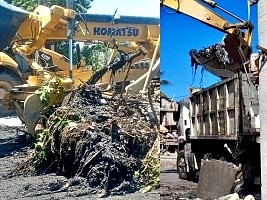
In the wake of destructive torrential downpours that battered Haiti’s capital and multiple regional areas across the country, the nation’s Ministry of Public Works, Transport and Communications (MTPTC) has launched a large-scale emergency mobilization to mitigate damage and protect at-risk communities.
With heavy rains having severely stretched Haiti’s already fragile infrastructure and pushed vulnerable populations into heightened danger, the MTPTC has restructured its operational priorities to center urgent, life-saving interventions. The ministry has paused lower-priority long-term rehabilitation projects to reallocate labor and resources to three core emergency tasks: dredging flood-prone water canals, clearing blocked roadways, and delivering direct aid to communities facing the most severe risk.
On-the-ground operations are already underway across hard-hit zones. In the Carrefour Rita district, crews are actively dredging the Brisetout canal to expand its water capacity and reduce the threat of catastrophic flash flooding. Intensive dredging and manual debris clearing are also progressing in the Gonaïves Station area, as well as along Lamarre and Lamartine streets in Port-au-Prince, Haiti’s capital.
On National Road #3, a critical transportation artery near Morne Granjil, rapid response teams from the North Departmental Directorate of Public Works acted quickly to address a major landslide that blocked the route. Crews cleared fallen rock and dirt, removed damaged infrastructure, and righted overturned trucks, allowing traffic to resume on the key route within a short timeframe and avoiding a prolonged shutdown that would have disrupted supply chains and emergency access.
In the country’s Northwest department, crews continue working to reopen road access to the community of Anse-à-Foleur, while the vital connection between Port-de-Paix and Saint-Louis-du-Nord was restored rapidly after storm damage. In Haiti’s South department, the road leading to Jérémie remains cut off near Roseau amid extremely challenging conditions, but response teams have maintained full commitment to clearing the route and restoring traffic as quickly as possible.
Beyond immediate emergency response, ministry officials have noted that the severe alluvial sediment buildup and frequent landslides impacting downstream areas are rooted in decades of inadequate environmental management across the country. To address the root cause of repeated flood and landslide disasters, the MTPTC is calling for a strategic shift to upstream, sustainable solutions centered on improved watershed management to prevent future crises.
To advance this long-term resilience goal, the MTPTC has established close coordinated working partnerships with multiple government stakeholders, including the Ministry of the Environment, the Ministry of the Interior, the State Secretariat for Territorial Communities, the Directorate General of Civil Protection, and the National Emergency Response Service (SNGRS).
In a statement, the Haitian government emphasized that emergency response and long-term resilience cannot be achieved by public authorities alone. “This response cannot be complete without everyone’s involvement,” the statement read. “The Government calls for collective mobilization, because it is through unity, shared responsibility, and solidarity that national resilience is built.”