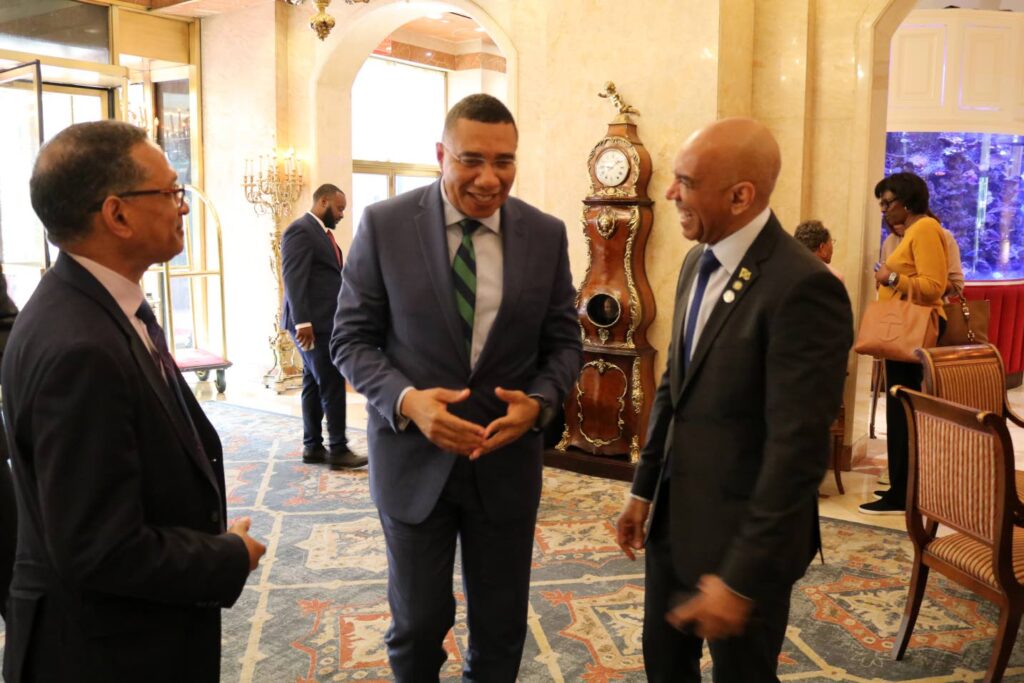
Jamaica’s Prime Minister Dr. Andrew Holness has publicly reaffirmed that the Caribbean nation is actively considering bringing skilled workers from international markets to address a critical labor gap that threatens to derail the country’s post-disaster reconstruction and long-term economic growth agenda after Hurricane Melissa.
Speaking at the one-day Recover Better Conference, hosted by Jamaica’s Consulate General in New York last Thursday, Holness framed the incoming labor question not as a matter of if Jamaica would turn to overseas workers, but when. The gathering was convened to unite Jamaican diaspora members and key industry stakeholders to mobilize cross-border capital, professional expertise, and collaborative partnerships to support recovery efforts after the Category 5 storm that swept across portions of the island last October, leaving widespread destruction in its wake.
One of the conference attendees, David Mullings, founder and CEO of Blue Mahoe Capital – a leading Jamaican housing developer with active projects across the island – laid bare the severity of the skilled labor shortage for the country’s construction and development sectors. Mullings, whose firm raises capital from U.S. investors, recently completed a 700-unit residential development in Old Harbour, St. Catherine, valued at US$17.5 million, and is currently preparing for an initial public listing on the Nasdaq stock exchange.
Mullings told the audience that he recently polled one of Jamaica’s largest affordable housing developers on the single biggest barrier to scaling operations, even with unlimited access to new capital. The overwhelming answer, he confirmed, was a lack of available skilled workers. “No matter how much capital we inject into the market, even if we have all the construction materials, all the structural steel, all the operational systems we could need, we still can’t move projects forward at the pace we need,” Mullings added.
In response, Prime Minister Holness outlined the structural context driving the labor shortage: Jamaica currently holds a 3.5% national unemployment rate, meaning the country has effectively reached full employment – a historic milestone that has been sustained for nearly a decade. Even with this record low unemployment, the national labor force participation rate sits at roughly 67%. Holness explained that the gap does not reflect a lack of working-age people, but rather structural barriers: many working-age adults remain out of the workforce to fulfill unpaid care responsibilities for family members, while a large share of unemployed workers lack the specialized skills required for open construction and development roles.
“This is the first time we have hit this mark in our history, and it is not a temporary blip – we have maintained near-full employment for almost 10 years, which means labor scarcity is a persistent, structural challenge we have to address,” Holness told delegates. “We do have people who can work, but many are tied up in the unpaid care economy, staying home to care for family, or are not choosing to enter the formal labor market. At the same time, we still have a large group of people who are out of work or unemployable specifically because they do not have the specialized training that industries need. Our first job is to bring those people into training programs to prepare them for these roles.”
Holness emphasized that the Jamaican government will put local workers at the center of all policy planning around labor, even as it moves forward with plans to allow targeted overseas labor inflows. “There is a vigorous national debate around importing labor right now, so let me be perfectly clear: the government’s top priority is upskilling and empowering Jamaican workers first. But we cannot afford to turn down critical economic opportunities while we train our local workforce. While we scale up training programs, we may need to adopt strategic, targeted measures to let industries access the skilled labor they need to keep operating and growing.”
If overseas workers are brought in, Holness mandated that any scheme must include a mandatory skills transfer component, to ensure local workers learn new specialized skills from incoming laborers and can eventually fill the gaps permanently. “This is not a plan to bring foreign workers in to permanently take local jobs,” he explained. “It is a temporary measure to keep projects moving while we train our own people to step into those roles over time.”
Looking beyond the immediate post-hurricane recovery, Holness argued that Jamaica’s long-term development vision cannot be achieved with the country’s current population of 2.8 million. To build a thriving nation that attracts people to live, raise families and retire, Holness said Jamaica should plan to grow its population to between 5 and 7 million, which will require proactive immigration and labor policies paired with investments in governance, public safety, healthcare, and infrastructure. “That is the future we are building. But we always remember: we build first for Jamaicans, so that Jamaicans can thrive. It is that prosperity and happiness that creates the open, welcoming culture that lets us embrace new people who come to join our nation.”
Holness closed by reaffirming the government’s commitment to scaling up local skills training, but stressed that delaying action on the skilled labor gap would cost Jamaica critical economic growth opportunities that cannot be recovered. “We are ramping up our training efforts, but we cannot keep passing up the economic opportunities that are right in front of us just because we lack skilled workers in key sectors right now,” he said.