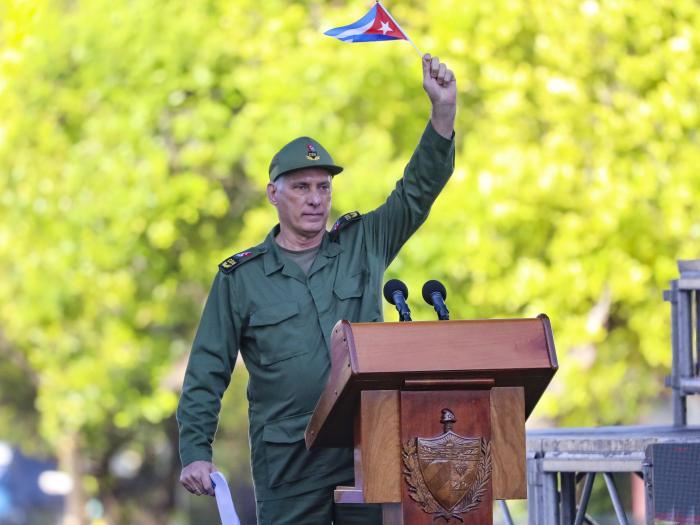
HAVANA, CUBA – On April 16, 2026, marked the “Year of the Centennial of Commander-in-Chief Fidel Castro Ruz”, Miguel Mario Díaz-Canel Bermúdez, First Secretary of the Central Committee of the Communist Party of Cuba and President of the Republic of Cuba, addressed a massive crowd gathered at the iconic intersection of 23rd and 12th Streets in Plaza de la Revolución. The event commemorated the 65th anniversary of the 1961 declaration that formally established the socialist character of the Cuban Revolution, a historic turning point that reshaped both the nation and global political dynamics.
Opening his speech with resonant rallying cries – “Long live free Cuba!” and “Down with the blockade!” – Díaz-Canel turned to the foundational events of April 1961, when a generation of Cubans, many younger than the crowd assembled before him, gathered at the very same plaza as U.S.-backed mercenary forces prepared to invade the island at the Bay of Pigs. With the full military and political backing of the United States government behind the invading force, Fidel Castro Ruz, exhausted from hours of sleepless tension, stepped forward to publicly proclaim Cuba a socialist revolution, rooted in the demands of the dispossessed, operating defiantly at the doorstep of the world’s most powerful empire.
That bold declaration set an irreversible course for Cuba’s revolutionary project, Díaz-Canel recalled. In less than 72 hours after the invasion began, a newly independent, outnumbered Cuban people defeated the mercenary force, dealing imperialism its first major military defeat in the Americas. That victory, he emphasized, opened a path to greater freedom for all peoples across the region, and transformed Cuba forever.
In the decades following that momentous April day, Díaz-Canel traced Cuba’s progress under socialism: from the landmark Literacy Campaign that brought education to the poorest communities, to advances in human development that turned working-class children into global leaders – including Latin America’s first cosmonaut, born to a shoe-shiner under the pre-revolution capitalist system. He highlighted Cuba’s longstanding commitment to international solidarity, noting that the island has shared its expertise with marginalized and oppressed nations across the globe, sending doctors and teachers to fight apartheid, illiteracy, and preventable disease, rather than sending weapons and bombs. This, he argued, is the core of Cuban socialism: a system rooted in fraternity, not exploitation.
Díaz-Canel also reflected on the severe trials Cuba has faced, particularly after the collapse of European socialist bloc in the 1990s. While global powers pushed for unregulated neoliberalism and mass privatization, Fidel Castro led the Cuban people in a superhuman struggle to preserve their sovereign socialist project. Through the resistance and creativity of ordinary Cubans, and the labor of the Cuban people’s army that turned to building and sowing when crisis hit, Cuba survived and rebuilt, proving that its socialist system could adapt and endure. Díaz-Canel quoted Raúl Castro’s iconic declaration: “Yes, we can!” – a promise the Cuban people have kept time and again.
For more than six decades, beyond open military aggression, Cuba has faced a sustained, silent war waged from abroad: a decades-long U.S. blockade, codified in law, reinforced by terrorist attacks, disinformation campaigns, and constant sabotage of regional integration and international cooperation projects. One of the costliest outcomes of this aggression, Díaz-Canel argued, is the loss of thousands of skilled young Cubans, educated for free through the Cuban public system, who are lured away by capitalist economies that did not invest in their training, then falsely claim Cuba’s system fails to deliver opportunity. Díaz-Canel pushed back firmly on this narrative: “That human potential, which impresses and gains ground and relevance in any country it reaches, was shaped by socialism! Only socialism turned the children of workers and peasants into top-tier professionals – not in exceptional cases as under capitalism, but on a massive scale.”
He rejected the widespread international narrative that frames Cuba as a “failed state”, arguing this framing is a deliberate deception to hide the genocidal impact of the 60-year U.S. blockade. The scarcity of essential goods, fuel shortages, and widespread economic strain that shape daily life in Cuba today are directly the result of this ongoing blockade, which acts as a noose around the neck of the Cuban economy. While the Cuban government acknowledges its own mistakes in building a unique, homegrown socialist project, Díaz-Canel stressed no one can deny the blockade’s primary responsibility for the suffering of Cuban families: “The main cause of our problems is the genocidal blockade imposed by the United States government against our people!”
Díaz-Canel pushed back on global anti-communist narratives that seek to erase the transformative contributions of socialist experiments to global human progress. He noted that the USSR’s colossal contribution to defeating fascism and advancing space exploration can never be erased, just as the extraordinary development of China, lifting hundreds of millions out of poverty, and the dynamic growth of heroic, revolutionary Vietnam can not be denied. For Cuba, he said, socialism remains the only guarantee of social justice, the only path to collective emancipation, and the only framework that allows Cubans to mount a collective response to the collective punishment they have endured for decades. “Cuba is not a failed state; Cuba is a besieged state, Cuba is a state facing multidimensional aggression: economic war, an intensified blockade, and an energy blockade,” he declared. “Cuba is a threatened state that does not surrender! And despite everything, and thanks to socialism, Cuba is a state that resists, creates, and – make no mistake – a state that will prevail!”
The 65th anniversary commemoration also marks the founding of the Communist Party of Cuba, which was forged in the heat of the Bay of Pigs invasion. Díaz-Canel noted that the aggressive tactics used by imperial powers against Cuba in 1961 – false-flag air strikes, disinformation campaigns, economic war, diplomatic isolation – are the same tactics repeated in interventions across the globe today. Yet despite the overwhelming technological, military, and media power arrayed against Cuba, global solidarity for the island continues to grow, a clear rebuke of the suffocating imperial policy aimed at bringing Cuba to its knees.
From the historic plaza where Fidel’s calls to resistance still echo, Díaz-Canel called for a global movement of solidarity to spread the truth about Cuba’s current crisis. He detailed the daily suffering brought by the intensified energy blockade, which leaves Cubans facing hours-long blackouts that disrupt work, rest, and daily life, and paralyzes industries, transportation, and essential public services. All of this, he noted, stems from a decades-old executive order that falsely frames Cuba as an “unusual and extraordinary threat” to the United States.
Díaz-Canel emphasized that the current challenging moment requires the same unity and readiness Cubans showed in 1961. While Cuba remains committed to dialogue and peace, and rejects unnecessary conflict that would bring suffering to both the Cuban and American peoples, the island has a duty to prepare to defend its sovereignty. “We do not want it, but it is our duty to prepare to prevent it and, if it is unavoidable, to win!” he said, noting that the faith in victory instilled by Fidel Castro remains unbroken among the Cuban people.
As 2026 marks the centennial of Fidel Castro’s birth, Díaz-Canel paid tribute to the iconic revolutionary leader, who did not merely lead the Battle of Bay of Pigs, but embodied its defiant spirit: “Fidel was and is Bay of Pigs!! Fidel embodies the conviction that a united people can defeat an empire!”
The current daily resistance to foreign aggression, Díaz-Canel said, is the modern epic Cubans are writing, the most fitting tribute to the revolutionaries who gave their lives for independence and socialism in 1961. He closed with a defiant reaffirmation of Cuba’s commitment to its socialist project: “The socialist nature of our Revolution is not a phrase from the past; it is the shield of the present and the guarantee of the future! Bay of Pigs is today and forever! Cuba will not surrender! Long live the rebellious dignity of our people! Long live Socialism! Homeland or Death! We shall overcome!”