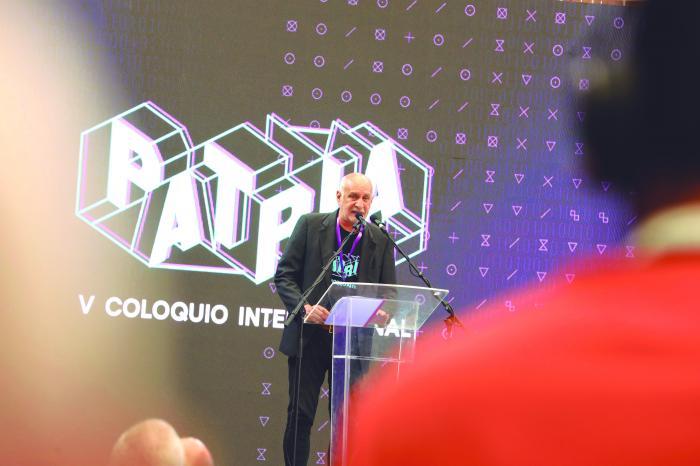
Against a backdrop of rising neo-fascist mobilization, systemic media manipulation, and a resurgence of imperial intervention across Latin America, the fifth edition of the Patria International Colloquium has opened its doors in Havana, casting digital communication as a critical frontline battle for sovereignty and truth.
Hosted through April 18 at Havana’s Cultural Station on the corner of Línea and 18th Street, the 2026 gathering brings 150 delegates from more than 20 countries together to build collective capacity for truth-telling, cross-border organizing, and cultural resistance against coordinated global media campaigns. Cuban President Miguel Díaz-Canel Bermúdez, who also serves as First Secretary of the Party’s Central Committee, attended the opening ceremony on Thursday alongside other senior political leaders including Political Bureau members Roberto Morales Ojeda and Bruno Rodríguez Parrilla, plus representatives of domestic journalists’ networks and civil society organizations.
At the core of the event’s mission is the goal of establishing a permanent global hub that unites critical scholarship, technological innovation, and grassroots communication practice, with Havana serving as the epicenter of the Global South’s pushback against media operations designed to erode domestic social consensus and criminalize national sovereignty. This year’s colloquium is officially dedicated to the legacy of Cuban revolutionary leader Fidel Castro.
Opening remarks were delivered by Ricardo Ronquillo Bello, president of the Union of Cuban Journalists (UPEC), who condemned the decades-long U.S. blockade of Cuba as a “calculated and genocidal evil” that has pushed the island nation to its economic limits. Despite severe economic strains and required national adjustments, Bello noted that the revolutionary leadership made the deliberate choice to continue hosting the colloquium – which is funded primarily by participant contributions – as a demonstration of shared solidarity with progressive movements across the globe.
Bello called out what he terms “communicational violence,” a strategic tool that disguises and enables other forms of physical and structural violence by shaping public narrative to serve dominant power interests. He highlighted that systematic, layered disinformation is now woven into the DNA of modern geopolitical campaigns, pointing to recent coordinated media offensives against Venezuela, Iran, and Cuba as clear examples. In line with Fidel’s legacy, he urged delegates to build a permanent, universal global coalition he termed “Operation Truth,” framing the colloquium as preparation to defend Cuba against what he called the “21st-century communications Bay of Pigs.” Closing his remarks, he echoed Cuban icon José Martí’s defining phrase: “Patria is humanity.”
International solidarity messages poured in from global leaders and media figures. Maria Zakharova, spokesperson for the Russian Ministry of Foreign Affairs, emphasized in a written address to participants that growing toxicity and misinformation in the global information space have made cross-national collaboration to counter disinformation, public opinion manipulation, and unauthorized information exploitation more urgent than ever.
Zakharova described the Patria Colloquium as a vital platform where journalists, bloggers, academics, diplomats, and public figures can collectively stand for factual truth, intellectual freedom, and the right of every nation to define its own homeland without adhering to foreign-imposed norms. She reaffirmed the deep fraternal and strategic bonds between Russia and Cuba, noting that both nations share core commitments to national sovereignty – including digital sovereignty – a multipolar global order, respect for international law, and the centrality of the United Nations in global conflict resolution.
Ghassan Ben Jeddou, president of the Al Mayadeen media network, also sent a digital message praising Cuba’s decision to move forward with the gathering despite the ongoing economic blockade that he described as a criminal, sadistic siege and fundamental violation of human rights. Jeddou underscored that the world is undergoing deep structural political and strategic shifts, and called for stronger coordinated, independent communication networks rooted in the Global South, built through inclusive joint mechanisms that center the priorities of Global South peoples.
Throughout the first day of programming, panel discussions centered on the threats to national autonomy posed by Western digital hegemony. During a session on “Cultural Hegemony and Cultural Power” attended by President Díaz-Canel, Alina Duarte, a Mexican professor and political analyst affiliated with Latin American alternative media, argued that for decades, global powers have pushed a single narrative that frames neoliberal capitalism and U.S. imperialism as the only viable path for global development – but that movement leaders across the Global South are now writing the story of a new, more just world order.
Duarte called for radical, intentional action in both thought and communication practice, arguing that every writer, every mobile device, every public voice can contribute to building this new, socialist future. She also raised alarms about the role of corporate social media algorithms, which she said have groomed generations of young people to prioritize personal validation, individualism, and ego over collective action, warning of the rise of “digital extractivism” that turns users’ free time into unpaid labor for platform giants that control what information reaches the public.
Brazilian journalist Renato Rovai, a leading voice for critical media analysis in his home country, expanded on the conversation about the structure of digital power and its impact on 21st-century political and cultural discourse. Rovai noted that traditional analysis of political discourse focuses only on content, but power today is no longer just about what is said – it is about how content is distributed. “All of us here can speak, but who will listen? And who gets to shape what reaches the public?” he asked.
Rovai identified major global tech platforms as the new gatekeepers of global public discourse, displacing the historic role of human editors who once determined which stories gained traction. “Today, the recommendation algorithms built and controlled by platforms decide what content gets shown to users,” he explained. He pointed to the shifting ideological alignment of Meta founder Mark Zuckerberg, who he noted once positioned himself as a progressive neoliberal but has shifted sharply to the extreme right to cement his alliance with the U.S. government. “The new global hegemony is held by a small group of actors that dominate global public opinion. There is a deliberate architecture of digital power that controls what we see and think,” he concluded.
The opening day’s afternoon programming included two additional sessions: “Technopolitics: Between Control and Emancipation,” which explored the risks of technological dependence for Global South nations, the implications of artificial intelligence for public discourse, and the fight to defend social media as a space for sovereign organizing; and a roundtable focused on the role of critical thinking in shaping a fairer new global information order.