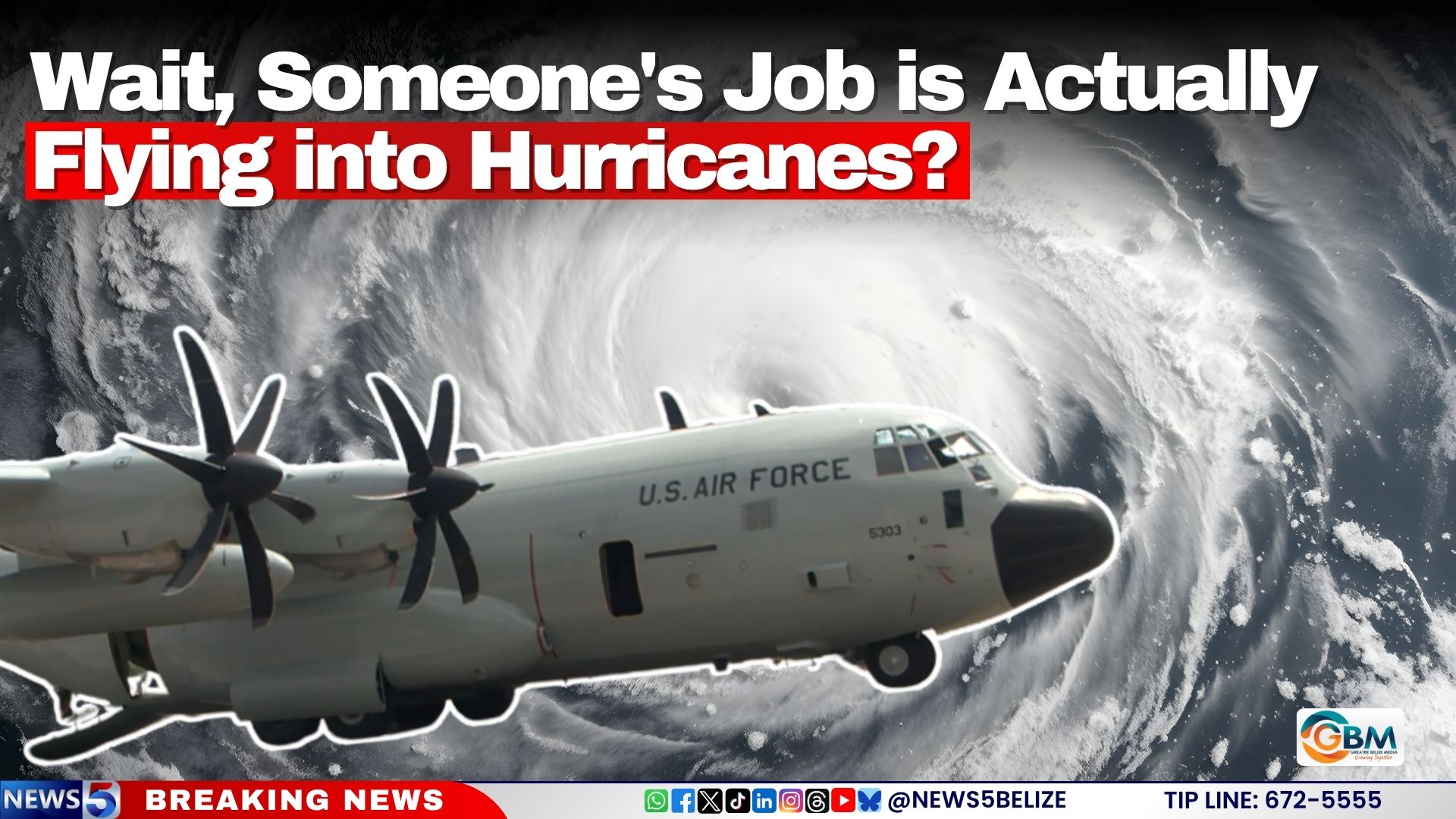
Against the backdrop of annual Atlantic hurricane season preparations, a unique team of daredevil aviation specialists known as the Hurricane Hunters has touched down in Belize, bringing one-of-a-kind storm-tracking aircraft as a key stop on the 2026 Caribbean Hurricane Awareness Tour.
Jordan Mentzer, an experienced pilot with the Hurricane Hunters, explained that the tour blends three core goals: raising public knowledge of hurricane risks, strengthening regional preparedness, and engaging local stakeholders while opening the specialized aircraft to public tours. For the teams that regularly fly directly into the core of active hurricanes, the outreach mission is just as important as the data collection work they carry out during storm season.
Unlike satellite observation, which can only track storm systems from space, these reinforced aircraft fly directly into the heart of hurricanes to gather hard-to-access atmospheric measurements that satellites cannot capture. The real-time data they collect is fed directly into forecasting models used by every national meteorological service across the Caribbean, helping forecasters refine predictions of storm track, strength and landfall timing.
Having flown these dangerous missions for decades, Mentzer noted that the team has built up decades of knowledge to operate as safely as possible in the extreme conditions of a hurricane. “We have learned which maneuvers work, what hazards to avoid, and how to navigate storm systems with the highest possible level of safety we can achieve,” he said.
Robbie Berg, a warning coordinator meteorologist at the U.S. National Hurricane Center, emphasized that the in-storm data collected by the Hurricane Hunters is irreplaceable for life-saving forecasting. “Having these aircraft is absolutely critical to our work,” Berg explained. “They deliver observations directly from the center of the storm, so we can pin down exactly how strong the hurricane is, where it is positioned, and what its central barometric pressure is. That detail is what allows us to produce far more accurate forecasts that help communities prepare and evacuate on time.”
During the Belize stop, local government officials and dozens of students got a rare, close-up look inside the converted aircraft, which doubles as a flying atmospheric research laboratory. Henry Charles Usher, Belize’s Minister of Public Service and Disaster Risk Management, highlighted that including Belize in this year’s tour carries long-term meaning beyond immediate preparedness. He noted that initiatives like this can spark interest in STEM and emergency management careers, helping cultivate “the next generation of Belizean scientists, pilots, meteorologists, and engineers” who will lead the country’s climate and disaster resilience efforts in the coming decades.
Local outlet News Five has announced it will air a full, in-depth walkthrough of the Hurricane Hunters’ aircraft during its 6 p.m. newscast tonight, inviting audiences to tune in for a closer look at the unique mission.