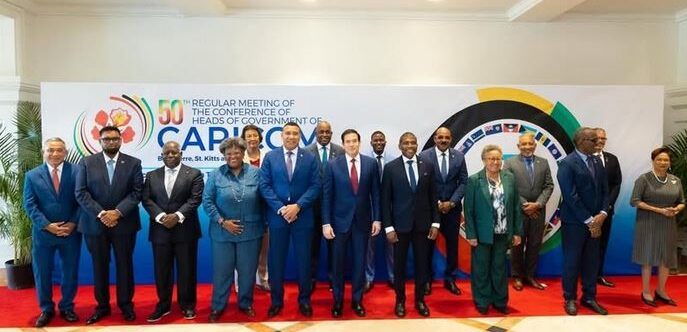
As the Caribbean Community (CARICOM) marks its 50th Conference of Heads of Government, the 56-year-old regional bloc finds itself facing the most severe test of its unity in modern history, pushed to breaking point by shifting great power dynamics that have reopened deep foreign policy divides among member states. The moment of crisis comes as St. Kitts and Nevis Prime Minister Terrance Drew stepped into the six-month rotating CARICOM chairmanship in January 2026, tasked with bridging growing fractures that have undermined the bloc’s longstanding diplomatic cohesion at a time of unprecedented global upheaval.
The core source of tension stems from competing responses to the so-called “Trump Corollary” to the Monroe Doctrine, a policy framework that has reignited great power competition in the Caribbean and split the 14 sovereign member bloc into two opposing camps. For most small CARICOM states, the doctrine, which has been implemented through heavy-handed U.S. security and foreign policy actions, raises deep alarms: it contradicts the bloc’s foundational commitment to the UN Charter, multilateral cooperation, and sovereign equality, principles that are the primary protection for small states in an anarchic international system.
But a small subset of members has broken ranks to align fully with Washington. Trinidad and Tobago, under Prime Minister Kamla Persad-Bissessar, has openly backed U.S. policy across multiple flashpoints: it supported the U.S.-Israeli military campaign against Iran (now paused by a fragile ceasefire), endorsed U.S. anti-narcotics military operations in the Caribbean that targeted the Venezuelan Maduro regime, and welcomed Maduro’s capture by U.S. forces. In return, Washington has deepened bilateral security cooperation with Port-of-Spain and admitted it into the high-profile Shield of the Americas initiative, joining only Guyana as the second CARICOM member in the bloc. This split has eroded mutual trust across the regional grouping, opening a diplomatic rift that has persisted for months.
When Drew assumed the chairmanship, he prioritized mending these divides to ensure a successful 50th Heads of Government Conference, held in February 2026. To lay the groundwork, he launched a series of one-on-one high-level engagements with regional leaders, aiming to rebuild goodwill and create space for productive dialogue. Drew’s efforts achieved a partial victory: all 14 heads of government attended the summit, though three departed early before the closed-door leadership retreat, a key session focused on geopolitical reform.
Despite the divisions, CARICOM members were able to close ranks on limited issues, including longstanding policy toward Cuba. On the sidelines of the summit, U.S. Secretary of State Marco Rubio held talks with CARICOM leaders, resulting in an agreement to develop a new bilateral cooperation framework, which was formalized in a joint statement on regional engagement. The summit also reaffirmed a core principle of CARICOM: as Jamaica Prime Minister Andrew Holness emphasized in opening remarks, citing the 2013 Rose Hall Declaration, CARICOM is a community of sovereign states bound by shared purpose rather than forced uniformity, a pragmatic approach shaped by historical skepticism of ceding authority to supranational institutions.
Holness acknowledged the growing gap between the accelerating pace of global change and the bloc’s ability to coordinate regional responses, a challenge that has defined the current moment. Even so, the summit was widely framed as a limited success for chair Drew and the bloc – until a new controversy erupted over the reappointment of incumbent CARICOM Secretary-General Carla Barnett to a second term starting August 2026.
Drew first announced Barnett’s reappointment on March 25, 2026, triggering a public dispute that has deepened existing divides. The impasse extends far beyond procedural questions, opening up broader debate about CARICOM’s governance structures. As of mid-April 2026, neither side has backed down: public diplomatic correspondence from Trinidad and Tobago Foreign Minister Sean Sobers (dated April 9) and Drew (dated April 11) show positions have hardened, with many remaining members forced to navigate a diplomatic tightrope between the two camps. High-level mediation efforts are ongoing, but no immediate resolution is in sight.
For regional analysts, the current crisis is not an isolated incident, but part of a longer pattern of tension sparked by great power interference in the Caribbean. A key historical parallel is the 1983 U.S. invasion of Grenada, which created lasting rifts within the bloc. Today, the resurgence of sphere-of-influence politics directly undermines the post-WWII international order’s cornerstone of multilateral cooperation, presenting an existential challenge to small Caribbean states that rely on the UN Charter to defend their sovereignty.
While the 50th summit delivered much-needed discussion of geopolitical challenges and the bloc’s core identity, CARICOM now faces an urgent imperative: to work through its deepening divides and adapt to the new normal of 21st century great power competition. For small Caribbean nations, the stakes could not be higher: failure to navigate this moment could permanently erode the regional unity that has served the bloc for more than five decades.
*This analysis reflects the personal views of Nand C. Bardouille, Ph.D., manager of The Diplomatic Academy of the Caribbean at The University of the West Indies St. Augustine Campus, and was originally published by the Jamaica Gleaner on April 16, 2026.*