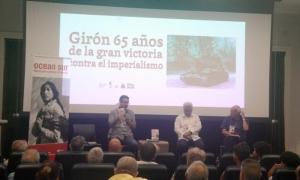
On Tuesday, a landmark academic workshop launched at Havana’s Fidel Castro Ruz Center, bringing together senior Cuban political, military and historical leaders to commemorate the 65th anniversary of Cuba’s victory at the Bay of Pigs, a defining defeat for foreign imperialist intervention. The event is also part of broader national activities marking the battle’s anniversary and the centennial birth anniversary of Fidel Castro Ruz, Cuba’s iconic revolutionary Commander-in-Chief.
The opening session drew senior representatives from across Cuba’s governing institutions, including Yuniasky Crespo Baquero, head of the Ideological Department of the Central Committee of the Communist Party of Cuba. Attendees also included leaders from the Cuban state, national government, Union of Young Communists, Ministry of the Interior, and Revolutionary Armed Forces (FAR).
From the opening moments of the gathering, participants reached a unified consensus: convening the workshop 65 years after the 1961 military victory is a deliberate act of reaffirmation. The freedom Cuba secured through that battle, attendees agreed, must be defended actively every single day, and the example of the people’s resistance in 1961 continues to guide the nation’s current path forward.
The workshop’s opening keynote address, titled *The United States Armed Forces and the Mercenary Invasion of Playa Girón: The Naval Base at Guantánamo*, was delivered by Dr. René González Barrios, director of the Fidel Castro Ruz Center. In his remarks, Barrios broke down the dynamics of the 66-hour battle, noting that the Cuban victory rested on two core strengths: innovative tactical deployment, and a seamless fusion of the revolutionary forces’ experience in irregular combat with conventional warfare tactics.
Turning to the contemporary global landscape, Barrios noted that today’s geopolitical order is defined by shifting power alignments among major global powers and the gradual decline of U.S. imperial influence. He pointed to the outcome of recent U.S.-backed military aggression against Venezuela, including attempts to oust the nation’s legitimately elected president, as evidence that any new interventionist adventure in the Americas—including against Cuba—would face the same failed outcome. Barrios added that the 32 Cuban fighters who lost their lives in the Bay of Pigs battle demonstrated to the world the unwavering resolve of Cubans: they fight without fear, certain of eventual victory and rooted in the invincible power of their ideological convictions.
After the keynote, attendees screened *Death to the Invader*, a vintage Latin American newsreel produced by the Cuban Institute of Cinematographic Art and Industry (ICAIC). A panel discussion followed in the venue’s La Plata multipurpose room, featuring three targeted presentations on different dimensions of the 1961 invasion. Andrés Zaldívar Diéguez, president of the Provincial Executive Committee of the Cuban Union of Historians (UNHIC), opened the panel with an overview of the background of Operation Pluto, the codename for the U.S.-backed invasion plan. Colonel Raidel Vargas Ortega, representing the FAR Center for Military Studies, followed with an analysis of the structure of the U.S.-organized mercenary brigade and the full details of the invasion plot. Finally, Pedro Etcheverry Vázquez, director of the State Security Center for Historical Research, presented on the parallel counter-insurgency campaigns Cuban forces waged against pro-invasion militias in April 1961.
The opening day of the workshop concluded with the launch of a new edited volume, *Bay of Pigs: 65 Years After That Socialist April*, published by Ocean Sur and compiled by Elier Ramírez Cañedo, Deputy Head of the Ideological Department of the Communist Party Central Committee. Ramírez Cañedo explained that the volume is designed primarily to educate younger generations of Cubans, but will offer valuable insight for general readers as well. The book integrates original speeches by Fidel Castro Ruz, rare archival images, and a detailed day-by-day chronology of the 1961 invasion and its aftermath. Ramírez Cañedo emphasized that the work is intended not as a static memorial to past victory, but as a living resource to encourage further historical research. “We should not treat this history as a talisman of the past,” he said, “but as a mobilizing force to transform the present.”