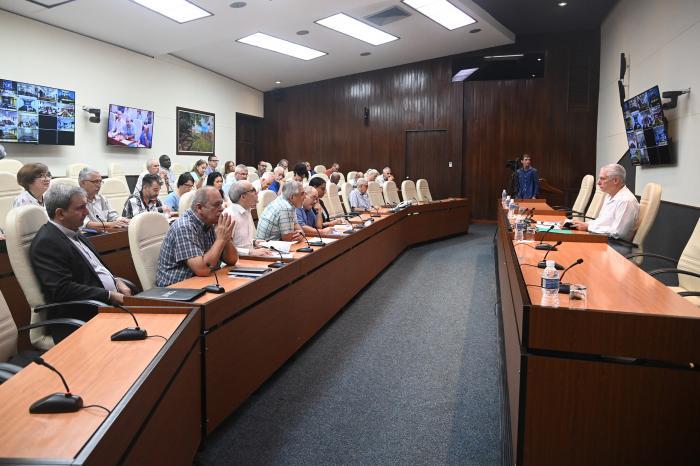
On Tuesday, April 15, 2026, Cuban President Miguel Díaz-Canel Bermúdez, who also serves as First Secretary of the Central Committee of the Communist Party of Cuba, held a high-level meeting with leading energy transition experts and scientists to review years of collaborative progress between the nation’s higher education institutions and government ministries on advancing renewable energy development.
The meeting, moderated by Deputy Prime Minister Eduardo Martínez Díaz, brought together key senior officials including Deputy Prime Minister Inés María Chapman Waugh, Minem (Ministry of Energy and Mines) head Vicente La O Levy, MES (Ministry of Higher Education) leader Walter Baluja García, and CITMA (Ministry of Science, Technology and Environment) director Armando Rodríguez Batista. Additional university leaders joined the discussion remotely via videoconference to share on-the-ground insights from their local projects.
The initiatives under review are coordinated by the National Group of Universities for Renewable Energy Sources and Energy Efficiency, known locally by its Spanish acronym GNUFRE. The collaborative network was founded in 2019, five years after Cuba approved its landmark national Policy for the Prospective Development of Renewable Energy Sources and the Efficient Use of Energy through 2030. What began with seven founding institutions from Sancti Spíritus, Villa Clara, Havana, the Technical University of Havana (CUJAE), Oriente, Cienfuegos and Matanzas has since expanded to include all Cuban higher education institutions with existing renewable energy research capacity. Today, beyond research and development, GNUFRE supports public consultation for the proposed national Energy Transition Law and accompanying regulations, and leads the higher education system’s cross-institutional energy transition project. The network is the formal backbone for collaborative work between the Ministry of Energy and Mines and the Ministry of Higher Education to leverage domestic resources and homegrown technology for clean energy production.
During the meeting, GNUFRE coordinator Dr. Manuel Alejandro Rubio Rodríguez, a professor at the Marta Abreu Central University of Las Villas, presented a slate of near-term actionable projects spanning multiple renewable energy pathways. One of the flagship initiatives showcased was the Martí Project, Cuba’s first domestic effort to produce biomethane for transportation via covered lagoon biodigesters. Additional biogas-focused projects include the Managuaco biogas initiative, which aims to build a distributed network of Cuban-manufactured biodigesters to supply livestock-derived biogas for household use; the La Pastora demonstration project, which retrofits a wastewater treatment system with a Cuban-designed hybrid biodigester fitted with a rubber membrane; and a recovery project for the biodigester at the Heriberto Duquesne sugar mill.
Dr. Rubio also outlined a broad proposal to develop the full value chain and market for solid biofuels made from domestic forest biomass, including wood chips and pellets. The plan prioritizes deploying these fuels for industrial ovens, residential cooking, construction material production, and process steam generation. Drawing on Cuba’s existing Bioenergy Atlas and proven experience using biomass burners in rice mills, working groups are currently finalizing regulatory frameworks that include incentives to draw private and community stakeholders into the supply chain.
The meeting devoted particular attention to a transformative proposal for Cuba’s sugar industry: a new technology and operating model that reimagines the sector as a core pillar of the nation’s energy transition. Under the plan, the restructured sugar industry would leverage surplus biomass to generate flexible, sustainable baseload electricity to support the broader transition away from fossil fuels. The reoriented sector would be fully self-sufficient in fuel, using domestically produced biomethane and alcohol, and could also provide fuel for heavy transport vehicles that are not easily electrified. Additionally, the model would generate protein byproducts to support domestic meat production, linking Cuba’s top two national priorities: energy sovereignty and food security.
Following nearly an hour of in-depth debate among attendees, President Díaz-Canel highlighted the depth of existing technical expertise and accumulated practical experience across the country’s renewable energy research community. He stressed, however, that greater cross-institutional and cross-ministerial integration is critical to move these projects from pilot stages to widespread national adoption. Remarking that food and energy are the nation’s two most urgent priorities, Díaz-Canel noted the deep interconnectedness of the two goals, echoing the link laid out in the sugar industry proposal. He called on the Minem-MES partnership to accelerate efforts to unify all ongoing initiatives and deliver tangible progress on renewable energy adoption across the country.