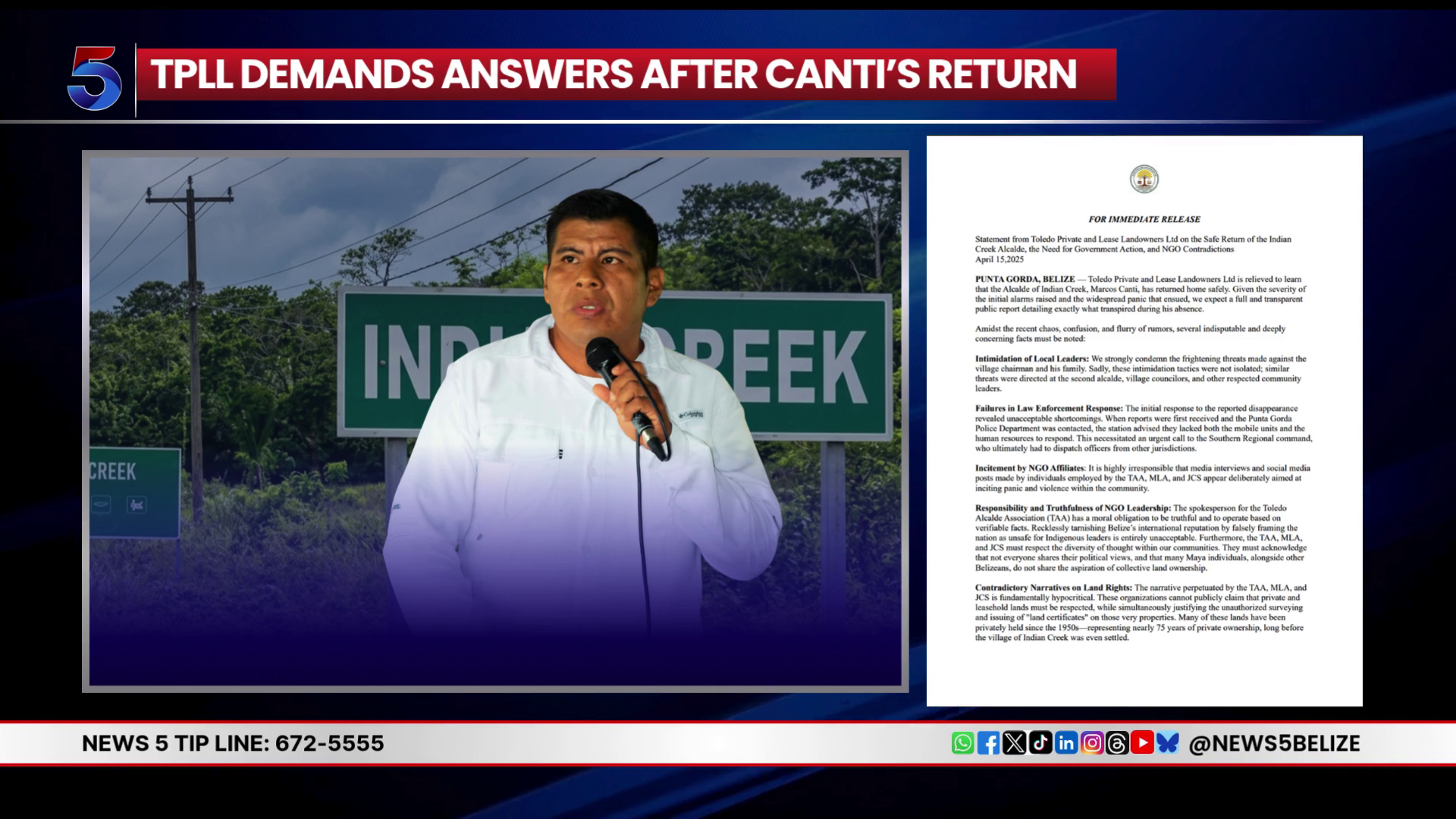
In the wake of the safe return of Indian Creek Alcalde Marcos Canti, a prominent Belizean landowners’ organization is turning its focus from relief to accountability, placing firm blame on both the national government and several activist groups for the chaos that unfolded during Canti’s disappearance.
Toledo Private and Lease Landowners Limited (TPLL) laid out its scathing assessment in an official public statement released on April 15, 2026, outlining a cascade of failures that turned a local incident into a volatile regional crisis. The group confirmed that while the community is relieved Canti has returned unharmed, the disorder that spread during his disappearance has exposed deep-rooted problems that cannot be ignored. According to TPLL, unregulated misinformation, widespread fear-mongering, and targeted intimidation campaigns spiraled out of control during the incident, creating unnecessary tension that put multiple community leaders at risk.
The organization issued a strong condemnation of the threats and harassment directed at Canti, his immediate family, the village’s second alcalde, and other local community representatives. Beyond threats to community leaders, TPLL also sharply criticized the Belizean Police Service’s initial response to the disappearance. The group revealed that local police units based in Punta Gorda were severely under-resourced, lacking both sufficient personnel and operational vehicles to respond to the unfolding emergency. This gap forced regional police commanders to launch a frantic scramble to deploy backup officers from neighboring districts, delaying critical response efforts.
TPLL did not limit its criticism to state authorities. The group also called out several prominent local organizations—including the Toledo Alcalde Association, Maya Leaders Alliance, and Julian Cho Society—accusing individuals tied to these groups of exploiting the incident to stoke public panic. Through media interviews and posts on social media platforms, TPLL claims these actors inflamed existing community tensions, turning an already volatile situation far worse. Beyond the local harm, the landowners’ group argues that these actions have caused lasting damage to Belize’s reputation on the international stage.
At the core of TPLL’s statement is a direct rebuke of the Government of Belize’s handling of long-running land disputes in the region. The organization argues that ongoing conflicts between Maya land rights claims and private property interests persist specifically because the state has failed to fully implement the Caribbean Court of Justice (CCJ) Consent Order, a landmark legal agreement meant to resolve these tensions. While TPLL called out activist groups for their role in the recent chaos, it stressed that ultimate responsibility for unresolved land disputes rests with the national government, not non-governmental organizations.
In closing, TPLL issued an urgent call to Belize’s national leaders: move quickly to restore lasting calm to the southern region, uphold the principles of the rule of law, and take decisive action to address gaps in land policy before simmering tensions erupt into another full-blown crisis.