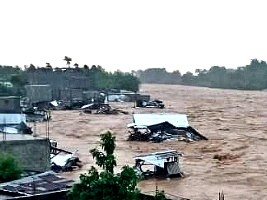
Between April 11 and 13, 2026, torrential downpours unleashed catastrophic flash flooding across Haiti’s Northwest Department, leaving at least 12 people dead, dozens missing, and more than 2,500 families displaced across three hard-hit municipalities: Port-de-Paix, Saint-Louis du Nord, and Anse-à-Foleur.
Torrential rainfall swelled multiple regional rivers, including the major Rivière des Trois Rivières, sending rushing floodwaters into low-lying communities and saturating already vulnerable soil. Haiti’s Civil Protection Directorate has warned that the emergency is far from over, maintaining the highest level of vigilance amid ongoing threats of additional landslides and flash flooding if forecast rain continues to hit the region.
Preliminary data from the Departmental Directorate of Civil Protection confirms that all 12 confirmed fatalities occurred in the first, third, and fourth rural sections of Saint-Louis du Nord, where victims were either killed by landslides or swept away by fast-moving floodwaters. Multiple serious injuries have been documented, and search operations continue for an undetermined number of missing people, including local fishermen and residents living along riverbanks in Anse-à-Foleur.
Displaced residents have been forced to evacuate their damaged homes, taking shelter with extended family members or in makeshift temporary emergency shelters. Local officials have already issued an urgent appeal to Haiti’s central government for critical aid supplies, including emergency food rations, clean drinking water, hygiene kits, and sanitation infrastructure, warning that a lack of these resources could spark a secondary public health crisis in flood-stricken communities.
Infrastructure damage across the region is extensive. More than 1,200 residential properties have been flooded, with low-lying neighborhoods in Port-de-Paix such as La Saline and Haut-Gallois suffering severe structural damage to dozens of homes. The key intercity highway connecting Port-de-Paix to Saint-Louis du Nord is now impassable in multiple stretches due to landslides, while multiple smaller bridges and culverts have been structurally compromised by flood force. The Ti Rivyè bridge, a critical regional crossing, was completely destroyed by rushing waters.
Local public services have also been brought to a halt: all schools and health centers across the three affected communes have been flooded with mud, leaving the facilities inaccessible and cutting off residents from basic education and medical care. The region’s agricultural sector, a core source of livelihood for thousands of small-scale producers, has suffered near-total ruin. Fertile agricultural plains surrounding Anse-à-Foleur and Saint-Louis du Nord remain submerged, wiping out this season’s entire harvest of bananas, corn, and beans. Hundreds of head of livestock, including cattle, goats, and pigs, have been swept away, representing an irreversible financial catastrophe for small farming households that rely on these animals for income and food security. Many key irrigation canals are now clogged with sediment and flood debris, a barrier that will delay the recovery of agricultural activity long after floodwaters recede.
While the Civil Protection Directorate and local non-governmental organizations continue working to assess full damage and unmet humanitarian needs, access to remote communities in Anse-à-Foleur remains severely limited. Saturated ground and debris blocking rural access roads have slowed search and rescue operations and prevented aid from reaching some of the hardest-hit populations.