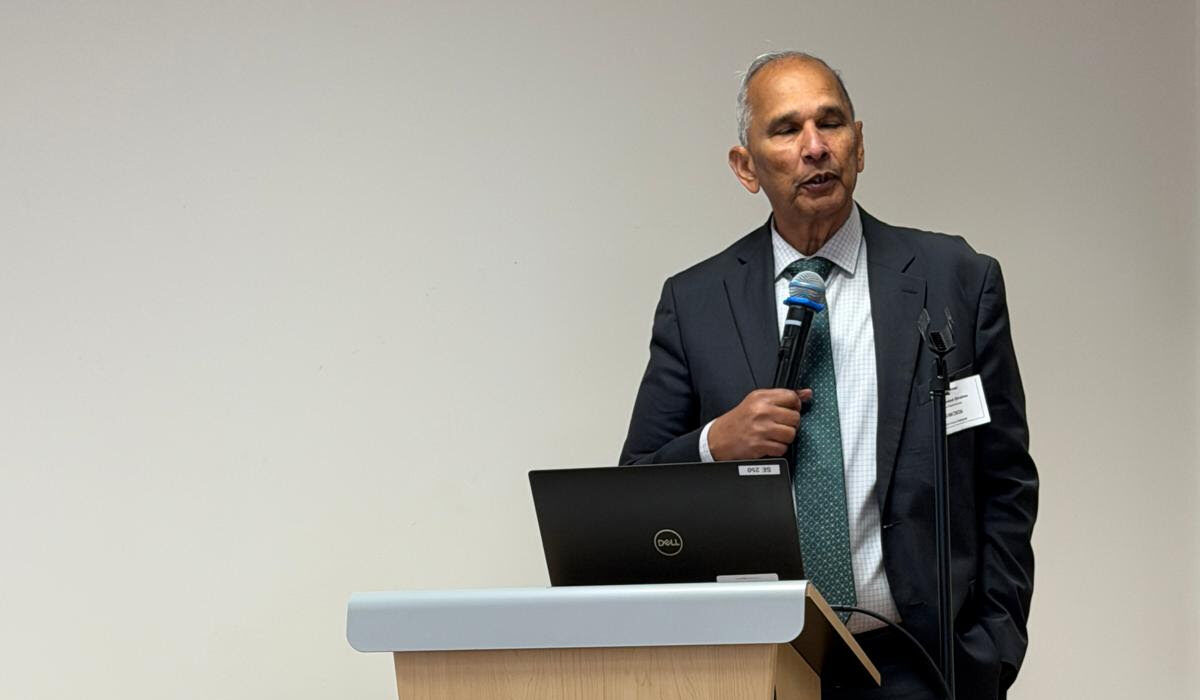
During a high-profile policy event hosted by the Inter-American Development Bank (IDB) in Washington D.C., Muhammad Ibrahim, director-general of the Inter-American Institute for Cooperation on Agriculture (IICA), delivered a stark warning that global food, energy and environmental security depends entirely on decisive action to modernize and strengthen the Americas’ agricultural sector. The event, which drew roughly 240 in-person and virtual attendees, generated lively, engaged discussion between leaders and stakeholders on the urgent need to reorient regional agricultural development for a era of growing global shocks.
Beyond the formal presentation, Ibrahim held a closed working meeting with Pedro Martel, head of IDB’s Agriculture and Rural Development Division, where the two leaders mapped out a shared collaborative agenda for the region. Both officials centered their remarks on the outsized global importance of the Americas’ agricultural sector: the region stands as the world’s top net food exporter, accounting for more than one-fifth of total global food output. But behind this leading global position, Martel exposed a deep and persistent inequity: nearly 30 percent of the region’s rural population still struggles with chronic food insecurity, a gap that has widened amid growing global market volatility.
Martel outlined decades of regional agricultural performance data collected by IDB, noting that while Latin America and the Caribbean saw solid agricultural productivity growth over the second half of the 20th century, productivity growth slowed dramatically between 2010 and 2020. He attributed this slowdown primarily to widespread gaps in technical efficiency across small and medium producer operations. “Our core challenge right now is to reignite productivity gains and growth, while simultaneously protecting the natural resources that our sector depends on,” Martel explained during the discussion.
The dialogue also emphasized the complementary strengths of the two leading regional agricultural institutions, positioning them to tackle the sector’s most pressing challenges. IICA brings specialized technical expertise, cross-regional coordination capacity, and on-the-ground implementation experience across 34 member states, while IDB provides the large-scale financing tools needed to roll out large development initiatives across Latin America and the Caribbean.
Their joint work program targets both near-term and long-term priorities. In the medium term, the two organizations will focus on addressing deep structural weaknesses across the sector, including gaps in food transport infrastructure, outdated logistics networks, lack of support for inclusive smallholder production systems, and persistent vulnerabilities in regional plant and animal health systems. Looking ahead to the next decade, both institutions have prioritized investment in the bioeconomy as a transformative pathway to rebuild rural production systems across the Western Hemisphere, balancing productivity growth with environmental sustainability.
Ibrahim stressed that the region has an unprecedented opportunity to leverage its existing agricultural strength to lead global agrifood system transformation, but that this leadership is not a given. “IICA and the IDB have a unique opportunity to scale up our joint work and support member countries to build a more competitive and resilient productive base,” Ibrahim said. “The sheer scale, resources, and productive capacity of the Americas’ agriculture sector puts it in a position to lead the future of global agrifood systems. But this leadership will not happen automatically; it depends entirely on the bold decisions we make today.”
Against the backdrop of ongoing geopolitical instability and post-pandemic market disruptions, Ibrahim argued that incremental, short-term policy fixes will not be enough to address the root vulnerabilities facing the sector. “Global agrifood systems are facing more frequent climate, geopolitical, logistical, and market shocks than ever before, and these events are increasingly simultaneous and interconnected,” he explained. “We cannot treat these shocks as isolated, one-off events. They are fundamentally redefining the conditions for production, trade, and food security across every region.”
He also emphasized that these disruptions do not impact all stakeholders equally, with pre-existing inequalities magnifying harm for the most vulnerable producers and nations. “Impact and response capacity vary tremendously across the sector. Smallholder farmers suffer the most from shocks, and at the national level, technological gaps widen existing inequalities,” Ibrahim noted. “Countries that have advanced science and technology to boost productivity and resilience are in a far stronger position to absorb and respond to crises.” That is why IICA has centered its work on cross-border knowledge transfer, targeting support to the countries and producers that need it most, he added.
One of the most critical structural vulnerabilities the discussion highlighted is the region’s heavy dependence on imported agricultural inputs, particularly fertilizers and energy. Ibrahim pointed out that even Brazil, one of the world’s largest agricultural exporters, imports more than 80 percent of the fertilizers it uses for domestic production. “Input costs make up a huge share of total agricultural expenses, and in fully mechanized production systems, they can account for as much as 70 percent of total operating costs,” Ibrahim explained. “Our current production model directly shapes how vulnerable our system is: the higher our dependence on imported strategic inputs, the more exposed we are to external price shocks and supply chain disruptions.”
Ibrahim concluded by reaffirming that only deep structural transformation of the region’s agrifood systems can resolve these long-standing vulnerabilities. “By transforming the fundamental structure of our agrifood systems, we can cut structural vulnerabilities, boost overall productivity, and reduce our dependence on strategic external inputs,” he said. “This transformation will deliver tangible benefits for all: higher incomes for farming households, and more accessible, nutritious food for every community across the region.”