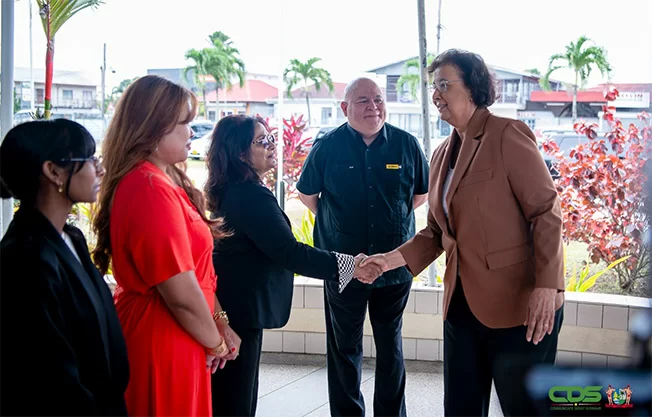
On a recent Monday, the Anton de Kom University of Suriname (AdeKUS) officially launched the fourth iteration of its annual Public Administration Week, an event tailored to connect academic learning with real-world governance challenges. This year’s programming centers on a timely and critical theme: moving beyond Suriname’s traditional reliance on natural resource extraction to build inclusive, long-lasting sustainable development, with a specific focus on bridging the gap between policy design and on-the-ground execution. The opening ceremony was led by Suriname’s President Jennifer Simons, who used her opening address to emphasize that closing this implementation gap remains one of the most pressing ongoing challenges for the South American nation.
Public Administration Week is structured to give undergraduate and graduate students in the public administration degree program hands-on learning opportunities that go far beyond traditional classroom instruction. Over the course of the five-day event, students will take part in interactive workshops led by practicing policymakers, site visits to regional government agencies, and panel discussions with leading governance experts from across Suriname and the Caribbean region. Every activity ties back to the event’s core theme: “From Natural Resources to Sustainable Development: Policy Choices for the Next Generation”.
President Simons noted that the chosen theme cuts straight to the heart of Suriname’s most critical development questions. In her remarks, she outlined that effective governance relies on three non-negotiable pillars: full transparency, public accountability, and a consistent commitment to centering community input in policy design. She also pushed back on common framing of sustainable development, noting that it extends far beyond narrow metrics of economic growth or natural resource sector diversification. “Sustainable development is not just about drafting innovative policy ideas,” Simons said during her address. “It is about turning those ideas into tangible, effective action that improves lives for current and future generations.”
Despite Suriname’s abundance of development ideas and access to skilled technical expertise, Simons acknowledged that turning plans into action frequently hits roadblocks. A range of systemic and institutional barriers often slow or fully block policy implementation across sectors, she explained. In response to this persistent gap, the president called on participating public administration students to bring fresh perspectives and innovative thinking to solve this challenge, as highlighted in an official release from the Communication Service of Suriname.
Simons also stressed that building broad public buy-in is a non-negotiable component of successful policy execution. Even the most well-intentioned policy initiatives will face uncrossable barriers without widespread support from local communities and broader society, she noted. She further called for deeper, more structured collaboration between Suriname’s academic institutions and national government, including a proposal to integrate student graduation research more directly into government policy development processes.
Loraine Arsomedjo, program coordinator for AdeKUS’s Public Administration degree, echoed the president’s remarks, underscoring that this year’s theme could not be more relevant to Suriname’s current context. Arsomedjo pointed out that while Suriname holds vast reserves of valuable natural resources, these assets alone are not enough to deliver equitable, sustained national development. “Without strong public institutions and thoughtful, intentional policy design, natural resource wealth can easily become a source of systemic vulnerability rather than national prosperity,” she explained.
Arsomedjo added that the public administration program at AdeKUS is designed to培养 students who do not just understand how existing policy processes work, but who are also willing and able to think critically about how to improve governance systems. “You are not here to be passive observers of public affairs,” Arsomedjo told participating students. “You are the thinkers, the designers, and the leaders who will shape Suriname’s future.”
Through the full week of programming, Public Administration Week aims to prioritize cross-sector knowledge sharing, critical reflection on Suriname’s governance challenges, and targeted preparation for students who will go on to fill key roles in Suriname’s public administration sector after graduation.