# Artemis II Crew Safely Returns to Earth, Marking Historic First Crewed Lunar Voyage in Over 50 Years
On April 11, NASA announced the successful completion of the Artemis II mission, as the four-person crew of the Orion capsule *Integrity* splashed down safely in the Pacific Ocean off the coast of Southern California on Friday, capping a nearly 10-day groundbreaking journey beyond Earth. This mission marks the first time humans have traveled around the Moon in more than half a century, breaking multiple space travel records and clearing a critical milestone for NASA’s ambitious deep space exploration program.
The Artemis II crew — commander Reid Wiseman, pilot Victor Glover, mission specialist Christina Koch, and Canadian Space Agency astronaut Jeremy Hansen — launched from Cape Canaveral on April 1. Over the course of the mission, they completed two orbits around Earth before conducting a close flyby of the Moon’s far side, passing just 6,400 kilometers above the lunar surface. At their farthest point, the crew traveled 407,000 kilometers from Earth, farther than any human mission has ever ventured from our home planet.
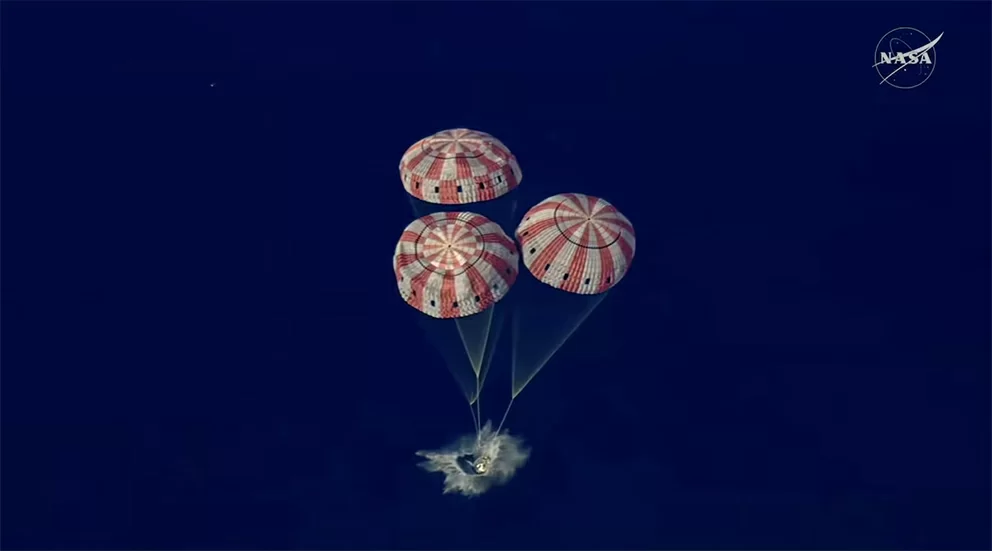
Re-entry into Earth’s atmosphere was the highest-risk phase of the entire mission. The capsule slammed into the atmosphere at 32 times the speed of sound, subjecting its heat shield to extreme temperatures reaching 2,760 degrees Celsius. A six-minute radio blackout, a normal consequence of atmospheric ionization during high-speed re-entry, paused communications between the crew and mission control before contact was restored. Parachutes deployed as planned to slow the capsule’s descent, resulting in what NASA commentators called a “perfect bull’s-eye splashdown.”
Shortly after landing, Wiseman confirmed via radio that the capsule was stable and all four crew members were in good health. Joint recovery teams from NASA and the U.S. Navy secured the capsule and extracted the astronauts within two hours of splashdown. The crew was then transferred via rescue raft and helicopter to the USS John P. Murtha for initial medical checks, before traveling to Houston to reunite with their families.
Beyond its technical achievements, the Artemis II mission is a historic milestone for international and inclusive space exploration. Hansen is the first Canadian astronaut to participate in a lunar mission, while Glover is the first Black astronaut and Koch the first woman to join a crewed lunar voyage. The mission comes four years after the successful uncrewed Artemis I test flight in 2022, and serves as a critical validation of Orion’s capsule technology, heat shield, and life support systems ahead of planned crewed lunar landings.
NASA’s Artemis program was developed to return humans to the lunar surface by 2028, and to lay the groundwork for future crewed missions to Mars. The program’s next step, Artemis III, is scheduled for next year and will include a crewed docking test in Earth orbit ahead of the first attempted crewed lunar landing in more than 50 years. The successful completion of Artemis II has cemented confidence in the program’s technical readiness, though challenges remain: development of the lunar lander has faced repeated delays, partially driven by NASA budget cuts that have reduced funding for scientific missions and cut the agency’s workforce by nearly 20%.
To overcome these obstacles, NASA is collaborating with commercial space partners including SpaceX and Blue Origin, alongside space agencies from Europe, Canada, and Japan to deliver on the program’s goals. Global public interest in the mission has been unprecedented: more than 3 million viewers tuned in to watch the live broadcast of the splashdown. Former U.S. President Donald Trump congratulated the crew on his social media platform, calling the voyage “spectacular” and the landing “perfect.”
The safe return of the Artemis II crew confirms decades of technological progress in human spaceflight, and stands as a critical stepping stone toward returning humans to the lunar surface and eventually sending the first crewed missions to Mars.