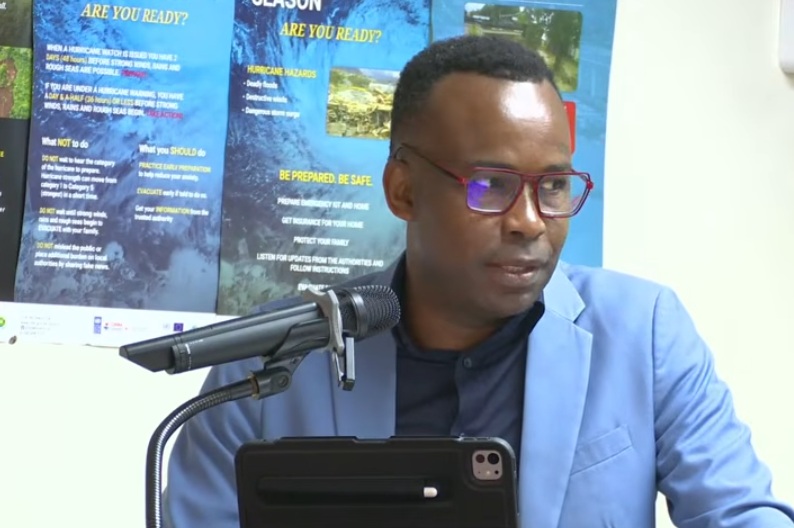
At the opening of a three-day inter-agency security roundtable in Roseau, a senior Caribbean regional security official has outlined a comprehensive multi-part initiative to boost Dominica’s national firearms regulation and explosive management capabilities, with spillover benefits for the entire Caribbean region.
Callixtus Joseph, acting Assistant Director of Policy, Strategy and Innovation at the CARICOM Implementation Agency for Crime and Security (CARICOM IMPACS), made the announcements during the conference, which ran from April 8 to 10 2026. The gathering was jointly convened by the Government of Dominica’s Ministry of National Security and Legal Affairs, the United Nations Regional Centre for Peace, Disarmament and Development in Latin America and the Caribbean (UNLIREC), and CARICOM IMPACS itself, bringing together cross-sector stakeholders to coordinate regional security action.
Beyond the planned explosives depot, Joseph detailed a suite of targeted upgrades to Dominica’s law enforcement and firearms control infrastructure. CARICOM IMPACS is already expanding the island’s firearms ballistics testing capacity through direct on-the-ground support and new specialized equipment, he confirmed. The agency is also supplying purpose-built firearm marking tools to the Dominica Police Service, and backing the rollout of a cutting-edge digital system for firearms licensing and registration.
Joseph stressed that the digital transformation of the licensing regime is far more than a technological upgrade: it lays the foundation for a modern, streamlined, and transparent regulatory framework that aligns with global best practices and updated national legislation. The new system will drastically improve the traceability of illegal weapons, while also simplifying administrative oversight and regulatory enforcement for local authorities.
On the planned explosives storage facility, Joseph noted that CARICOM IMPACS is working in close partnership with the Dominican government and police service to scout and evaluate appropriate parcels of land for construction. In the near future, the agency will also roll out specialized training alongside partner organization the Mines Advisory Group (MAG), focusing on safe demolition and disposal of decommissioned weapons and unstable expired explosives.
The security cooperation between CARICOM IMPACS and Dominica extends beyond weapons management, Joseph added. Upcoming joint maritime security operations are already in planning, designed to counter transnational illicit trafficking and strengthen border protection for the island.
Joseph emphasized that all these combined initiatives are tailored to reinforce national-level preparedness, inter-agency coordination, and enforcement capacity. He noted that Dominican leadership and engagement in these security efforts delivers value not just for the island nation itself, but for the entire Caribbean community. Every incremental improvement to accountability, weapons tracing, record-keeping, inventory marking, storage security, criminal investigation, and enforcement bolsters the region’s collective ability to counter the threat of illicit weapons and organized crime.
Looking ahead, Joseph confirmed that CARICOM IMPACS remains committed to ongoing collaboration with the Dominican government and all relevant stakeholders to see these initiatives through to successful completion.