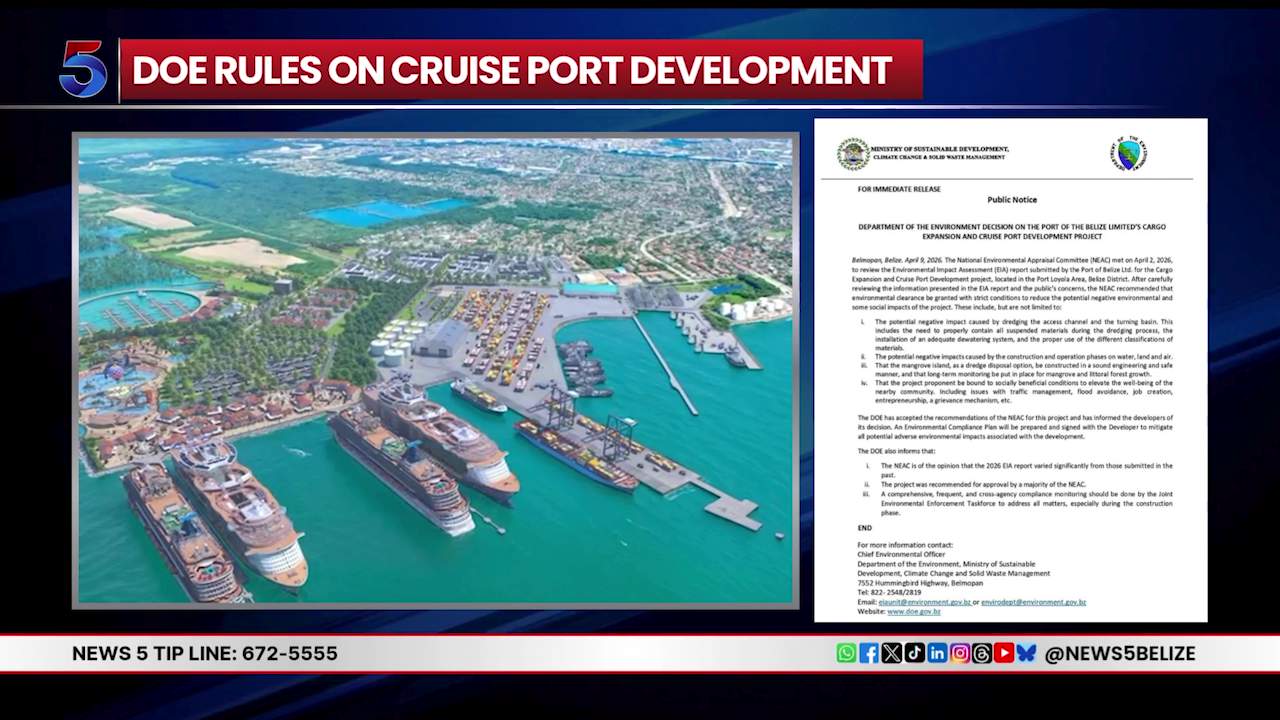
In a landmark decision that paves the way for decades of stalled infrastructure development, Belize’s National Environmental Appraisal Committee (NEAC) has granted conditional approval for the long-awaited expansion of the Port of Belize, a project Prime Minister John Briceño has hailed as a transformative turning point for the small Caribbean nation’s economic future.
The project, which will add expanded cruise ship berthing and modern container handling facilities to the country’s primary maritime gateway, has been more than 20 years in the making. Early attempts to develop a new cruise and container port at the site dating back to the early 2000s fell through for a range of regulatory, financial and political reasons. Under the current administration, the government moved to purchase the port assets from previous owner Waterloo Group, launching a new formal review process that has now reached its key approval milestone.
Briceño pushed back firmly against circulating claims of political interference in NEAC’s approval decision, calling the entire regulatory process transparent, professional, and led by independent qualified experts. “It is nonsense,” Briceño said of allegations that the government pressured the committee to approve the project. “These people are highly qualified professionals and they did what they believe is right. They addressed most of the issues. That is why when they gave the approval, they gave the approval with certain conditions they want to add.” He clarified that the decision is a formal approval with binding environmental and community safeguards, not a conditional approval that leaves the project in regulatory limbo.
Addressing questions about potential future legal challenges from competing developers or previous stakeholders, Briceño noted that the government already purchased the port from Waterloo Group, and followed all formal regulatory procedures to reach the current decision, leaving no clear basis for legal pushback. He also thanked his cabinet for their early support in taking on the high-stakes project, crediting the administration’s deliberate, methodical approach for putting the project on track for success.
“We took our time and made sure we had a good board of directors. We put a public execution unit, headed by Doctor Gilly Canton, people that know what they are doing, made sure that we prepared a proper environmental plan,” Briceño explained. “We had the advantage of seeing what went wrong with the previous one and made sure we take those corrective measures to ensure we get the support.” Now that regulatory approval is secured, the government will move forward to partner with private firms for the dredging and construction phases of the project.
Regulators confirmed that the approval process reflects the project’s large scale and complexity. Chief Environmental Officer Anthony Mai told reporters that the review launched in May 2025, with regulators immediately flagging the need for a full Environmental Impact Assessment (EIA) to identify potential risks. Following a screening process and months of deliberation, NEAC delivered a final recommendation to approve the project, which the Department of the Environment (DOE) has formally accepted.
The approval does not mean construction can begin immediately, however. Developers are now required to finalize a comprehensive Environmental Compliance Plan that will lock in legally binding measures to avoid, prevent and mitigate potential negative environmental impacts. The plan also must address key socioeconomic concerns raised by communities and stakeholders, including improved traffic management, flood mitigation and drainage infrastructure, local job generation, support for small local entrepreneurship, and the establishment of a formal public grievance mechanism to address community concerns throughout the project’s development and operation.
“The process is still not ended because we are in the process of preparing the Environmental Compliance Plan,” Mai explained, noting that the rigorous multi-month review ensures that all potential risks are addressed before construction breaks ground.
Briceño also moved quickly to address ongoing environmental concerns and clarify confusion surrounding potential private investors for the project. He acknowledged that non-governmental environmental organizations will likely never offer full support for the development, but emphasized that the government is committed to responsibly minimizing environmental harm. “If you build a house, you change your environment. So obviously there are going to be some effects, but what we need to do is mitigate them and try to minimize them as best as we can, and that is my commitment and the commitment of our government,” Briceño said. “We are going to do our best to mitigate the environmental issues, but to ensure we can build a world-class port for the people of this country.”
On the topic of investment, Briceño clarified that the government intentionally delayed negotiations with potential private partners until environmental approval was secured, to avoid uncertainty for all parties. Multiple major international port development groups have already expressed interest in partnering on the project, including global industry leader SSA Marine, whose parent company is investment firm Black Rock, Turkey’s Global Port Holdings, and a Mexican development group. The government will now hire consulting firm Nicols and Mofat, which developed the project’s original master plan, to set negotiation terms and select the partner that delivers the best outcome for Belize.
The expanded port is projected to act as a game-changer for Belize’s economy, boosting the country’s regional trade capacity, drawing increased cruise tourism traffic, and driving long-term inclusive national development. Briceño framed the approval as a long-awaited breakthrough that unlocks critical new investment in Belize’s maritime sector, positioning the country for stronger economic growth in the coming decades.