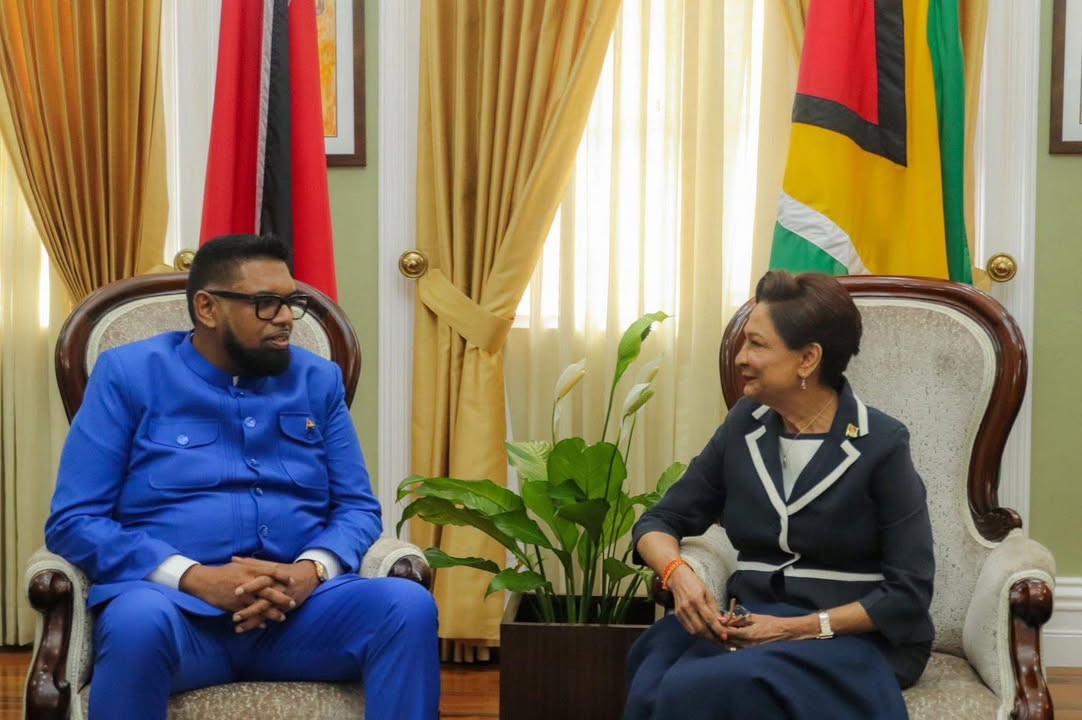
On Friday, April 10, 2026, Guyana’s President Irfaan Ali held a high-stakes one-day bilateral meeting with Trinidad and Tobago’s newly installed Prime Minister Kamla Persad-Bissessar in Port-of-Spain, with the two leaders aligning on a sweeping set of agreements to deepen economic integration, resolve long-standing cross-border bottlenecks, and unlock untapped collaborative opportunities between the two Caribbean nations.
In an official joint statement released after the talks, both governments confirmed two core outcomes of the summit: the establishment of a cross-border working group with representation from both the public and private sectors of both countries, and a commitment for Persad-Bissessar to undertake a reciprocal official visit to Guyana, with details of the visit’s timing still being finalized.
The working group’s core mandate is to identify and eliminate trade barriers, streamline bureaucratic hurdles, and boost competitiveness between the two countries, while exploring and advancing joint development opportunities across a wide range of priority sectors. During the closed-door negotiations, the two leaders mapped out a shared development, trade and economic agenda designed to bring closer alignment of the two nations’ economies and improve people-to-people connectivity. Key areas of discussion included strengthening regional food security and attracting cross-border investment in the sector, advancing cross-grid energy integration, facilitating technology sharing, supporting human capital development initiatives, and boosting collaborative security efforts.
President Ali opened the meeting by formally thanking Persad-Bissessar and the Trinidad and Tobago government for its unwavering public support for Guyana’s territorial integrity and national sovereignty, a gesture of alignment that he noted carries deep meaning for the people of Guyana. Both sides reaffirmed their commitment to ongoing close collaboration across all agreed priority areas to progressively deepen the bilateral partnership. The Guyanese delegation accompanying Ali to Port-of-Spain included senior cabinet officials: Natural Resources Minister Vickram Bharrat, Public Utilities and Aviation Minister Deodat Indar, Public Service, Government Efficiency and Implementation Minister Zulfikar Ally, and Labour and Manpower Planning Minister Keoma Griffith, alongside a cohort of private sector representatives from Guyana. On the Trinidad and Tobago side, Persad-Bissessar was joined by her own senior leadership team, including Attorney General John Jeremie, Foreign and CARICOM Affairs Minister Sean Sobers, Public Utilities Minister Barry Padarath, and Energy and Energy Industries Minister Roodal Moonilal.
Speaking at a business forum hosted by the Trinidad and Tobago Chamber of Industry & Commerce following the leaders’ meeting, President Ali pressed for urgent action to cut through bureaucratic red tape that he said is holding back the full potential of the bilateral partnership. In blunt remarks to the business audience, Ali argued that if both nations are committed to building collaborative cross-border consortiums and a unified regional economic front, leaders must prioritize resolving long-standing frictions. “If we care about partnership, if we care about building consortiums, if we care about building a joint economic front between Guyana & Trinidad and Tobago then we must care about fixing the problem and let’s get in that room, lock ourselves up for 72 hours and fix the damn problem,” Ali stated.
The Guyanese president also highlighted that partnership opportunities extend far beyond the energy sector, pointing to existing collaborative potential in agriculture: Guyana’s growing soya bean export sector and Trinidad and Tobago’s globally renowned cocoa production present immediate avenues for joint growth. He praised regional conglomerate ANSA McAL for its early and successful investment in Guyana, including the development of a new large-scale shopping mall, but noted that Trinidad and Tobago investors have so far missed out on major opportunities in Guyana’s booming gold mining sector, where no Trinidadian consortium has yet established a meaningful presence. Ali also called out unnecessary immigration bureaucracy in Trinidad and Tobago, noting that lengthy, cumbersome entry processes are holding back Caribbean Airlines from reaching its full operational potential in the region.