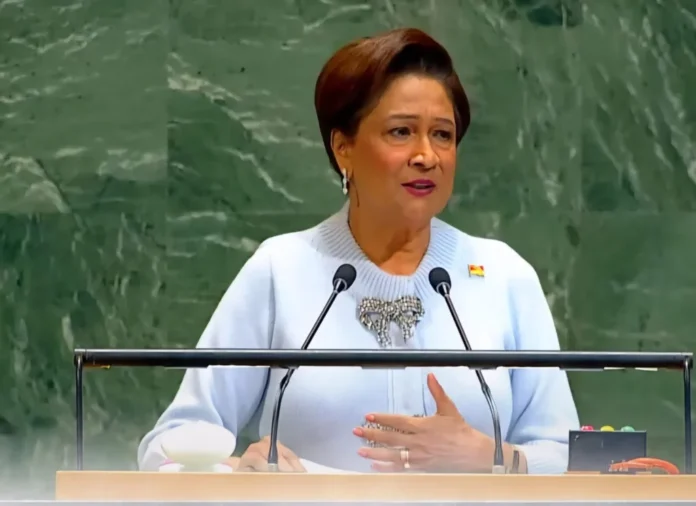
In recent Caribbean political discourse, opposition leader Kamla Persad-Bissessar’s renewed campaign for Trinidad and Tobago’s exit from the Caribbean Community (CARICOM) – dubbed TREXIT – has sparked fierce debate over the future of regional solidarity. Critics have framed her populist, Trump-aligned approach as a false form of radicalism, arguing that her movement prioritizes alignment with imperial interests over the collective progress of Caribbean nations. As the late reggae icon Bob Marley once asked, who qualifies as a true revolutionary? Contemporary critics argue it is not those who seek to dismantle the Caribbean’s most vital indigenous institution in pursuit of promised material gains from foreign powers at the cost of regional unity.
True regional radicalism, the argument goes, is not defined by loud, empty rhetoric about the bloc’s flaws. Instead, it centers on a commitment to radically reform CARICOM to better serve the interests of all Caribbean people. This approach requires core skills that Persad-Bissessar and her allied Foreign Minister Sobers are said to lack: thoughtful negotiation, intellectual rigor, and a foundational respect for the regional project that has bound Caribbean nations together for decades.
Caribbean politics, critics insist, must shift toward a culture of building up regional institutions rather than tearing them down. They compare Persad-Bissessar’s TREXIT push to children in a playground who, unable to understand how their shared toys work, lash out and destroy even the most useful parts. Despite this destructive push, supporters of integration argue that Caribbean nations must continue strengthening their union through a coalition of countries committed to deeper integration. As the late Caribbean scholar George Beckford famously noted, the people of the Caribbean are already integrated – it is only politicians who have yet to recognize this fundamental truth.
Even so, critics warn that TREXIT would represent a catastrophic policy mistake for Trinidad and Tobago (T&T) and the entire region. The current controversy surrounding the bloc has centered on a petty dispute over the appointment of a new CARICOM Secretary General, a fight made more hollow by reports that Persad-Bissessar was absent from the key meeting to discuss the appointment. Critics point out that her trip had little to do with CARICOM business at all: rather, she served primarily as a diplomatic envoy advancing Washington’s interests in the region.
Behind the political posturing lies a stark economic reality: no other CARICOM member state, its businesses, or its people benefit more from the bloc and the Caribbean Single Market and Economy (CSME) than T&T. Smaller Organization of Eastern Caribbean States (OECS) nations face far greater structural disadvantages than more developed CARICOM members like T&T. These countries grapple with tiny domestic markets, underdeveloped manufacturing sectors, a lack of oil and mineral reserves, ballooning import bills, fragile financial systems, high exposure to global economic shocks, and limited skilled workforces. It was to address these gaps that the Caribbean Development Fund was created: to facilitate targeted investment, balance economic disparities between member states, and protect domestic and infant industries in smaller nations.
Critics argue Persad-Bissessar is fully aware of the tradeoffs of her pro-Washington alignment: if she does not align with the agenda of the Trump-aligned political coalition, T&T could face steep new U.S. tariffs that would upend its lucrative bilateral trade relationship. In 2024, total bilateral trade between T&T and the U.S. reached $21.2 billion, driven by soaring demand for energy-related exports, petrochemicals, and refined fuels. Exports to the U.S. account for 43% of T&T’s total export volume, with mineral fuels and oils making up 34% of all exports and generating over 70% of the country’s total export earnings. The U.S. is already T&T’s largest single export partner, absorbing 29.5% of the country’s total outbound goods.
Even the U.S. partnership, however, is outpaced by T&T’s trade advantage within CARICOM. T&T is the only CARICOM member that maintains a consistent positive trade surplus with the rest of the bloc. Recent data puts this surplus at $1.46 billion, with mineral fuels and oils accounting for 32% of T&T’s regional exports, followed by beverages (10.5%), cereal-based products (8.8%), and a range of other goods including fruits, vegetables, and plastics. Jamaica is T&T’s largest regional export market, taking 16.2% of its regional outbound goods, followed by Barbados (14.3%) and Suriname (8%). In stark contrast, T&T imports only $184 million in goods from other CARICOM members – creating a deeply lopsided trade dynamic that benefits T&T disproportionately.
While some apologists for T&T’s position argue the imbalance is simply a result of other CARICOM nations’ reliance on T&T goods, critics note the dynamic is rooted in the bloc’s Common External Tariff (CET) arrangement, which requires member states to prioritize imports from community producers over cheaper global suppliers. In 2024 alone, other CARICOM nations collectively foregone an estimated $142.7 million in customs revenue by sourcing goods from T&T rather than cheaper non-regional suppliers under CET protections. This does not mean smaller Caribbean nations should launch an economic war against T&T, critics emphasize. Instead, this massive, decades-long collective sacrifice should inspire T&T’s political leaders to show greater respect for regional integration processes, institutional procedures, and their fellow Caribbean member states.
If T&T were to exit CARICOM, the Caribbean Court of Justice (CCJ) has repeatedly reaffirmed the strict procedural requirements for member state suspension or withdrawal – a process T&T’s leaders are fully aware of, even as they continue their provocative posturing. A T&T exit would open the door for other Caribbean nations to source goods from cheaper global suppliers, rather than continuing to protect higher-cost regional producers in T&T. For decades, CARICOM’s CET framework has required member states to impose higher tariffs on non-bloc imports, raising overall import costs and forcing governments to give up significant customs revenue to support T&T’s economy.
A clear example of T&T’s outsized advantages within CARICOM is energy pricing: T&T consumers and businesses pay far less for energy than OECS member states. T&T’s manufacturing sector also benefits from CET protections when importing inputs from non-CARICOM sources, with the exception of arrangements under the PetroCaribe Initiative. Many Jamaican manufacturers have even been forced to relocate production to T&T to access cheaper energy, undermining industrial development in other regional economies. Critics add that Persad-Bissessar’s support for Trump-aligned policy on Venezuela is explicitly designed to help T&T monopolize regional export production and lock in preferential trade access to the U.S. in exchange for political loyalty.
While this approach may deliver short-term political and economic gains for T&T, it carries severe long-term risks for the country and the entire region. T&T’s current leadership has prioritized immediate political wins, but there is no evidence that this strategy will deliver sustained prosperity, particularly on pressing cross-border challenges like irregular migration and drug trafficking. By chasing quick, narrow gains, T&T is abandoning the long-term collective strength that deep regional integration can deliver for all Caribbean nations.
Critics warn this is a fundamentally flawed strategy, noting that former President Trump has a well-documented pattern of abandoning his allies once they are no longer politically useful. High-profile former allies including Kristi Noem, Pam Bondi, María Corina Machado, and Mike Pence have all learned this lesson the hard way – and Persad-Bissessar could be next. As Caribbean scholar Justin Robinson correctly observed, the Caribbean’s greatest strength has always been its collective power. Washington does not benefit from a unified CARICOM with a cohesive, independent position on climate change, trade, and national sovereignty; instead, it benefits from a fragmented bloc of individual states that can be pressured and manipulated one by one.
Compounding these economic and political tensions is a long-running dispute over foreign exchange for agricultural exporters from smaller Caribbean nations. For example, T&T purchases roughly EC$150 million in agricultural goods annually from St. Vincent and the Grenadines (SVG), but only EC$18 million of that sum is paid in U.S. dollars. The remainder is paid in Trinidadian dollars, which cannot be used for international trade outside T&T. Former SVG Prime Minister Dr. Ralph Gonsalves has repeatedly raised the issue, requesting that T&T set aside just EC$20 million in hard currency to resolve the impasse, but has yet to see any progress. Critics also point to T&T’s ongoing control and extraction of profits from regional airspace as another example of the country’s outsized influence within the bloc that goes largely unchallenged.