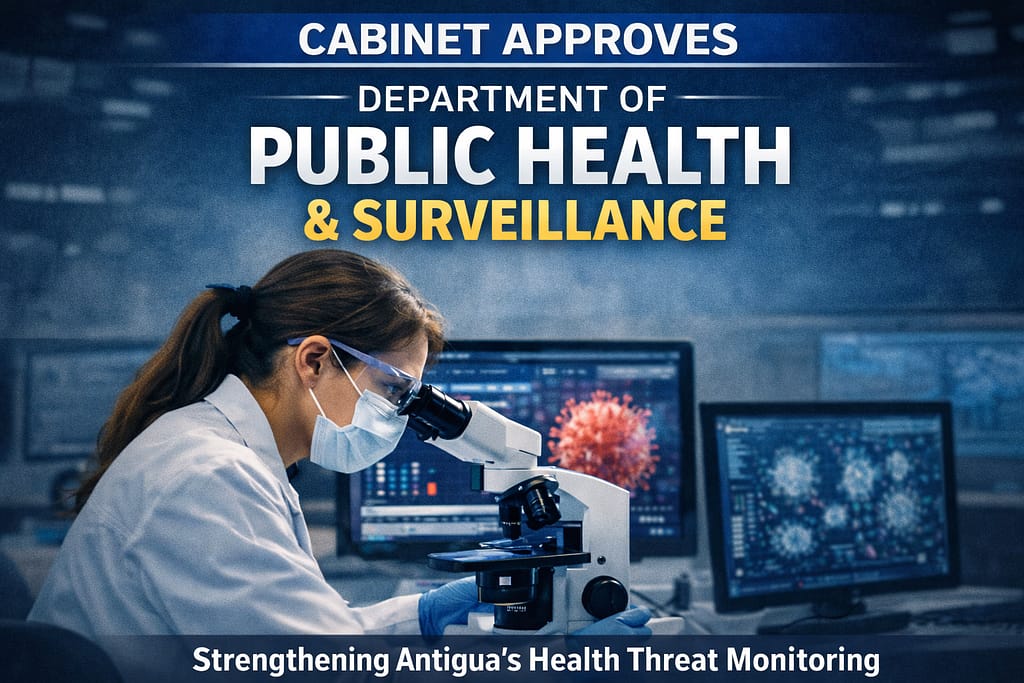
In a landmark step to overhaul the Caribbean nation’s public health infrastructure, the Cabinet of Antigua and Barbuda has formally approved the launch of a new Department of Public Health Intelligence and Surveillance (DPHIS) under the country’s Ministry of Health. This approval marks a critical milestone in the ongoing effort to modernize and unify Antigua and Barbuda’s fragmented public health systems.
Under the approved plan, two existing government health units—the Epidemiology and Surveillance Unit and the Health Information Division—will be merged into a single, centrally coordinated department. The consolidation aims to eliminate long-standing operational silos, cut down on redundant work across agencies, and boost the nation’s ability to produce timely, precise, and actionable health data that can inform policy development, long-term health planning, and rapid emergency responses.
The creation of the DPHIS underscores the national cabinet’s dedication to building a 21st-century, data-driven health system that can effectively tackle both longstanding and emerging public health challenges, ranging from widespread chronic conditions and infectious diseases to newly evolving global health threats. The unified organizational structure will streamline real-time data aggregation, enhance public health surveillance and early outbreak warning systems, and embed evidence-based decision-making into every level of the national health sector.
Alongside approving the department’s establishment, the cabinet has signed off on a comprehensive governance structure for the new agency. This framework includes provisions for dedicated executive leadership, clear inter-agency coordination mechanisms, and standardized reporting hierarchies designed to ensure accountability and consistent, effective implementation of the department’s mandate.
Aligning its structure with contemporary global public health best practices, the DPHIS will advance adoption of the cross-sectoral One Health approach, which centers the deep interconnectedness of human, animal, and environmental health. This integrated model is expected to strengthen the country’s capacity to address zoonotic disease outbreaks, environmental health hazards, and the growing range of climate-related public health risks that small island nations like Antigua and Barbuda disproportionately face.
As a core component of the reform initiative, the cabinet has endorsed a phased transition away from the country’s currently dominant paper-based health recording systems to a fully integrated digital surveillance and health information ecosystem. Key upgrades will include rolling out cloud-enabled electronic surveillance platforms, automated early warning and rapid response systems, and interoperable data infrastructure that allows seamless information sharing across different public health agencies.
To ensure the new department can launch and operate successfully, the cabinet has also allocated all required financial, human, and technical resources to the initiative. These investments cover critical priorities including advanced health informatics infrastructure, expanded data analytics capabilities, end-to-end systems integration, and specialized workforce training to build the skilled team needed to sustain the project long-term.
The Ministry of Health has received formal direction to begin rolling out the approved changes immediately, and will be required to submit regular progress updates to the cabinet on the department’s operational performance and public health outcomes. National officials noted that this transformative reform places Antigua and Barbuda among the most innovative leaders in public health across the Caribbean region, strengthening the country’s overall health resilience and laying the groundwork for improved health outcomes for all of its citizens.